What Is the bitFlyer MEXC Suspension and When Does It Start?
Crypto news from Tokyo: the bitFlyer MEXC suspension will stop all crypto sends and receives between the two exchanges from Monday, December 7, 2026. The Japanese exchange announced the step on November 25, 2026, saying it follows a US Treasury order.

The suspension covers sending to MEXC, receiving from it, and removing it from the approved send list. According to the official notice, addresses already registered will stop working on that date, and new ones cannot be added.
The notice applies the label to MEXC Global and its branches, subsidiaries, and successor entities, using the definition in the FinCEN order.
Why Did FinCEN Target MEXC Global in Its November 6 Order?
On November 6, 2026, the Financial Crimes Enforcement Network (FinCEN) found MEXC Global to be a financial institution of primary money laundering concern tied to Russian illicit finance. The FinCEN news release says the exchange facilitated at least $16 billion in illicit transactions linked to sanctions evasion and cybercrime.
The order text is more precise. It cites $16.7 billion between May 2021 and May 2026 and notes that regulators in Seychelles, Hong Kong, and Japan found the platform operating without a proper license. It was published in the Federal Register on November 10, 2026.
Finding (May 2021 to May 2026)
Figure
Funds linked to illicit activity
$16.7B (order); at least $16B (press release)
Exposure to Russian sanctions evasion
Nearly $1.5B
Direct transactions with US, EU, or UK sanctioned entities
$232M
Direct transactions with 40+ Iranian exchangers
About $1B
Transactions tied to Iran's central bank and the IRGC
About $22M
The Treasury press release adds that the platform was still processing transactions with sanctioned Russian exchange Garantex and its successor Grinex as recently as June 2026.
How Does the bitFlyer MEXC Suspension Affect Customer Funds?
Under the bitFlyer MEXC suspension, crypto sent from the other exchange on or after December 7 will be held, not credited to the user's account, while the review runs. After review, bitFlyer may take these steps under its terms:
restrict sending and receiving of crypto assets
restrict the use of the account
terminate the user agreement
temporarily limit trading functions during the review
restrict sending and receiving of crypto assets
restrict the use of the account
terminate the user agreement
temporarily limit trading functions during the review
Held assets may be returned, but the notice says return is not guaranteed. Any return carries a send fee plus a return fee, both charged to the user.
Indirect transfers through other wallets or services may also be restricted, per the notice. That wording leaves open how multi-hop transfers will be treated. This is an editorial reading, not a company statement.
Wu Blockchain also covered the news in an X post, a secondary summary that matches the hold-and-review rule. The bitFlyer MEXC suspension is a compliance step, unlike routine exchange updates about listings or delistings.
bitFlyer MEXC suspension summary posted by Wu Blockchain on X
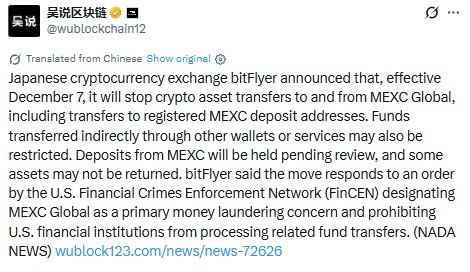
Source: Wu Blockchain Official X post
Which Dates Matter Between November 25 and December 10?
Date (2026)
Event
Source
November 6
FinCEN issues its order.
FinCEN
November 10
Order published in the Federal Register
Federal Register
November 25
Suspension announced
bitFlyer
December 7 (Monday)
Sends and receives stop
bitFlyer
December 10
FinCEN order takes effect, no end date.
FinCEN order
The Japanese exchange acts three days before the order's December 10 effective date and 12 days after its own announcement.
The order applies to covered US financial institutions. The notice calls the step part of bitFlyer's own AML/CFT efforts and does not say the order binds it directly. That reading is an analysis based on the two documents.
What Should bitFlyer Users Check Before December 7?
Based on the notice, anyone with MEXC links should review these points:
Registered addresses stop working for sending on December 7.
Deposits arriving after that date will be held, not credited.
Routes through other wallets may be restricted.
Questions about held assets go to bitFlyer support.
Registered addresses stop working for sending on December 7.
Deposits arriving after that date will be held, not credited.
Routes through other wallets may be restricted.
Questions about held assets go to bitFlyer support.
The open questions are scope and timing. The bitFlyer MEXC suspension notice does not say how long reviews will last or which indirect routes count.
No response from the platform appeared in the sources reviewed for this update. Watch December 7, then December 10, for the next cryptocurrency news on how other exchanges respond.
Key terms in this crypto news update
FinCEN: the US Treasury bureau that enforces anti-money laundering rules.
AML/CFT: anti-money laundering and countering the financing of terrorism.
Primary money laundering concern: a FinCEN finding that allows special measures against a foreign institution.
Covered financial institution: a US institution bound by the order.
Disclaimer: This article is for educational and informational purposes only and should not be considered financial or investment advice. Always conduct your own research before making investment decisions.
About the Author Nikhil Vishwakarma
English News Writer at coingabbar.com
Nikhil Vishwakarma is an English news writer and crypto content writer associated with CoinGabbar. His work focuses on cryptocurrency news, blockchain technology, digital assets, and emerging Web3 trends. He writes about Bitcoin, altcoins, memecoins, AI coins, decentralized finance, tokenomics, and new blockchain projects. His content aims to make complex crypto topics easier to understand through clear explanations, relevant research, and reader-focused insights. By following developments in the cryptocurrency industry, he strives to help readers stay informed about market trends, understand new technologies, and recognize the risks associated with digital assets.
Frequently Asked Questions (FAQ)