On October 24, 2026, the Canadian Department of Finance released proposed Stablecoin Regulations—the first detailed implementation rules under the Stablecoin Act (SCA). This is the concrete stablecoin regulatory framework that every business relying on stablecoin payments, from cross-border fintechs to DAOs, has been waiting to see. The public consultation runs until December 23, 2026, as noted by Borden Ladner Gervais LLP (BLG) on November 4, 2026.
Table of Contents
- What just happened with Canada’s stablecoin regulation?
- Why This Matters for Global Businesses Now
- The Background: A Quick Primer on Stablecoins and Why They’re Being Regulated
- Concrete Implications: What the Canadian Framework Means for Your Business
- Recommended Actions: How to Prepare Now
- What to Watch Next: Open Questions and the Global Picture
- Key Takeaways
- Further reading
What just happened with Canada’s stablecoin regulation?
The October 24 proposal, outlined in BLG’s November 4 analysis, operationalizes a law that received royal assent in March 2026 but has not yet come into force. It does two things simultaneously: it sets detailed stablecoin issuer requirements under the SCA, and it amends the Retail Payment Activities Regulations (RPAR) to pull certain payment service providers (PSPs) that handle prescribed stablecoins into the Retail Payment Activities Act (RPAA) framework. For global business stablecoins, this dual-track approach means both issuers and payment intermediaries face new compliance obligations.
The Stablecoin Act and New Regulations Explained
The SCA, outlined in the Stablecoin Act - Justice Laws Website, is administered by the Bank of Canada and will apply to domestic and foreign stablecoin issuers (excluding financial institutions and central banks). The proposed regulations fill in the gaps: they define what qualifies as a prescribed stablecoin, establish licensing, reserve, and reporting obligations, and—critically—prohibit issuers from paying yield or interest to stablecoin holders (a point Yahoo Finance covered on October 24). Issuers must hold reserves that are high-quality and liquid, mark them to market, and undergo regular audits. These SCA regulations create a comprehensive stablecoin compliance architecture.
Simultaneously, the RPAR amendments mean that PSPs performing payment functions with a prescribed stablecoin—say, a PSP that facilitates cross-border stablecoin payments—must register under the RPAA and meet its operational risk, safeguarding, and reporting standards. The scope is no longer limited to traditional payments; it now explicitly catches stablecoin-based payment activities.
Key Dates: October 24 Release and December 23 Consultation Deadline
The window for public comment is open. Businesses have until December 23, 2026 to submit feedback. Once the regulations are finalized and the SCA is proclaimed in force, the Bank of Canada will begin accepting applications for registration. This stablecoin news 2026 timeline suggests a gradual phase-in, but the exact date for mandatory compliance will depend on the final rules.
Why This Matters for Global Businesses Now
Stablecoins as Cross-Border Payment Rails
Stablecoins have moved from niche to necessity in cross-border commerce. Circle’s Q3 2026 results showed $865 million in quarterly revenue, driven by rising USDC usage for payments and settlement. Businesses use stablecoins to move funds across borders instantly and at a fraction of the cost of traditional correspondent banking. Canada’s new stablecoin regulatory framework will directly affect any company routing stablecoin payments through Canadian platforms, holding Canadian-dollar stablecoins, or serving Canadian counterparties.
The Ripple Effect Beyond Canada’s Borders
Canada is the first G7 nation to table a complete, standalone stablecoin regime. Canada’s approach, detailed in the Canada's Stablecoin Framework page maintained by the Department of Finance, is explicitly designed to influence global norms. Its design choices—the yield ban, the RPAA expansion, and the Bank of Canada as overseer—will likely influence other jurisdictions. For a global business, this means that stablecoin regulation Canada sets a standard that may become a baseline for operations in North America. If a stablecoin fails to meet Canadian standards, it could be delisted by Canadian platforms, cutting off a significant segment of the market. The fragmentation of cross-border stablecoin payments is a real risk.
Why does it matter for businesses using stablecoins?
Any entity that holds, transacts, or issues stablecoins could face new obligations when its activities touch Canada. This includes startups paying remote teams in USDC, DAOs managing treasuries, and fintech platforms integrating stablecoin rails. The regulations could limit which stablecoins are available to Canadian users, impose new know-your-business requirements, and compel businesses to rethink their banking relationships. A crypto-friendly banking platform that can adapt to both fiat and crypto compliance demands becomes essential.
The Background: A Quick Primer on Stablecoins and Why They’re Being Regulated
What are stablecoins?
Stablecoins are digital assets engineered to maintain a stable value, typically by pegging 1:1 to a fiat currency like the U.S. dollar. Examples include USDC, USDT, and DAI. They achieve the peg through reserves held in cash equivalents or other assets, or algorithmically, though fiat-backed models dominate regulated use.
How are stablecoins used?
Beyond trading and DeFi, businesses use stablecoins for cross-border stablecoin payments, merchant settlement, payroll, and treasury management. They settle in minutes, not days, and often cost pennies—making them an attractive alternative to SWIFT wires.
How are stablecoins regulated in the US?
The US passed the GENIUS Act in 2025, establishing federal standards for stablecoin issuers, including capital, reporting, and redemption requirements. The OCC subsequently issued final rules that allow national banks to custody stablecoin reserves and engage in certain stablecoin activities.
How are stablecoins regulated abroad?
The EU has MiCA, which classifies stablecoins as e-money tokens and imposes a licensing regime. Japan, Singapore, and the UK have each tailored frameworks. Canada’s approach, analyzed in Canada enacts framework to regulate stablecoin in Bill C-15, stands out for explicitly banning yield and pulling PSPs into the regulatory perimeter, creating a model that blends prudential and operational oversight. The Stablecoins page from the Bank of Canada outlines its ongoing role in overseeing these instruments.
Concrete Implications: What the Canadian Framework Means for Your Business
For Stablecoin Issuers: New Licensing and Operational Requirements
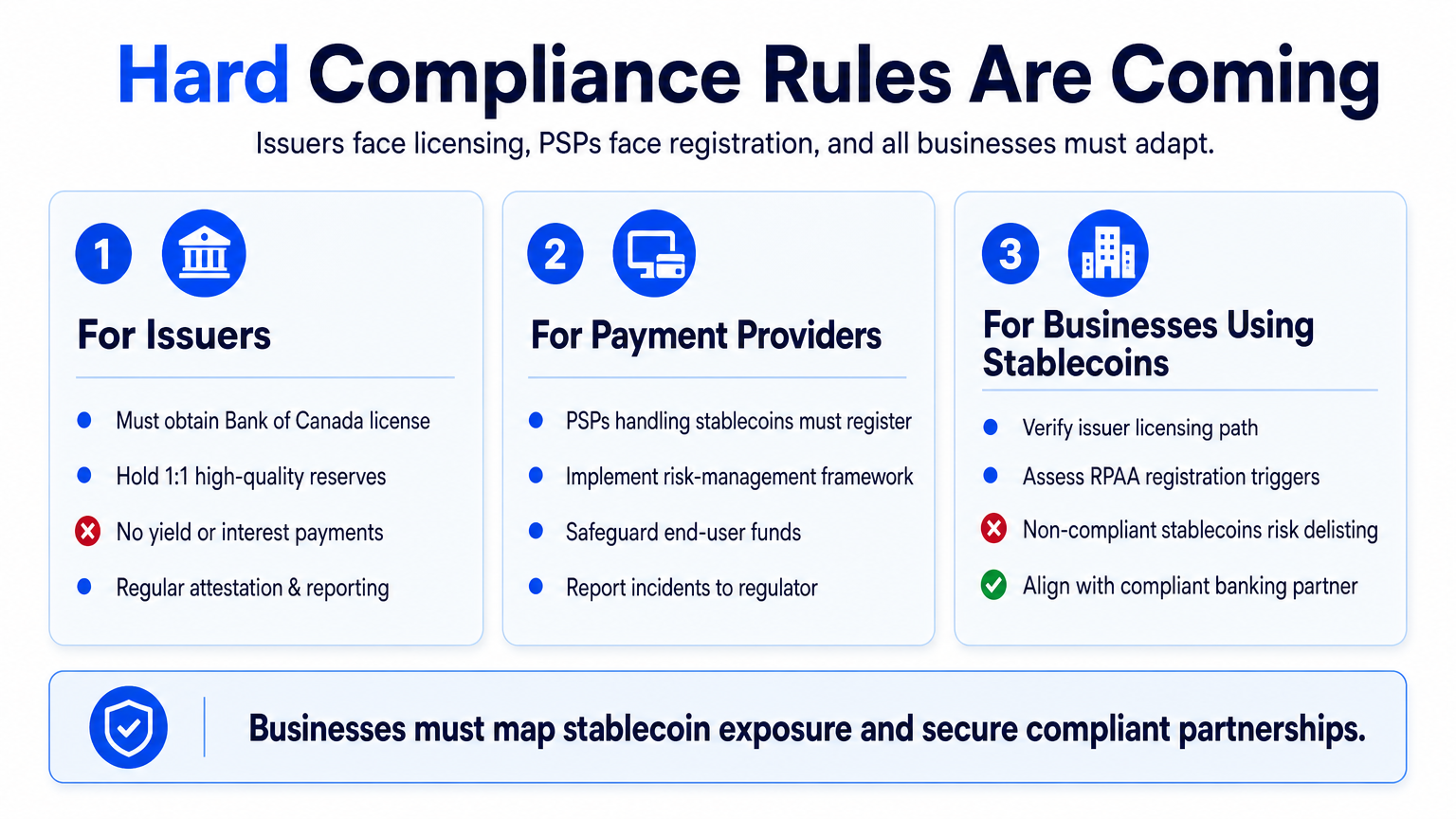
Issuers of prescribed stablecoins must obtain a license from the Bank of Canada. They must hold reserves that cover outstanding stablecoins at all times, using high-quality, short-term liquid assets. The proposed regulations explicitly ban yield payments, meaning no interest-bearing stablecoin products will be permitted in Canada (Yahoo Finance, October 24, 2026). Issuers will also face regular attestation and reporting requirements. Any stablecoin that cannot meet these stablecoin issuer requirements risks being shut out of the Canadian market.
For Payment Providers and Fintechs: Expanded RPAA Scope
The RPAR amendments redefine “payment function” to include activities involving prescribed stablecoins. The Canadian stablecoin act thereby pulls fintechs directly into the regulatory perimeter. A fintech that facilitates USDC transactions, for example, may need to register as a PSP under the RPAA, implement a risk-management framework, safeguard end-user funds, and report incidents. This is a significant shift: stablecoin payment processing is no longer a regulatory gray zone in Canada.
For Businesses Using Stablecoins: Compliance and Banking Relationships
Businesses that rely on stablecoins for payroll, vendor payments, or treasury must ensure that their chosen stablecoin and payment provider will remain operational in Canada. Non-compliant stablecoins could be removed from Canadian exchanges and platforms, stranding funds or forcing expensive conversions. Working with a banking partner that understands both fiat and crypto compliance becomes a practical necessity for maintaining stablecoin compliance across all operations.
What are the concrete implications and what should businesses do?
The immediate implications are clear: the Canadian market is about to impose hard requirements on stablecoin usage. Businesses should first map their stablecoin exposure—identify every touchpoint where a Canadian nexus exists. Then, verify whether the stablecoin issuer has a credible path to licensing. If you run a PSP or fintech, assess whether your current stablecoin activities would trigger RPAA registration. Finally, align with a banking platform that can bridge fiat and crypto under the new rules, so you’re not forced to choose between compliance and operational continuity.
Recommended Actions: How to Prepare Now

- Audit your stablecoin exposure. List all stablecoin flows—payments, payroll, treasury—that involve Canadian counterparties or platforms.
- Review your stablecoin partners. Contact your stablecoin issuer to understand their plan for Bank of Canada licensing. If they cannot commit, start evaluating alternatives.
- Assess RPAA applicability. If you provide payment services using stablecoins (even as a non-Canadian entity serving Canadian users), determine whether you fall under the expanded PSP definition.
- Submit consultation feedback. The December 23 deadline is an opportunity to shape the final rules. Comments on the yield ban, reserve composition, and PSP scope could influence the outcome.
- Secure a crypto-friendly banking infrastructure. Choose a platform that offers segregated fiat and crypto accounts, built-in compliance, and the ability to seamlessly convert between currencies as regulations shift.
What to Watch Next: Open Questions and the Global Picture
The US GENIUS Act and Other International Moves
The US is implementing its own stablecoin framework. The OCC’s final rule on custody and the GENIUS Act’s requirements create a regulatory floor for the world’s largest stablecoin market. Canada’s move could spur cross-border coordination or, conversely, a new set of compliance mismatches. Watch how US regulators respond, especially regarding yield-bearing stablecoins and PSP oversight.
Canada’s Consultation Period and Likely Timelines
The final regulations are not expected until well into 2027. The SCA must still be proclaimed in force, and the Bank of Canada will need to build its registration infrastructure. Canada’s Stablecoin Act: overview and implications | Insights provides a detailed look at the legislation’s phased rollout. During this period, market participants will test the boundaries—especially around which stablecoins get “prescribed” and how foreign issuers are treated. Staying current on stablecoin news 2026 and beyond is critical. Services that plan, write, and publish SEO articles daily can help teams automate regulatory monitoring. Meanwhile, businesses should use the consultation window to advocate for workable rules, particularly for cross-border stablecoin payments and decentralized organizations.
Key Takeaways
- Canada’s proposed stablecoin regulations, released October 24, 2026, set licensing, reserve, and reporting requirements for issuers and expand payment oversight to stablecoin PSPs.
- The yield ban and the inclusion of PSPs under the RPAA are the most operationally significant changes for businesses.
- Global business stablecoins with any Canadian nexus must undergo a compliance audit, preparing for a market where only compliant stablecoins remain accessible.
- Partnering with a crypto-friendly banking platform that integrates fiat and crypto compliance will help businesses adapt without disruption.
- The public consultation is open until December 23, 2026—an opportunity to shape the final rules.
Further reading
Ready to put this into practice? Get started with onesafe.io.
Get started with Business in minutes!
Get started with Business effortlessly. OneSafe brings together your crypto and banking needs in one simple, powerful platform.