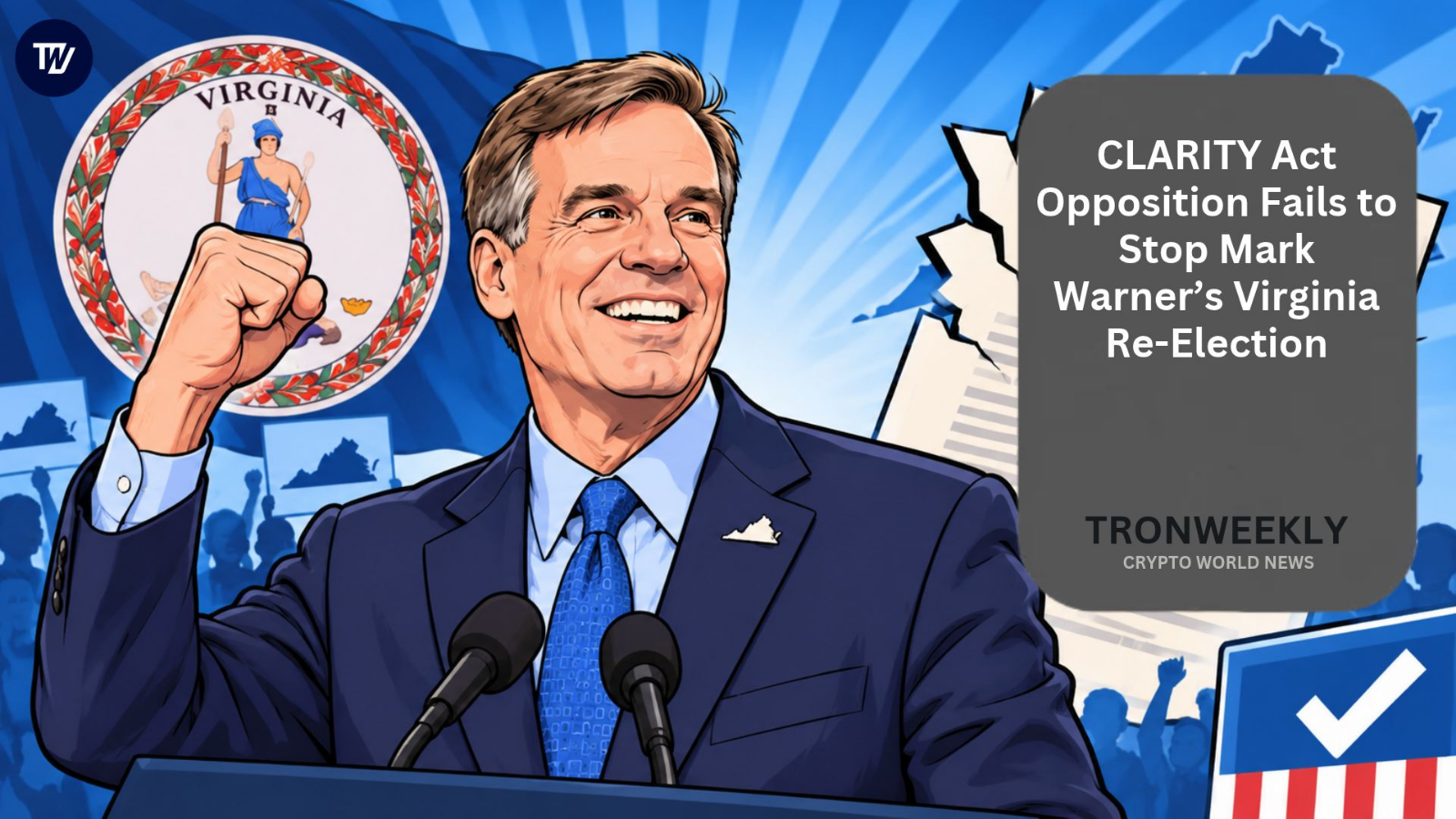
The CLARITY Act debate has gained renewed attention after US Senator Mark Warner won re-election in Virginia, defeating Republican challenger Bert Mizusawa in the November 3 election. His victory brings renewed attention to the CLARITY Act, as Warner supports federal cryptocurrency regulations but opposed advancing the legislation over ethics concerns involving President Donald Trump and his digital asset interests.
Table of Contents
The Associated Press projected Warner as the winner shortly after polls closed, declaring the race at 7 p.m. EST. As a result of his victory, Senator Warner will be serving again in the Senate along with Senator Tim Kaine from the same political party.
Warner’s victory came as Virginia voters considered federal policy issues, including the Trump administration’s government workforce reductions. The state has a substantial federal employee population, making changes to federal agencies and employment an important issue during the election. Warner has also criticized policies that he believes place additional financial pressure on American households.
Also Read | CLARITY Act Includes $50 Million Annual Crypto Fundraising Cap
Warner’s Crypto Position Draws Attention
The stance of Warner on the CLARITY Act gained significance after its discussion in the Senate in September. The purpose of this Act is to develop a federal market structure for digital assets, define the scope of regulatory responsibility, and provide guidelines for cryptocurrency companies conducting business in the US.
While Warner agreed with the need for regulations, he was of the opinion that the Act had inadequate measures to ensure no conflicts of interest arise. His specific concerns were President Trump’s personal cryptocurrency investments and any decisions made by the President that may favor him in this regard.
CLARITY Act Vote Faces Ethics Dispute
Warner voted against cloture of the CLARITY Act on September 15, thus preventing an action required to move the bill along. Warner suggested that Congress should not endorse significant cryptocurrency regulations while letting the president benefit from such regulations directly because he is involved in the industry regulated by them.
Also, Warner called for proper ethics rules for the president and other high-ranking officials in the government. According to Warner, no one can be interested in financial gain from his own policies. Warner was concerned about it regardless of ongoing negotiations concerning provisions regarding law enforcement, national security, and other regulatory issues included in the bill.
Warner was not the only person who raised questions about conflicts of interest concerning this bill since several Democratic senators shared similar opinions about it. The Republicans had already amended the bill and issued their new version of the bill before voting on it.
Digital Asset Industry Awaits Regulatory Clarity
Importantly, the proposed act will attempt to clarify the role of each of these agencies, which will help in determining the regulation of each digital asset and cryptocurrency activity according to federal law.
In terms of cryptocurrency exchange operations, cryptocurrency businesses, and investors, the legislation may affect compliance and regulatory frameworks of various products. The uncertainty of federal regulation of cryptocurrencies was one of the concerns of the industry. It is necessary to note that Warner’s victory in the Senate did not change existing rules for cryptocurrency companies.
However, the inactivity of the Senate and its inability to approve the proposed bill mean that there is still no regulatory framework suggested in the bill. Lawmakers need more negotiations in order to reconcile their positions concerning the issue of ethics, consumer protection, financial stability, and enforcement.
Fourth Term Keeps Warner in Senate
Warner’s political career extends beyond his Senate service. He previously served as Virginia’s governor from 2002 to 2006 before winning election to the Senate in 2008. He secured re-election in 2014 and 2020, making the November 2026 result his fourth successful Senate campaign.
His challenger, Mizusawa, brought a military and government background to the race. The retired Army major general served 41 years, went on four combat tours and got the Silver Star for bravery. He also gained considerable experience of working in the Senate, the Army, and the Central Intelligence Agency before his candidacy for this election.
Warner’s victory means that he will continue his work in the United States Senate as vice-chairman of the Select Committee on Intelligence. He will also serve in the Senate together with Senator Tim Kaine, who is Warner’s partner at the two-member Virginia delegation in the Senate. The result gives Warner another six-year term while Congress faces continuing debates over digital asset oversight.
The next step for the CLARITY Act will be determined by whether legislators can come to some agreement concerning the controversial provisions. Warner expressed his willingness to vote for reasonable crypto bills if they have some adequate ethics protection measures included.
Also Read | Why Lummis Says Wyoming Proves the CLARITY Act Can Work
Bena Ilyas is a Global News Correspondent and Market Analyst at Tronweekly with over four years of experience covering global cryptocurrency, blockchain, and Web3 developments. She has written 1,000+ articles for leading crypto news platforms, reporting on Bitcoin, Ethereum, altcoins, DeFi, and global crypto regulation, alongside Web3 trends, Layer 2 ecosystems, and AI-driven crypto use cases. Her work is based on verified sources and fact-based reporting for global market participants.