The business of managing a corporate crypto balance sheet just absorbed its biggest regulatory shock in years. On November 16 and 18, 2026, two detailed rule packages landed at the White House, and they change the operational reality for any U.S.-connected business holding stablecoins. The centerpiece is an explicit ban on paying yield or interest to stablecoin holders—a rule that directly rewrites what crypto treasury management and stablecoin treasury management mean in practice. This article distills what the rules say, what they forbid, and what treasury teams must do before the January 18, 2027 effective date. For a broader look at where treasuries are heading, Stablecoin Treasury Management: A Guide for Businesses outlines the payments-first model that the new rules lock in.
Table of Contents
- What just landed at the White House
- The yield ban on stablecoins is the story—get used to saying ‘stablecoins don’t pay interest’
- How crypto treasury management shifts overnight
- Crypto treasury best practices 2027: what treasury teams need to check before January 18
- Where neobanks fit: neo-banking crypto treasury with a unified interface
- What we still don’t know, and what to watch next
- Key facts at a glance
- What does the new U.S. stablecoin regulation mean for corporate crypto treasury management?
- How will the yield ban impact how I manage idle stablecoins in my treasury?
- Can I still earn any yield on stablecoin reserves under the new rules?
- What alternatives exist for earning a return on treasury cash when stablecoin holders can’t be paid interest?
- What steps should my treasury team take before the January 18, 2027 effective date?
- How does this change custody and payment setups for businesses that hold both fiat and crypto?
- Are DeFi yields or non-U.S. stablecoins a workaround, and what are the risks?
- What does all this mean for DAOs and Web3 startups that used stablecoin yields as part of their treasury management?
- Key Takeaways
What just landed at the White House
The two rules that matter—FDIC stablecoin rule and FinCEN AML—dated November 16 and 18, 2026
On November 16, 2026, the Federal Deposit Insurance Corporation (FDIC) submitted its final stablecoin prudential rule to the White House for review. Two days later, on November 18, the Treasury Department’s Financial Crimes Enforcement Network (FinCEN) followed with a separate anti-money laundering (AML) and sanctions framework covering all federally supervised stablecoin issuers. Both rules are now in active review, finalizing the stablecoin regulation 2026 architecture, with an effective date locked in for January 18, 2027.
The FDIC stablecoin rule establishes reserve, capital, and risk-management requirements—the stablecoin prudential requirements—under the GENIUS Act. The FinCEN rule imposes new AML and sanctions obligations, bringing stablecoin issuers squarely into the Bank Secrecy Act perimeter. Together, they form the operational skeleton of a U.S. stablecoin rulebook.
Effective date January 18, 2027: what’s in the yield ban and what it covers
The yield ban is the most operationally disruptive piece. Federally supervised stablecoin issuers are prohibited from paying holders any form of interest or yield. The ban is categorical, backed by prudential supervision, and covers all major USD stablecoins issued by institutions under FDIC oversight. Treasury teams holding USDC, USDT, or any other dollar stablecoin from a regulated issuer will no longer be able to earn a return directly from the issuer.
GENIUS Act treasury framework: what it meant and where these rules lock in specifics
The GENIUS Act created the broad architecture for federal oversight, requiring prudential regulation and AML controls but leaving details to regulators. The FDIC and FinCEN rules now lock in specifics: capital adequacy ratios, liquidity coverage, a strict prohibition against yield, and wallet-level AML screening. The period of regulatory ambiguity is over—concrete, dated rules now exist.
The yield ban on stablecoins is the story—get used to saying ‘stablecoins don’t pay interest’
How the ‘no yield’ rule rewires idle stablecoin strategies for treasuries
Idle stablecoin balances used to double as dollar-equivalent cash and modest-yield assets. That ends. Issuers cannot pay holders any yield, so a stablecoin balance becomes a pure transactional tool—a payment and settlement layer, not a return-producing asset. As the Stablecoin Guide for Treasury: No-Hype Insights warns, relying on stablecoin yield is no longer viable.
What the ban covers (all federally supervised issuers—so every major USD stablecoin)
The FDIC rule applies to any entity issuing a payment stablecoin in the U.S. under federal supervision. The two largest stablecoins—USDC and USDT—will fall under this ban if they operate in the U.S. The prohibition extends to any form of remuneration: yield in-kind, token rewards, or revenue-share models are all out.
The false comfort of unregulated or offshore yield alternatives and why compliance matters
Unregulated offshore stablecoins or DeFi pools may still offer yield, but the FinCEN rule adds sanctions and AML obligations that make those alternatives risky. Unregulated stablecoins expose a treasury to sanctions risk and loss of banking access. Chasing yield through unregulated channels could leave you unable to off-ramp to fiat through any compliant banking partner.
How crypto treasury management shifts overnight
From yield-earning cash buffer to a pure payment-and-settlement layer
The conceptual shift: stablecoin holdings become a pure working-capital tool. They exist for speeding payments, settling cross-border transactions, and bridging crypto-fiat rails. The old model of holding a large idle buffer to earn 2-4% is dead for compliant U.S. businesses.
What happens to the reserve-vs.-operating balance split
With yield gone, there’s no economic reason to keep a reserve balance in stablecoins. Hold only what you need for near-term settlement; move the rest into fiat cash sweep accounts, short-term Treasuries, or other traditional yield-bearing instruments. That restores a clean separation: crypto for speed, fiat for return.
Rethinking liquidity: on/off-ramps, DeFi lending, and the return of fiat sweep accounts
Liquidity management becomes more dynamic. On-ramp and off-ramp from stablecoins to fiat must be instant and low-cost because you’ll convert more frequently. DeFi lending protocols that pay yield are not directly banned, but they carry smart-contract and compliance risks. For most treasuries, the simpler path is fiat sweep accounts for idle cash, paired with a crypto-operating account for payments.
Crypto treasury best practices 2027: what treasury teams need to check before January 18

Custody: are your stablecoins held with an issuer (now barred from yield) or a neobank?
If you hold stablecoins in an issuer-affiliated account that includes yield, that arrangement ends on January 18, 2027. Migrate to custody via a qualified custodian or a platform that does not pay yield on crypto. Platforms like OneSafe, which provide digital asset custody via Fireblocks without yield, already fit this model.
Payment rails: can your platform still convert stablecoins to fiat instantly when you can't earn on them?
Instant conversion becomes critical. Minimize the time your stablecoins sit idle. Check that your payment rails support instant USDC-to-fiat conversion with low or zero fees.
Reporting: evidencing a zero-yield position to auditors and the board
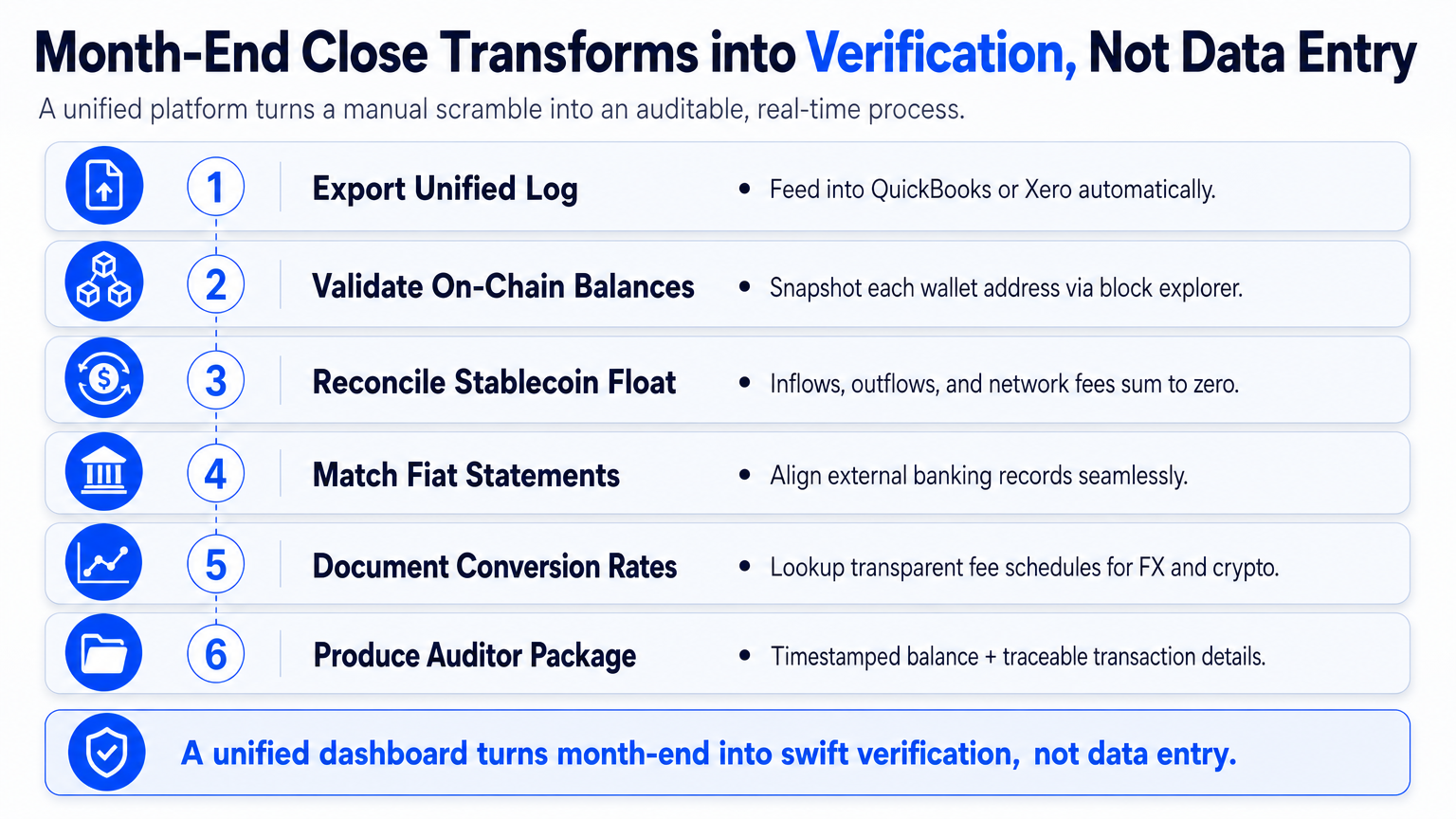
Auditors will want to verify that the company receives no prohibited yield. Document that stablecoin accounts carry a zero yield rate with clear custody statements. Transparent, auditable transaction records make this simpler.
AML and sanctions: FinCEN’s framework adds new watchlist expectations for crypto treasury wallets
FinCEN’s rule requires screening all outbound wallet addresses against OFAC sanctions lists and maintaining counterparty due diligence records. Integrate a compliance tool or work with a platform that natively embeds this screening.
Where neobanks fit: neo-banking crypto treasury with a unified interface
What a platform that natively bridges fiat accounts and on-chain custody already gets right
A neo-banking crypto treasury platform that offers both fiat accounts and on-chain custody in a single interface eliminates the need for two separate treasury stacks. It natively handles conversion, payments, and compliance checks. When yield disappears, the value of a single interface for moving funds between fiat and crypto rises dramatically.
OneSafe’s model: no yield on crypto, but free USDC on/of-ramps and built-in compliance workflows
OneSafe is a financial technology company providing neo-banking services to global businesses and DAOs. It does not offer yield on crypto assets; instead, it provides free USDC deposits and withdrawals, ACH and wire transfers, and integrated compliance workflows. That model aligns with the new rules: businesses can hold fiat and crypto, move between them without friction, and avoid any prohibited yield payments. Its multi-currency accounts, corporate cards, and automated invoicing support the fiat side, while crypto custody sits on secure Fireblocks infrastructure with mandatory MFA.
Serving DAOs when staking and lending are no longer stablecoin options—what the new default looks like
DAOs that used stablecoin yield must restructure. The new default is a zero-yield stablecoin operating treasury paired with a separate fiat or traditional investment portfolio for returns. OneSafe’s platform, with customizable roles, secure custody, and automated payment workflows, lets DAOs hold an operating budget in USDC, pay contributors instantly, and sweep excess into compliant yield-bearing fiat instruments.
What we still don’t know, and what to watch next
White House review timeline and the possibility of eleventh-hour changes
Both rules are under White House review and could be modified. Final text is expected in early December 2026. Prepare for the rules as written while monitoring for adjustments.
How exchanges and non-issuer wallets will be treated under the rules
The rules target issuers. It’s unclear if exchanges offering yield on stablecoin deposits through lending programs will be treated as functionally equivalent to issuer yield. Until guidance clarifies, treat any yield from a stablecoin balance as a compliance risk unless clearly from separate, disclosed DeFi activity.
The international ripple effects: will other jurisdictions follow the U.S. yield ban?
Other major jurisdictions tend to converge on U.S. standards. If the yield ban stands, similar prohibitions could emerge in Europe and Singapore. Treasury teams with international operations should build flexible policies that can adapt to a global no-yield norm.
Key facts at a glance

What does the new U.S. stablecoin regulation mean for corporate crypto treasury management?
It means that stablecoins can no longer serve as a yield-bearing cash reserve. Corporate crypto treasury management must now treat stablecoins as a pure transactional and payment tool, with any idle balances converted to fiat if yield is desired.
How will the yield ban impact how I manage idle stablecoins in my treasury?
You will move away from holding large idle stablecoin balances. Instead, hold only what is needed for near-term settlement and convert the rest into yield-bearing fiat instruments like Treasury bills or sweep accounts, moving back and forth via low-cost on/off-ramps.
Can I still earn any yield on stablecoin reserves under the new rules?
Not from the issuer. Yields paid directly by a federally supervised stablecoin issuer are prohibited. Yield from DeFi lending protocols or other third-party applications is not directly banned, but it carries separate legal, technical, and compliance risks that treasury teams must weigh carefully.
What alternatives exist for earning a return on treasury cash when stablecoin holders can’t be paid interest?
The primary alternatives are traditional short-term investment vehicles: money market funds, Treasury bills, commercial paper, and fiat sweep accounts. For the crypto-native portion, some businesses may explore DeFi strategies only after thorough risk assessment. A neobanking platform that offers both fiat accounts and crypto custody can act as the bridge, letting you move cash into yield-earning fiat accounts while keeping an operational crypto balance.
What steps should my treasury team take before the January 18, 2027 effective date?
- Audit your stablecoin holdings and identify any accounts or programs that currently pay yield from an issuer—these must be terminated or moved.
- Review custody arrangements: ensure your stablecoins are held with a qualified custodian or a platform that does not pay yield, and that your custody provider is not an issuer under the FDIC rule.
- Test payment rails: confirm that your platform supports instant stablecoin-to-fiat conversion with low fees.
- Update reporting protocols: document that stablecoin positions carry zero yield, and prepare samples for auditors.
- Implement wallet screening: integrate AML and sanctions checks for all outbound stablecoin transactions, as required by FinCEN’s framework.
How does this change custody and payment setups for businesses that hold both fiat and crypto?
It consolidates the need for a single, integrated provider that handles both fiat and crypto without offering yield on the crypto side. A neo-banking platform like OneSafe that provides multi-currency fiat accounts, on-chain custody, and free USDC on/off-ramps becomes an attractive alternative to fragmented issuer-and-bank setups.
Are DeFi yields or non-U.S. stablecoins a workaround, and what are the risks?
DeFi yields are not directly banned, but they introduce smart-contract risk, illiquidity risk, and potential AML exposure. Non-U.S. stablecoins may fall outside the FDIC’s direct jurisdiction, but using them could trigger FinCEN’s sanctions and AML obligations and may cut off access to U.S. banking rails. For most compliant treasuries, the risks outweigh the marginal yield gain.
What does all this mean for DAOs and Web3 startups that used stablecoin yields as part of their treasury management?
It forces a structural separation: stablecoins for operations, fiat or traditional investments for yield. DAOs will need to rework their treasury allocations and adopt platforms that allow easy movement between the two domains.
Key Takeaways
- The U.S. stablecoin prudential rule, effective January 18, 2027, bans issuers from paying any yield or interest to holders, eliminating a key use case for idle corporate stablecoin balances.
- Treasury teams must pivot to treating stablecoins as a pure payment layer, holding only what’s needed for settlement and sweeping excess into fiat yield instruments.
- Compliance now demands that companies audit their stablecoin custody, ensure zero-yield documentation, and implement wallet-level sanctions screening before the effective date.
- Neo-banking platforms that bridge fiat and crypto natively and do not offer yield on crypto are positioned to become the default operating stack for compliant corporate treasuries.
- DAOs and Web3 startups that relied on stablecoin yield must restructure their treasury to separate operational crypto from yield-bearing fiat reserves.
As you refine your treasury operations, consider automating your content marketing with Joyrise, which publishes daily SEO-optimized articles to keep your audience engaged while you focus on compliance.
To future-proof your treasury against these changes, open an account on OneSafe’s unified fiat-and-crypto platform today.
Get started with Crypto in minutes!
Get started with Crypto effortlessly. OneSafe brings together your crypto and banking needs in one simple, powerful platform.