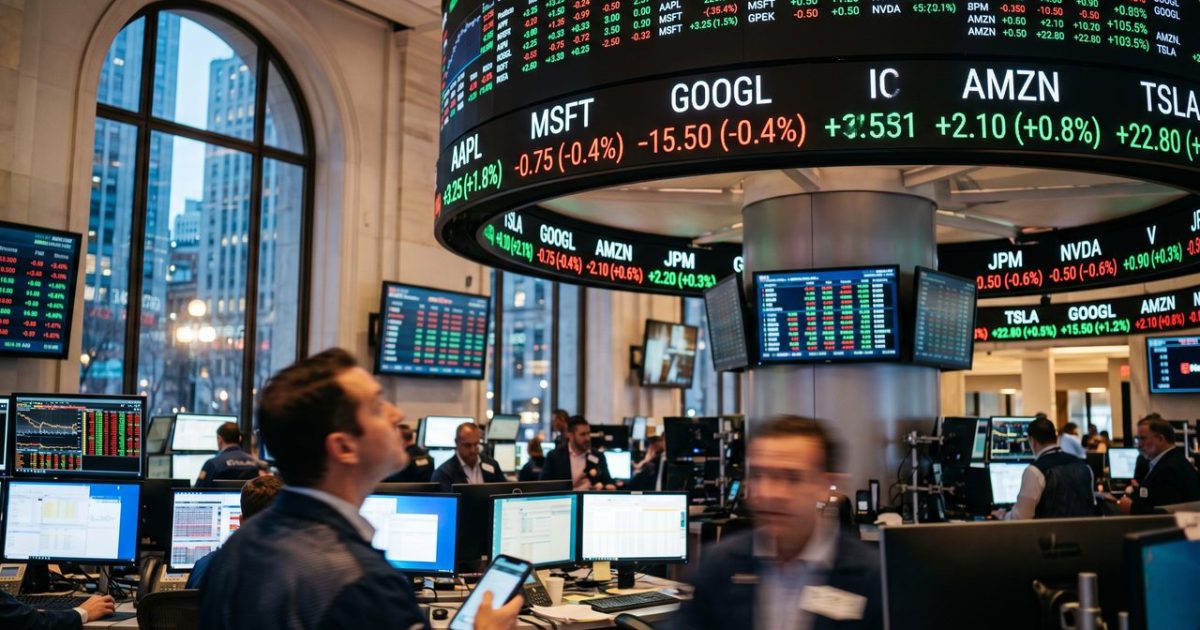
A $969 million liquidation of positions occurred within a 24-hour period as cryptocurrency prices declined, signaling continued volatility in the market. This turbulence arrives as 19 Federal Reserve officials agreed to the first rate increase in three years, though officials including Fed Vice Chair Philip Jefferson suggest time remains to assess the economy before further action.
Anthropic’s $2 Trillion IPO and Potential Market Impact
Kathleen Brooks, Research Director at XTB Platform, indicated that Anthropic’s planned capital expenditures signal continued investment in the AI sector, potentially bolstering semiconductor and AI infrastructure companies. The company’s forthcoming initial public offering, anticipated next month, could value it at over $2 trillion, a figure that analysts believe could sustain momentum in AI-related stocks as investors enter the fourth quarter.
Brooks stated, “The fact that Anthropic is planning on spending big on capex means that the capex cycle is not over yet. I believe that if Anthropic had signaled a lower level of spending, this could have caused a wobble in the AI trade, since it would lead to fears about the sustainability of the AI trade as we move into Q4.” This commitment to substantial financial outlay suggests Anthropic anticipates continued growth and demand for its AI technologies, influencing investor confidence. Despite a reported $8 billion loss last year and projected financial commitments exceeding $500 billion over the next decade, many analysts assess that Anthropic’s growth potential justifies its valuation.
The company’s decision to proceed with the IPO, while other firms like OpenAI have delayed their offerings citing safety concerns and market sentiment, emphasises a belief in the enduring strength of the AI market. Eric Trump argued that AI agents using crypto would result in both markets growing in the future.
He said, “The thing that’s going to spawn the growth of digital assets by far the quickest is actually the AI trade,” and continued, “The faster our, kind of, friends on the other side of the aisle in AI can sprint toward their goal, the better this industry is going to do.” Dan Khus, chief analyst at LVRG Research, noted that crypto investors reacted positively to recent jobs data, indicating a willingness to embrace risk assets, but cautioned that inflation remains the primary driver of Federal Reserve policy.
Federal Reserve Policy Shifts and Crypto Market Response
Recent commentary from Federal Reserve officials suggests a measured approach to future monetary policy, despite a prior rate increase and ongoing economic data analysis. Market observers are now considering the interplay between this significant IPO and the performance of digital assets, particularly as institutional investment in crypto ETFs continues to grow.
The scale of the Anthropic offering introduces a new dynamic to the investment landscape, and could draw capital away from or towards the crypto sector depending on investor sentiment. “There is a welter of money sitting on the sidelines waiting for more positive figures,” suggesting a readiness to deploy capital should conditions improve.
September’s market activity offered a mixed signal, but the expectation is for a more bullish “Uptober,” historically a strong month for Bitcoin. However, last year’s October saw a significant liquidation event on October 10, and a subsequent monthly loss for BTC, a reminder of the inherent volatility within the crypto space. This year, despite a brief rally to around $87,000, Bitcoin is currently down approximately 3% for the month, though many analysts remain optimistic.
As measured by assets gathered in the first month of its existence as an ETF, the Zcash ETF is in the top 1% of ETFs launched in the past decade, demonstrating increasing mainstream acceptance of digital assets, Anthropic says. According to market analysis, “If we get those softer [inflation] figures and no rate rise, BTC will move very quickly and drag the rest of the quality assets with it.”
The connection between the AI sector and cryptocurrency is also gaining attention. Eric Trump believes the AI boom could be crypto’s biggest catalyst, while Ray Dalio cautions that AI represents a bubble. Regardless, the growth of artificial intelligence is increasingly seen as a potential driver for digital asset adoption. BitMine CEO Tom Lee said that the firm will stop buying Ethereum once it reaches its goal of owning 5% of the circulating supply of ETH, a goal it expects to reach in six or seven weeks.
October’s Historical Crypto Performance and Q4 Outlook
Some analysts have suggested that the vast investment being deployed into AI leaves less capital for crypto. Historical data reveals that October has, on average, delivered nearly 20% monthly gains for Bitcoin since 2013, closing in the green 77% of the time. However, this positive track record was interrupted last year, demonstrating that historical performance is not a guarantee of future results.
The current market environment is further complicated by the impending cessation of purchases by Ethereum’s largest buyer, adding another layer of uncertainty for investors. BitMine CEO Tom Lee said that the firm will stop buying after reaching its goal of owning 5% of the circulating supply of ETH, which it expects to reach in six or seven weeks.
Source: https://www.coinbase.com/bytes/archive/is-the-ai-boom-good-or-bad-for-crypto
See today’s quantum computing news on Quantum Zeitgeist for the latest breakthroughs in qubits, hardware, algorithms, and industry deals.
Dr. Donovan is a futurist and technology writer covering the quantum revolution. Where classical computers manipulate bits that are either on or off, quantum machines exploit superposition and entanglement to process information in ways that classical physics cannot. Dr. Donovan tracks the full quantum landscape: fault-tolerant computing, photonic and superconducting architectures, post-quantum cryptography, and the geopolitical race between nations and corporations to achieve quantum advantage. The decisions being made now, in research labs and government offices around the world, will determine who controls the most powerful computers ever built.