Fidelity Chainlink ETF: FLNK Filing and Staking Questions
Fidelity wants to offer a spot Chainlink ETF through regular brokerage accounts. Would the proposed Fidelity Chainlink ETF pay staking rewards, and when could it trade?
This report uses the S-1 filing dated November 25, 2026, and fund data as of November 26. It separates what the filing says from what is still blank.
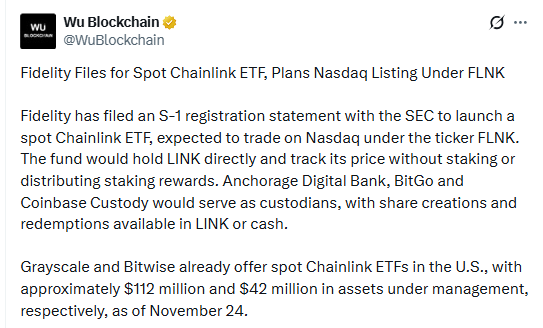 Source: X (formerly Twitter)
A filing is not a launch.
How Would the FLNK Fund Work?
The Fidelity Chainlink Fund is a Delaware trust formed on November 19, 2026. It would hold Chainlink tokens directly and track its price, minus fund costs. The proposed Nasdaq ticker, FLNK, is still in brackets in the filing.
Feature
What the filing says
Sponsor
FD Funds Management LLC, an FMR LLC subsidiary
Holdings
LINK on Ethereum only, with no derivatives or borrowing
Custodians
Anchorage Digital Bank, BitGo Bank & Trust, Coinbase Custody
Price source
A Fidelity reference rate, updated every 15 seconds
Share creation
Authorized participants use LINK or cash
An authorized participant is a financial firm allowed to create or redeem fund shares. You would buy Fidelity ETF through a broker, so you wouldn't hold Chainlink tokens keys yourself.
The fund isn't registered under the 1940 Act, so it lacks some mutual fund protections. The registration statement also cites a March 17, 2026 SEC and CFTC release naming LINK as a digital commodity.
Why Does FLNK Skip Staking Rewards?
The registration statement says the trust will not stake its LINK. Shareholders won't receive staking rewards through the offering.
Staking means locking tokens to help secure a network in return for rewards. Chainlink Staking is capped at 45 million tokens, or 4.5% of the 1 billion supply. Withdrawals need a 28-day cooldown.
The registration statement doesn't explain Fidelity's choice. Staking also isn't open to every holder, since the pool has a fixed cap.
Holding LINK directly
Owning FLNK shares
Staking rewards
Possible, if space and rules allow
None
Keys and wallet
You manage them
Custodians manage them
Access
Crypto account or wallet
Brokerage account
Don't confuse the two products. Fidelity Crypto added direct LINK trading on November 24, while the Fidelity Chainlink ETF is only a proposal.
Fidelity Chainlink ETF: Fees, Rivals and Launch Date Gaps
Two spot LINK funds already trade in the US. Grayscale's GLNK launched on December 2, 2025, and Bitwise's CLNK on January 14, 2026.
Fund
Launch
Published fee
Assets, Nov 24
GLNK (Grayscale)
Dec 2, 2025
0.35%
$112.10M
CLNK (Bitwise)
Jan 14, 2026
0.34%
$41.64M
FLNK (Fidelity)
Not set
Blank
Not launched
The two funds hold $153.74 million combined. That's reported assets, not new demand.
Fidelity's sponsor fee is a blank percentage in the S-1. The transfer agent, seed capital and effective date are blank too.
No flows exist yet. Money moving from GLNK or CLNK into Fidelity ETF would add no net LINK demand.
At GLNK's 0.35% fee, a $10,000 holding costs about $35 a year. That's arithmetic, not a forecast.
The Bottom Line
This Fidelity Chainlink ETF filing shows a brokerage-ready LINK fund. It has no staking rewards, no stated fee and no launch date. The SEC hasn't approved it.
Watch for the fee, the effective date and early offering flows before judging FLNK.
Disclaimer: This article is for informational purposes only and is not financial or investment advice. It is based on Fidelity's preliminary S-1 filing and publicly available GLNK and CLNK information reviewed as of November 26, 2026. Competitor asset figures were independently verified. FLNK's fee, effective date and other registration statement details may change. Crypto investments carry a risk of loss, including total loss.
About the Author Yash Shelke
English News Writer at coingabbar.com
Yash Shelke is a crypto content writer with hands-on experience in blockchain, cryptocurrency markets, and Web3 ecosystems. He specializes in delivering timely crypto news, in-depth token analysis, and insights driven by on-chain data and market trends.
With a technical background in blockchain and finance , Yash brings a data-oriented and analytical perspective to his writing. His work focuses on decoding complex market movements, covering high-volatility events, and simplifying DeFi, altcoins, and macro crypto cycles for a wide audience.
He aims to bridge the gap between technical blockchain concepts and practical market understanding—helping both retail investors and experienced traders make informed decisions through clear, research-backed, and engaging content.
Frequently Asked Questions (FAQ)