The GENIUS Act stablecoin regulation: federal registration for issuers but state money transmission laws apply. Learn compliance steps for businesses, DAOs, and exchanges.
The GENIUS Act, signed on May 8 2025, introduced a federal registration pathway for stablecoin issuers. For non‑issuer firms the pivotal moment came on November 4 2026, when OneBullEx reported that the law deliberately leaves state money‑transmission laws intact for firms that touch customer funds without issuing a stablecoin. This guide translates the boundary between issuer and transmitter into concrete compliance steps and shows how a unified platform like OneSafe reduces the licensing burden.
Table of Contents
- What the GENIUS Act Changes for Stablecoin Issuers
- Why This Matters for Global Businesses and DAOs
- Background: Before the GENIUS Act
- Stablecoin Compliance 2026: Audit Your Activity
- How Are Stablecoins Regulated in the US Under the GENIUS Act?
- What Does the GENIUS Act Mean for Payment Processors and Exchanges?
- How Can My Business Ensure Compliance When Using Stablecoins?
- Do I Need a State Money Transmitter License for Payroll or Payments?
- Risks and Benefits for Global Businesses
- What to Watch Next
- Key Takeaways
What the GENIUS Act Changes for Stablecoin Issuers
The Act requires any entity issuing a “payment stablecoin” in the US to register with the appropriate federal regulator—banks under their primary federal agency, non‑bank issuers with the OCC. It mandates:
- High‑quality liquid reserves equal to outstanding stablecoins.
- At‑par redemption within one business day.
- Regular attestations on reserve composition.
The OCC opened a non‑bank application portal after the Federal Register’s September 19 2025 guidance (OCC). This federal registration stablecoin issuers framework is a major step, but its pre‑emption is narrow.
The Distinction That Matters: Issuer vs. Transmitter
The OneBullEx report (November 4 2026) confirmed that the GENIUS Act does not broadly pre‑empt state money‑transmission laws. Exchanges custodying customer stablecoins, wallets holding user funds, payment processors, and remittance firms must still answer whether their activity constitutes money transmission under 49 state statutes. Issuing a federally registered stablecoin doesn’t shield a firm from state licensing for related activities—this is the core stablecoin compliance 2026 question.
Why This Matters for Global Businesses and DAOs
Stablecoin Regulation for Businesses
Many blockchain‑native organizations assumed using a fully reserved, regulated stablecoin exempts them from state money‑transmitter requirements. Under the Act, that assumption fails. If a platform accepts stablecoins from a user and sends value to a third party, it’s likely performing money transmission. The state money transmission laws stablecoin overlay means a DAO that sweeps contributions into USDC and then pays contributors via smart‑contract disbursements could need licenses in multiple states. The cost of a 50‑state money‑transmitter footprint—surety bonds, audits, net‑worth requirements—often exceeds seven figures.
DeFi Compliance: SEC Guidance Shapes 2026 Landscape explores how parallel SEC enforcement treats certain decentralized protocols as unregistered intermediaries.
DAO Stablecoin Compliance
For a DAO, the boundary is function, not form. Using your own stablecoins to pay your own payroll or vendors is not transmission. But receiving member contributions and disbursing grants via automated contracts may be viewed as transmitting on behalf of others—triggering DAO stablecoin compliance reviews under the same state laws that govern traditional money transmitters.
GENIUS Act Impact on Exchanges
Exchanges that list USDC or other registered stablecoins remain money transmitters if they custodially hold customer funds. The GENIUS Act impact on exchanges is indirect: a federally vetted stablecoin may simplify downstream risk assessments, but the exchange still needs state licenses in every jurisdiction where it has customers.
Background: Before the GENIUS Act
The US previously had no federal stablecoin framework. Activity was governed by a patchwork of state money‑transmitter laws. The OCC’s earlier interpretive letters and the SEC’s periodic interventions created confusion. The industry pushed for a single federal option for issuers. The GENIUS Act delivers that, but it deliberately preserves state transmission laws—a compromise that maintains the core US stablecoin laws 2026 tension. The OCC Opens Stablecoin Path: What It Means for Crypto Banking details how those OCC steps foreshadowed the Act’s structure.
Stablecoin Compliance 2026: Audit Your Activity
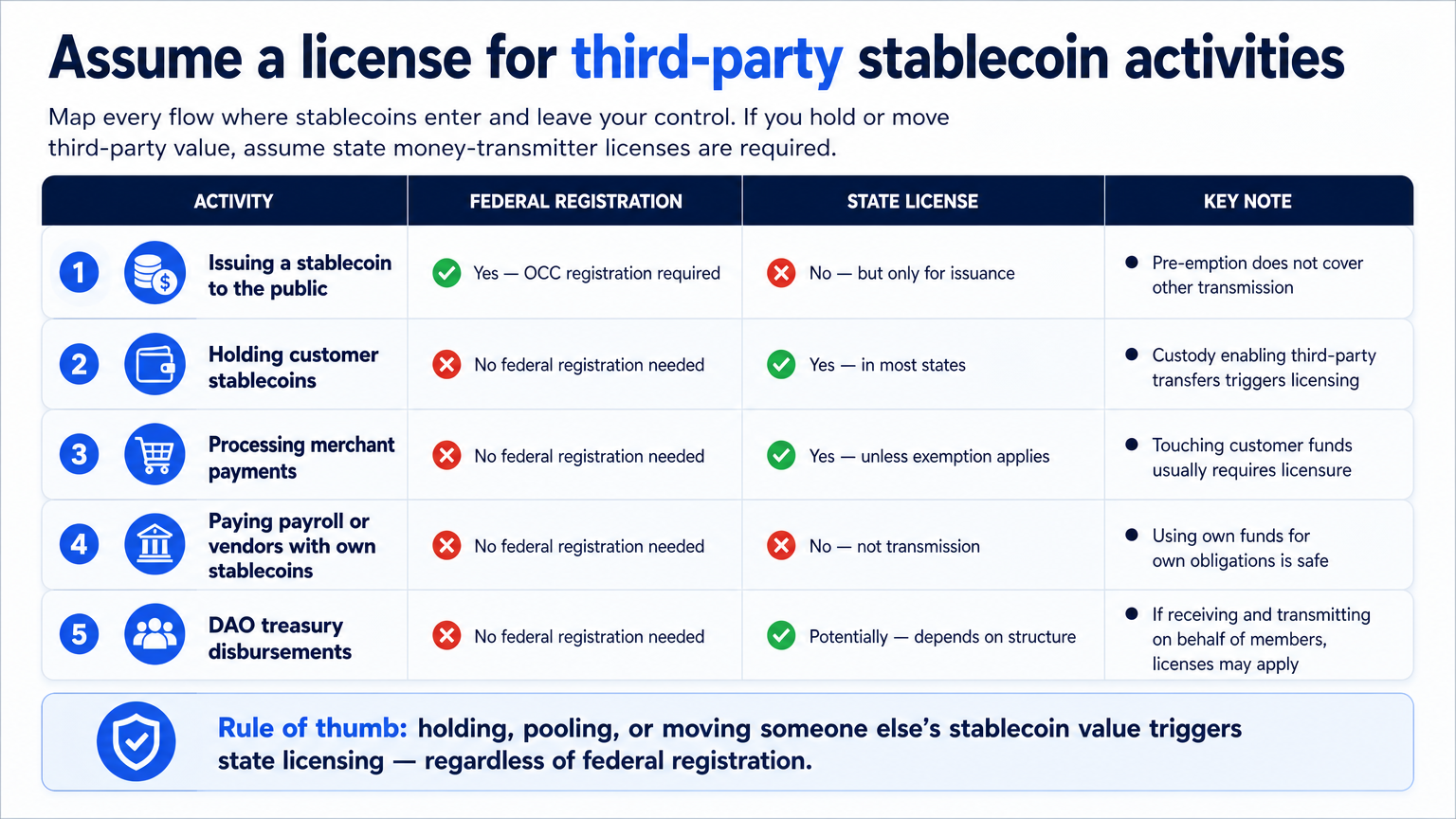
The first step is a clear audit of how your business touches stablecoins. The table below maps common activities to likely regulatory triggers under current law.
Rule of thumb: if your business holds, pools, or moves stablecoin value that belongs to someone else, assume you need state money‑transmitter licenses—regardless of the federal registration option.
Steps to protect your operation:
- Map every flow where stablecoins enter and leave your control.
- Classify each transaction: are you paying your own obligation or facilitating a transfer between two external parties? Only the latter triggers transmission laws.
- Verify any third‑party custodian’s licensing status.
- Get 50‑state legal advice; thresholds vary.
- Consider a unified banking platform that handles the transmission layer on your behalf, collapsing the 49‑state problem into one relationship.
How OneSafe Simplifies Compliance
OneSafe provides a single, neo‑banking interface for global businesses, Web3 startups, and DAOs—combining multi‑currency fiat accounts with on‑chain crypto custody. Because OneSafe’s services run through licensed partner institutions, the platform assumes the money‑transmission and custody licensing obligations. This crypto-friendly bank stablecoin regulation model means DAOs and startups can receive USDC, convert to USD, and pay grants, payroll, or vendors without the entity itself registering as a money transmitter. For cross‑border payroll, stablecoin‑funded payments settle in local currency through automated workflows and competitive FX, all while OneSafe stablecoin regulation sits at the partner‑bank level.
How Are Stablecoins Regulated in the US Under the GENIUS Act?
An issuer must register federally (OCC for non‑banks) and comply with reserves, redemption, and disclosure. But the Act’s pre‑emption is limited to issuance. Custody, transfer, payment processing, and exchange services stay under state money‑transmission laws, securities laws, and consumer‑protection statutes. The Act creates a two‑tier system: a federal license for the instrument, and up to 49 state licenses for everything else.
What Does the GENIUS Act Mean for Payment Processors and Exchanges?
For non‑issuer firms, the Act changes almost nothing about state obligations. Holding customer stablecoins or executing transfers still requires a state‑by‑state money‑transmission analysis. The only indirect benefit: a federally registered, vetted stablecoin may make it easier to defend the asset choice to regulators, but it does not replace state licensing.
How Can My Business Ensure Compliance When Using Stablecoins?
Start with the audit table above. If you’re not an issuer but hold or transmit third‑party stablecoins, get a 50‑state legal analysis. If building a multi‑state licensing program isn’t feasible, outsource the transmission function to a licensed platform. The platform’s regulated partners handle the perimeter; your entity avoids being a transmitter itself. Confirm segregation and transparent reporting.
Do I Need a State Money Transmitter License for Payroll or Payments?
No—if you pay your own employees or vendors with your own stablecoins. The moment you receive stablecoins from a client, hold them, and then pay a third party on the client’s behalf, you’re transmitting. The distinction always turns on whose money you’re moving.
Risks and Benefits for Global Businesses
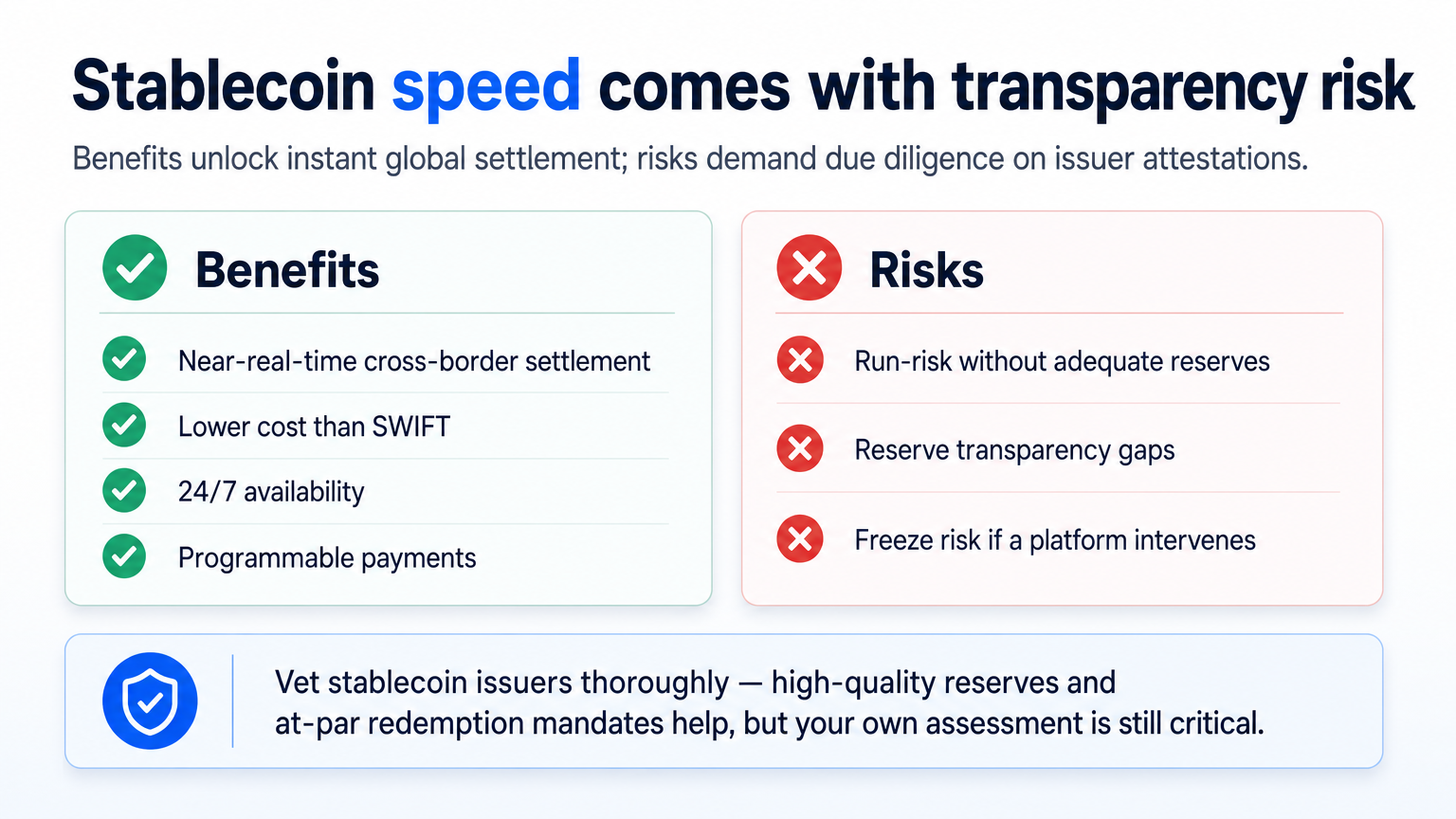
Benefits: near‑real‑time cross‑border settlement, lower cost than SWIFT, 24/7 availability, programmable payments. A Stablecoin Payments: USDC Settlement Test in Colombia pilot cut settlement time by 90% for merchant payouts. Risks: run‑risk, reserve transparency, and consumer‑protection gaps if a platform freezes your stablecoin. The GENIUS Act mandates high‑quality reserves and at‑par redemption for US issuers, but you still need to assess the issuer’s attestations.
What to Watch Next
Several states have signaled they will challenge the Act’s limited pre‑emption in court. The “walling off” of issuance from transmission remains contested; Stablecoin Regulation: The “Walling Off” Warning examines the arguments. Final Treasury rules are expected in early 2027. Meanwhile, the OCC is processing non‑bank applications. For businesses that want to keep stakeholders informed without distracting the compliance team, Joyrise plans, writes, and publishes illustrated SEO articles to your Webflow blog every day—read your first article before you pay.
Key Takeaways
- The GENIUS Act’s federal registration covers only issuance; non‑issuers still face state money‑transmission licensing if they handle customer funds.
- Audit every point where you receive, hold, or move third‑party stablecoins. Assume a license is required unless proven otherwise.
- Using your own stablecoins for payroll or vendor payments does not trigger transmission licensing.
- Outsourcing the transmission layer to a licensed platform delivers stablecoin speed while keeping your entity out of the 49‑state compliance labyrinth.
- Stay flexible: upcoming federal rulemakings and state‑court challenges could reshape the boundary.
For a platform that bridges fiat and crypto compliance in one account, explore how OneSafe helps businesses manage cross‑border payments and DAO treasury without the fragmentation of state‑by‑state licensing.
Get started with Business in minutes!
Get started with Business effortlessly. OneSafe brings together your crypto and banking needs in one simple, powerful platform.