- live LIVE: Why is the stock market ignoring Nvidia’s downfall? 17 hours ago Live Updates
- Go slow to be fast: Coinbase’s India product head on building for crypto’s next wave 12 minutes ago Exclusive Interviews with Crypto Founders & Influencers
- US targets the Megaspeed playbook as Nvidia CEO investigation heads up 1 hour ago Regulation
- Cryptopolitan Report: Will The Huang Scandal Matter For Nvidia? Our Readers Were Split 3 hours ago News
- State of the Crypto Industry 2026 report with Sumsub VP North America, Danielle Labarbera August 17, 2026 Exclusive Interviews with Crypto Founders & Influencers
- Building an AI-Native Travel Ecosystem: Exclusive Interview With Staynex CEO Yuen Wong July 2, 2026 Exclusive Interviews with Crypto Founders & Influencers
- How MovitOn is turning human movement into a delivery network with the Founder and CEO, Erik Beken Tleubeck May 25, 2026 Exclusive Interviews with Crypto Founders & Influencers
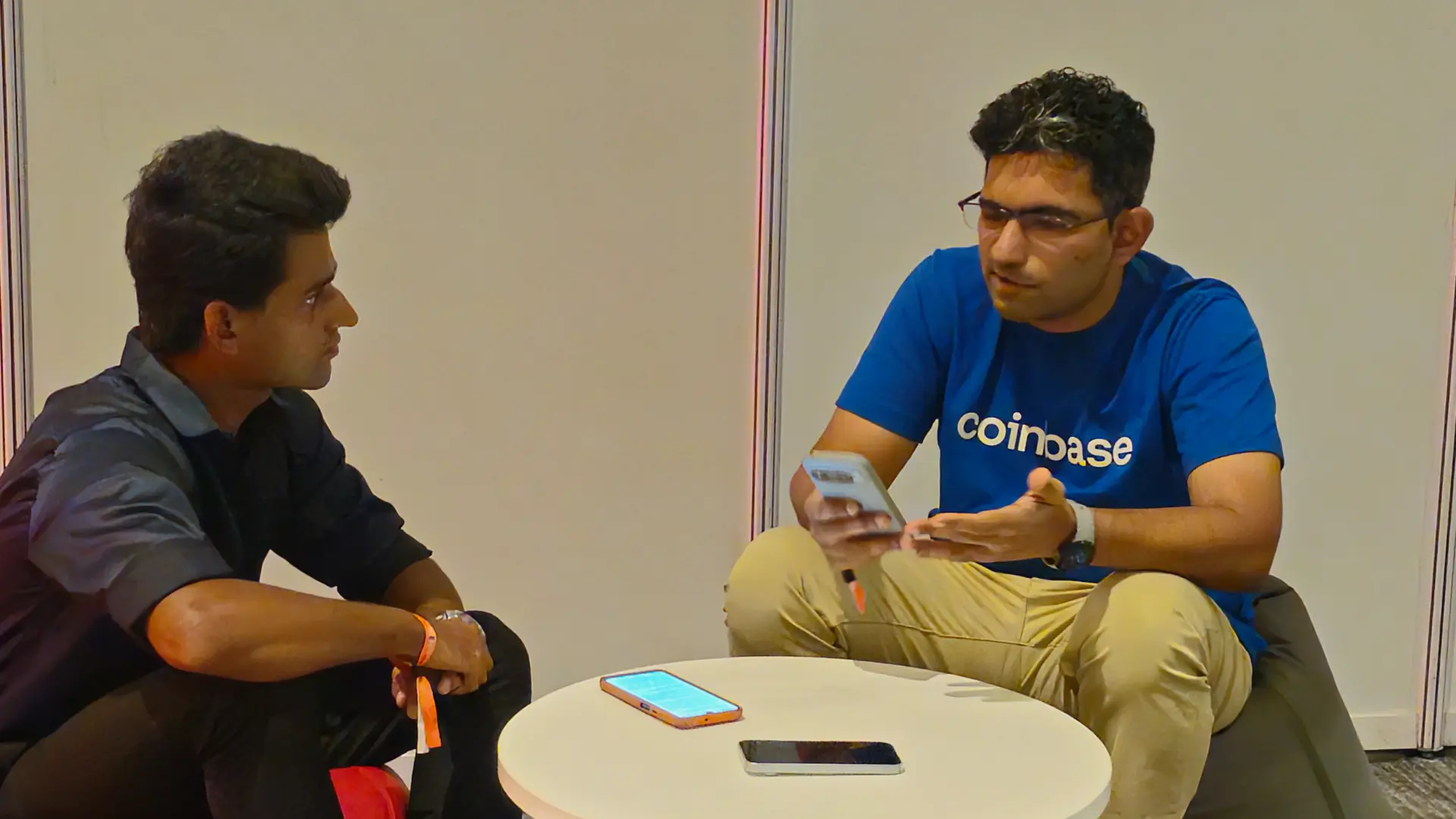
Coinbase is betting that the next phase of crypto adoption in India will be won through infrastructure, regulatory compliance and trust rather than simply attracting more traders.
After an earlier attempt to enter the market ran into regulatory and payment hurdles, the U.S. exchange is taking a more deliberate approach, building local banking connections, rupee payment rails and liquidity before expanding its product offering.
In an interview with Cryptopolitan, Roshan Prabhakar, Coinbase’s product lead for India and EMEA, said the company is prioritizing a fully onshore operation while preparing to bring more of its global product suite to Indian users.
Segment 1: The Journey
Question: Roshan, your path runs through BCG and Flipkart, so consulting and then building for Indian e-commerce at massive scale. What first pulled you into crypto, and what made you bet on Coinbase’s international expansion when you joined?
Answer: Yeah, sure. So, as you mentioned, I started my career at BCG in a consulting role. I also had a few consulting and product-related stints of my own, which I won’t get into right now.
After that, I joined Flipkart, where I spent the longest part of my career working in payments. I worked very closely with the team involved in integrating UPI as an asset rail at Flipkart. So, I was generally quite familiar with what was happening in the broader fintech space.
That’s when I started reading more about crypto assets. I also knew a bunch of people who were working at Coinbase and other companies in the industry. I kept seeing their posts about what was happening, what was being launched, and so on. All of that made me curious, and I started exploring the space more seriously.
I think the whole episode when Meta tried to launch its own stablecoin was when I started observing the crypto industry much more closely.
So, when Coinbase decided to expand its presence in India, hire people, and start building a team, I thought I’d give it a shot.
I chose Coinbase because it gave me the impression of being a mature organisation — kind of the adult in the room, considering everything that was happening in the crypto industry.
It was also around the time when Coinbase was getting close to its public listing, which was quite unimaginable for a crypto company at that point.
I genuinely got the sense that Coinbase was leading the way in bringing crypto to the masses in a more regulated, safe, secure, and compliant manner.
So, that was essentially my transition from Flipkart and e-commerce to payments and then to crypto.
I’ve been here ever since because, in a way, Flipkart is also a consumer internet company operating at scale, and fintech and crypto are also part of the broader consumer internet ecosystem. However, they bring some very interesting problem statements to solve.
And yeah, I’ve been at Coinbase ever since I joined.

Question: You’ve been part of Coinbase’s international expansion team for close to five years, and today you lead product for India and EMEA. What does building for India demand that other markets haven’t asked of you?
Answer: Yeah, I think there are a few things.
One thing to note is that one of the core components of being truly local in a market is allowing users to buy, sell, and invest using local payment methods and local fiat currencies.
If you look at most other markets, especially in Europe, the fintech and payment aggregator infrastructure is already quite well established. Integrating crypto into that existing infrastructure is relatively easier. It’s much easier to connect with card networks and local payment methods, and crypto is treated more or less on par with regular fintech services.
India, however, is a market where you need a much more bespoke setup, working directly with banks and other financial institutions.
A lot of the things that a payment aggregator or a third-party fintech company might handle in other markets have to be managed directly by the exchange itself in India. This includes building the entire downstream infrastructure, including local liquidity for crypto.
So, that was one of the very interesting challenges of building in India.
It also meant that you need to have a strong commitment to building locally for a market like India. Part of that commitment was reflected in Coinbase’s decision to launch completely onshore in a handful of international markets.
That’s one aspect.
Another thing I would say is that India has a very diverse user base. You’ll find someone who wants to invest as little as ₹100 in crypto, while you’ll also find highly sophisticated traders.
So, serving the Indian market is also about finding the right balance between catering to a wide and diverse range of users.
Indian users are also quite demanding, as they are accustomed to having access to excellent fintech services. That keeps us on our toes when operating in a market like India, compared to many other markets.
However, I would also say that there are a lot of similarities.
Many markets evolve in a similar way to how India is evolving right now. Several markets initially had limited regulatory frameworks, which gradually developed to include AML regulations, taxation, and other compliance requirements.
Eventually, some of these markets evolved into highly sophisticated regulatory environments, like Europe, where comprehensive crypto regulations are now in place across all member countries.
I clearly see India following a similar trajectory.
There are also many learnings we can take from EMEA and other markets, particularly in areas such as consumer protection, custody, and providing users with a safe, secure, and trusted exchange experience.
So, there are quite a few learnings we can take from these other markets as well
Segment 2: The Indian Market Today
Question: Indian users are sophisticated: they trade, they invest, and many already use offshore platforms. As you see it, how are their needs changing? Are we still in a trading-first market, or is demand shifting towards investing and onchain financial services?
Answer: I would say that India is still very significantly focused on trading, although we’re also observing a lot of new trends.
First and foremost, India is inherently a very trader-heavy market. If you look at stocks, futures and options (F&O), or even the broader financial markets, India is one of the largest retail markets for futures and options trading.
That kind of behaviour also spills over into the crypto space.
So, India is one of those markets where you’ll find a much larger number of sophisticated traders compared to many other markets. That’s perhaps one of India’s unique characteristics.
At the same time, the investment mindset is gradually developing in India.
If you look at equity mutual funds and the stock market, you’ll notice record SIP inflows. Investment behaviour is also growing significantly in India.
What I’m observing is that these trends are reflected in crypto as well. Indian investors increasingly view crypto as another asset class. The kind of investment behaviour they demonstrate in stocks and other traditional asset classes is gradually starting to appear in crypto too.
Coming to on-chain services specifically, I think the broader crypto landscape itself is changing. Various crypto protocols and crypto technologies are increasingly moving into the background and becoming part of the financial plumbing and infrastructure that makes financial services more efficient.
I would say the world is moving towards a situation where users don’t necessarily think, “I want to choose on-chain financial services over something else.”
Instead, they simply want to get their work done in the most cost-efficient, secure, simple, and convenient manner.
Whatever underlying infrastructure helps them achieve that is what matters. Users won’t necessarily care whether crypto is powering the services behind the scenes or whether some other technology is being used.
So, as things evolve and crypto becomes more mainstream and starts supporting financial infrastructure globally, I think we’ll gradually see some of these changes happening as well.
Question: India is home to one of the world’s largest developer bases, and many global Web3 teams quietly have Indian founders or engineers. Is India’s role in the crypto economy still mostly talent, or is it becoming a place where products and protocols are actually born?
Answer: Yeah, that’s probably a better question for Saumya Saxena. Saumya is essentially the person who’s been doing a phenomenal job of supporting the developer ecosystem, both in India and globally.
But I would say that India has always been one of the leading markets for developer talent.
I believe there were some recent reports suggesting that almost 12% of the global Web3 developer base is in India, and that the number of new developers is also growing significantly. That share is increasing as well.
So, India has been a developer hotbed for a long time, with a large pool of talented developers.
But what we’re also seeing is that the broader ecosystem has invested in bringing developers together, upskilling them, and helping them transition from being individual developers to becoming entrepreneurs and building startups.
We’re seeing a trend where individual developers are gradually evolving into entrepreneurs, founding startups, and even building fundamental building blocks and products with real-world utility, using Web3 as the underlying technology.
So, we’re clearly seeing that trend develop as well.
Yeah, I would say it’s happening in both directions.
Segment 3: Coinbase India’s Strategy
Question: Coinbase’s first India launch in 2022 ran into hurdles, and this time the company spent close to a year building before relaunching in June. What did Coinbase learn from the first attempt, and how did that shape the way you approached the comeback?
Answer: Yeah, I think our current approach is fundamentally built around having a truly onshore setup.
We want to operate as another Indian crypto trading exchange. That’s the approach we’ve taken while building the business, and it’s also why we’ve spent a significant amount of time getting everything in place before launching this time.
We started by establishing a local entity and getting it registered with the FIU. We’ve been very clear that this is not an offshore business. It’s a completely local, fully onshore operation.
As I mentioned earlier, being onshore also means building a lot of things from the ground up.
So, I think the key takeaway is that our approach is fundamentally based on getting the right foundations in place first.
These foundations include establishing a local entity, ensuring that we meet all the necessary local compliance requirements, building local liquidity, and integrating local payment rails before taking our products to market.
We took more than a year after our FIU registration to launch INR trading in India.
We were very clear that we wanted to get all the foundations completely right before bringing the product to market.
And yeah, we’re seeing that approach work well so far.
Question: Looking ahead, what are the two or three priorities on the India roadmap that you’d want users to hold you to? And what does a successful Coinbase India look like five years from now?
Answer: Yeah, I think there are probably two or three things I’d highlight.
First, as I mentioned earlier, we want to become as local a crypto exchange as possible.
One of our key priorities is to make every aspect of our user experience as INR-first as possible. This means having a complete product suite with the right local liquidity, operating through a fully compliant onshore setup, and ensuring that our products feel truly local in every aspect.
We’ve started with INR order books and local liquidity, and we’re gradually expanding that to more and more tokens. We’re also trying to build more products that are INR-first.
So, the first priority is to become as truly local as possible.
The second priority is aligned with Coinbase’s global philosophy of becoming an “Everything Exchange.” The idea is to bring multiple asset classes to the same set of users on a single platform.
We want to follow the same strategy in India by offering users access to as many asset classes as possible in a regulated and compliant manner, to the extent permitted by local regulations.
We’re always focused on bringing the right products to India that are available globally on Coinbase.
For instance, we recently launched crypto options, or started offering crypto options globally, and the same approach applies to India. Wherever possible, we try to bring as much of Coinbase’s global product suite to the Indian market.
Coming to your question about what success would look like, I think Coinbase, as a company, is fundamentally rooted in trust and security.
For me, success would mean that a serious investor or trader in India considers Coinbase their first choice because it’s a trusted, safe, secure, and easy-to-use exchange.
That’s a win for us.
And that’s why we’ve only just started. We take customer feedback very seriously and regularly engage with users to understand what’s working for them and what isn’t.
We also continuously try to understand the local regulatory environment and ensure that compliance doesn’t become a burden for users.
And, of course, we take security and safety very seriously.
So, if a few years down the line, Coinbase becomes the first-choice trading platform and exchange for serious Indian investors and traders, I would consider that a success.
Segment 4: Product, Payments & User Experience
Question: Rather than plugging into existing intermediaries, you built direct INR rails and integrated deeply with India’s payments stack. Walk us through that choice. What does it unlock for users, and what made it so much harder than it looks from the outside?
Answer: Yeah, I think this is again part of our philosophy of being as trusted, secure, and compliant as possible.
We don’t want to have a chain of intermediaries providing the deposit and withdrawal experience for users. The more intermediaries involved, the less reliable things can become, and the more expensive the overall experience can be.
So, this means putting in a lot of hard work on our end to build the underlying infrastructure and make INR deposits and withdrawals as seamless as possible for users.
However, that effort is worth the outcome because it allows us to build reliable systems and provide users with the best possible experience when depositing and withdrawing funds.
There are also several compliance-related aspects involved. We want to operate in a way that is as compliant as possible for our banking partners.
Whatever they require from a regulatory and compliance perspective, we make sure to build those requirements into our systems in-house to the best of our ability.
We don’t get the same level of flexibility when working with intermediaries.
Ultimately, it comes down to how we build an experience for users that is compliant, easy to use, reliable, and cost-effective.
So, we’re essentially trading off the additional effort involved in building everything ourselves against creating a more sustainable product for users.
This also connects to what I mentioned earlier about other markets. In many countries, it’s quite common for established fintech intermediaries to provide payment infrastructure for crypto companies. For example, crypto transactions can often be facilitated through existing card networks.
India is a little different because banks, payment providers, and other financial institutions have multiple considerations when it comes to serving crypto businesses.
So, the responsibility is also on us to ensure that we build everything necessary for a bank or payment provider to feel comfortable providing services to a crypto exchange.
It’s really a combination of all these factors.
Question: Every applicable trade has to handle TDS and GST in rupees. How do you design a product experience where compliance is built in rather than bolted on, without the app feeling heavy for a first-time user?
Answer: Yeah, I think there are two parts to this.
First, our foundational philosophy is that we don’t want to put the burden of compliance on users.
Many times, even when you look at offshore trading platforms, the responsibility for compliance ultimately falls on the users rather than the platform itself. The platform doesn’t necessarily handle everything, and users end up having to bear that burden.
We’re very clear that we want to give users peace of mind by ensuring that they don’t have to worry about compliance. We take care of all the heavy lifting.
From a user experience perspective, this means two things.
First, compliance should be invisible to users wherever possible. At the same time, it should be visible whenever necessary, especially in areas where it matters.
Let’s take TDS as an example. There are several complexities involved in calculating TDS.
There are multiple criteria to consider, such as how to value a primary token, how to value a secondary crypto token, and which time-based valuation should be used to calculate its equivalent INR value and determine the amount of TDS to be deducted.
There are also different rules depending on factors such as your bank account, tax residency status, and other criteria. The amount of TDS to be deducted can vary from one user to another.
So, there are a lot of permutations and combinations involved.
We abstract all of that complexity away from users and ensure that everything is handled properly within our systems.
Users can simply go ahead and execute their trades, while we take care of the tax calculations and other compliance-related requirements.
That’s how we try to ensure that the experience doesn’t feel overwhelming for a new user. We reassure them that we’ll handle all the complicated aspects on their behalf.
However, at the same time, transparency is equally important.
This is one area where we’re willing to sacrifice an immediate conversion from a new user if it means ensuring that they clearly understand what they’re getting into.
For example, when users deposit INR or go through the trading process, we educate them throughout that journey about the applicable laws and regulations, and explain how we handle the compliance requirements on their behalf.
This also means providing users with a lot of transparency and visibility into fees.
For instance, when you try to buy crypto on Coinbase, you’ll see the total fee. But right there, you’ll also have the option to access a complete, detailed breakdown, including how much tax is being charged, why that particular tax applies, and how the taxes are calculated.
So, if a user is unsure about what they’re getting into, all the relevant details are available at their fingertips.
It’s always possible to make a choice not to show users these details in order to encourage them to complete a trade.
But we take a step back and think about the bigger picture. Even if a user doesn’t trade on day one, we’d rather have someone who trades after fully understanding what they’re getting into than someone who’s simply pushed into completing a transaction.
So, that’s the philosophy behind our approach.
We make these kinds of trade-offs because we want to operate in every market for the long term.
Ultimately, building trust with users over time is much more important to us than getting them to complete their first trade as quickly as possible.
Segment 5: Trust, Security & Compliance
Question: Security breaches have escalated sharply over the past year, and some of them have hit even the largest, best-resourced platforms. For a first-time Indian user, that raises an uncomfortable question: if the giants can be breached, who can be trusted? How is Coinbase thinking about security right now, and how do you balance shipping new products quickly with staying the cautious, compliant platform users can rely on?
Answer: I think our philosophy is to go slow to be fast.
Many times, when you artificially try to move too quickly, you end up breaking more things, which eventually slows you down even further.
As a company, we’re deliberately comfortable with slowing down when necessary, especially when launching something for the first time.
We want to get things right from the beginning, as much as possible, and then scale faster once everything is working properly.
So, it’s about finding the right balance. But I would say we generally favour being deliberately slow at the beginning so that we can scale much more effectively in the later stages.
The advancement of artificial intelligence capabilities is rapidly changing the security landscape, and, in response, we are continuing to invest in best in class security innovation.
We are proud to be considered the most trusted platform in the industry. This trust can be seen in the fact that we safeguard more crypto than any other company. We are also the primary custodian for the majority spot Bitcoin ETFs and more than 150 government agencies trust Coinbase as a partner.
We keep over 99% of customer assets in cold storage today, and rebalance funds in and out of our hot wallets based on customer deposits and withdrawal demand. Transfers are protected by layers of controls, including distributed keys, withdrawal limits, anomaly detection and kill switches that can halt signing.
Segment 6: The Onchain Future

Question: To close, let’s look beyond the exchange. India already has one of the world’s largest and fastest-growing crypto developer bases, and leads globally on adoption. Yet many Indian-founded projects end up headquartered in Dubai or Singapore, so the code is written here but the value is captured elsewhere.
Coinbase has put over a million dollars into India’s builder community through Base. How do onchain products and developer tools fit into Coinbase’s India story, and what would it take for India to become not just the engine room of Web3, but a place where the next major protocols are built and stay?
Answer: I think, once again, it comes back to the fundamentals we discussed earlier.
A lot of crypto projects are gradually becoming more infrastructure-focused rather than being directly consumer-facing. So, what is important for India’s developer ecosystem, crypto startups, and protocol builders is to identify the right problems to solve and focus on addressing them. I believe those fundamentals remain the same.
The whole idea behind protocols is to build something that can serve a wider audience and operate at scale. We are already seeing this happen with several foundational use cases. For example, there is a lot of activity around agentic finance these days. Some protocols are helping people monetise the data they contribute to training large language models (LLMs), allowing them to receive returns in exchange for that contribution.
Many of these solutions are designed to operate globally, regardless of geographical boundaries.
So, I don’t think the question is simply about where the value is being created or captured. Ultimately, it comes down to whether you are building something just because it sounds exciting, or whether you are genuinely trying to solve a foundational problem or a universal problem that has global relevance.
As long as Indian developers and the broader ecosystem continue to focus on these fundamentals and build products that address meaningful use cases, I don’t see any reason why the developer ecosystem and new protocols cannot continue to flourish in India.
Disclaimer. The information provided is not trading advice. Cryptopolitan.com holds no liability for any investments made based on the information provided on this page. We strongly recommend independent research and/or consultation with a qualified professional before making any investment decisions.
Hannah Collymore
Hannah is a writer and editor with nearly a decade of blog writing and event reporting experience in the crypto space. At Cryptopolitan, Hannah contributes to the news page, reporting and analyzing the latest developments in DeFi, RWA, crypto regulation, AI and frontier tech industries. She graduated from Arcadia university with a degree in Business Administration.
5 Ingenious Applications of ChatGPT And What You Should Do About Them
93% Business Leaders Favor AI-Powered Solutions for Brand Sustainability Management, Reuters
Here’s How Macron Supports France’s Vibrant and Productive AI Ecosystem
Bloomberg Estimates the Generative AI Market to Reach $1.3 Trillion by 2032
- Bitcoin ETF vs. Ethereum ETF: What’s the Difference? November 5, 2025 Learn Crypto: Beginner Guides
- What Is Base? The Ethereum Layer-2 Network Launched by Coinbase October 21, 2025 Learn Crypto: Beginner Guides
- Dogecoin vs. Bitcoin: Key Technical Differences October 20, 2025 Learn Crypto: Beginner Guides
- What Is TVL (Total Value Locked) in Crypto? October 14, 2025 Learn Crypto: Beginner Guides
- How to Read a Crypto Whitepaper? October 13, 2025 Learn Crypto: Beginner Guides
- Ripple vs. XRP vs. XRP Ledger: What’s the Difference? October 13, 2025 Learn Crypto: Beginner Guides