Reth Security Patch: Bug Could Have Faked Ethereum State Roots
Crypto news today comes from node software, not a price chart.
As of November 6, 2026, the Ethereum execution client has a new Reth security patch, announced in a PSA on X by Georgios Konstantopoulos on November 5, 2026.
He asked users to move to Reth v2.10.0, OP Reth v2.8.1 and Base v1.5.3. Per the GitHub release pages, all three builds were published on November 5, 2026, the same day as the PSA.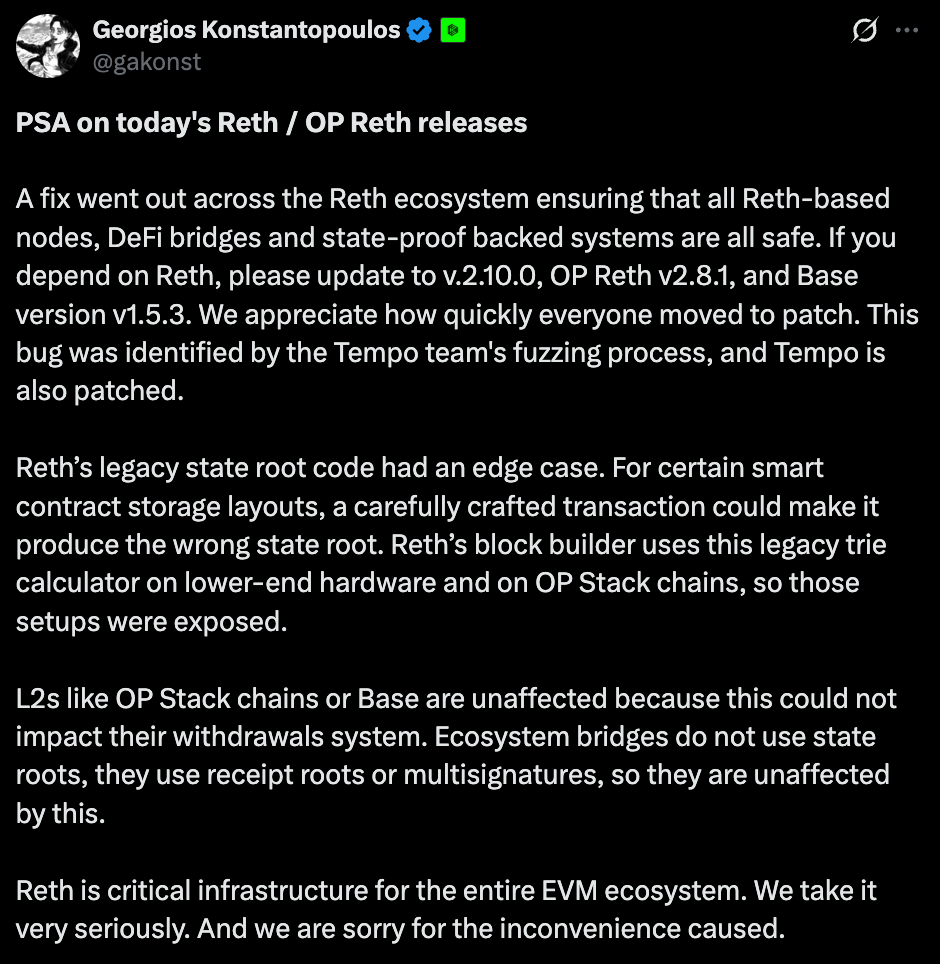
Reth Security Patch: What Happened?
Konstantopoulos wrote that the legacy state root code had an edge case. For certain smart contract storage layouts, a crafted transaction could make it produce the wrong state root.
He called the software critical infrastructure for the entire EVM ecosystem and apologized for the inconvenience. This is an EVM client bug, and the PSA describes no exploit or loss.
Paradigm Reth State Root Bug Explained
Per the PSA, the Reth bug found by Tempo fuzzing came from the Tempo team, which has also patched its own systems. Fuzzing feeds software unexpected inputs to expose edge cases.
In plain terms, the wrong state root bug meant a node could compute an incorrect fingerprint of chain state.
Which Reth Nodes Were Exposed?
The block builder relies on the legacy trie calculator on lower-end hardware and on OP Stack chains, so those setups were exposed, the PSA says.
Setup
Status per PSA
Lower-end hardware nodes
Exposed
OP Stack chains
Exposed
L2 withdrawals
Unaffected
Multisig bridges, receipt roots
Unaffected
Are Bridges Safe After the Reth Patch?
The PSA says ecosystem bridges do not use state roots. They rely on receipt roots or multisignatures, so they are unaffected.
Is Base Affected by the Reth Bug?
Per the PSA, L2s like OP Stack chains or Base are unaffected because the bug could not touch their withdrawals system.
Base v1.5.3 Update: What Changed?
Base’s side of the Reth security patch is v1.5.3. The Base v1.5.3 notes list a fix that prevents a state root mismatch, citing pull request 28264.
This Base node update is recommended for mainnet operators at their earliest convenience, with no deadline.
The OP Reth v2.8.1 release notes ask all node operators to upgrade but describe an eth_capabilities fix, not state roots.
The PSA still lists that build for the Reth OP Stack vulnerability fix, so operators on OP Stack Reth should follow both.
Reth v2.10.0 Update: Should You Upgrade?
This Reth update is tagged Latest, not a release candidate. Its Reth bug fix list includes the trie iterator seek decision at cached branch boundaries, numbered 28264.
Item
Detail
Release type
Hardening release
Update priority
High
Downgrade
Possible to v2.9.0
Per the notes, update priority is High for payload builders and non-payload builders alike. A Reth node update can still be reversed if needed.
How to Update Reth Node to v2.10.0?
Operators can take PGP-signed binaries or the Docker image from the official release page.
Expert View: What Could This Mean?
Analysts following crypto news may read Reth news today as an operations story, not a market one. One Ethereum execution client sits under many chains, so a single Reth vulnerability can reach many node operators.
Those on lower-end hardware or OP Stack chains, the exposed setups, may want to prioritise the upgrade.
Disclaimer: This article is for information only and is not financial or investment advice.
About the Author Lakshya Divekar
English News Writer at coingabbar.com
Lakshya Divekar is a Content Writer with 6 months of experience in creating well-researched, engaging, and SEO-friendly content focused on blockchain, cryptocurrency, Web3, and fintech. He specializes in simplifying complex technical concepts into clear, reader-friendly articles for both beginners and experienced readers. His expertise includes crypto market news, educational content, project research, and trend analysis. Passionate about emerging technologies, Lakshya consistently stays updated with the latest developments in the blockchain ecosystem. With strong research skills, attention to detail, and a commitment to accuracy, he delivers high-quality, plagiarism-free content that informs, educates, and engages readers while maintaining high editorial standards.
Frequently Asked Questions (FAQ)