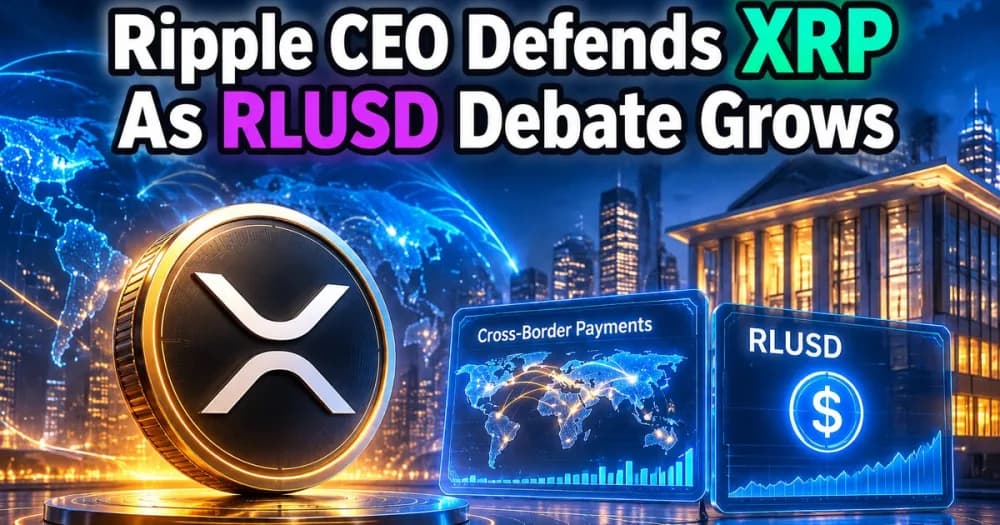
Ripple CEO Brad Garlinghouse defended XRP▼$1.16 on Nov. 7, calling it the company’s “North Star” as holders accused Ripple of shifting its focus to RLUSD▼$1.00 and other enterprise products. XRP traded at $1.16, down 1.77% in 24 hours and 66% below its July 2025 all-time high.
The dispute is over whether Ripple’s growing business will create demand for XRP, not whether the company has abandoned it. Garlinghouse says Ripple will pursue initiatives that benefit the token, while acknowledging that fiat or RLUSD can suit some transactions better.
- 👥Ripple CEO Defends XRP After Renewed Community Criticism
- ⚠️Schwartz’s Warning Adds to Public Tensions
- 🧠Ripple’s XRP Strategy Includes RLUSD and Other Products
- 🟠Business Update Puts XRP Alongside Other Services
- 🔸XRP Price and Market Figures Put the Dispute in Context
- ⚠️Risks for XRP Holders as Ripple Expands RLUSD
- 🔷What to Watch in Ripple’s Next Updates
- 🔒Separate XRP-Laundering Case Adds a Security Backdrop
- ❓FAQ
Ripple CEO Defends XRP After Renewed Community Criticism
The latest dispute began with a post by XRP commentator Fiduciary Ledger 17, who accused Ripple’s leadership of diminishing XRP’s economic importance as the company expands RLUSD and other enterprise products. The post said XRP holders had backed Ripple through regulatory uncertainty and its lengthy SEC battle, and called for a “fair value” of $15 to $20 or more.
That $15-to-$20 figure was the commentator’s demand, not a Ripple forecast or an independently supported valuation. Several accounts reposted the criticism, sharpening a familiar frustration: Ripple’s corporate expansion has yet to deliver the stronger XRP demand or price performance some holders expected.
At Swell 2026, Garlinghouse reaffirmed that XRP is Ripple’s “North Star,” according to CryptoPotato. He said the company wants to pursue initiatives that benefit the asset, while acknowledging that XRP will not suit every transaction.
Holders are measuring Ripple’s institutional growth against XRP’s utility and returns. The company has announced relationships with major institutions, but those announcements do not show that partners must use XRP or that their activity creates demand for the token.
The criticism also draws on Ripple’s regulatory uncertainty and SEC battle, which the commentator said were reasons holders continued supporting the company. At Swell 2026, Garlinghouse restated Ripple’s intention to pursue initiatives benefiting XRP while allowing other payment instruments where appropriate; he did not announce a change to the token’s role.
Schwartz’s Warning Adds to Public Tensions
Garlinghouse is Ripple’s CEO, while David Schwartz is its CTO Emeritus and a prominent XRP figure. Fiduciary Ledger 17, an XRP commentator on X, made the central accusation about Ripple’s priorities.
Schwartz separately said he planned to block many XRP accounts for irrelevant replies and unsolicited promotions on his X posts. He described users posting insults, accusations and XRP-related messages in unrelated conversations. He also said he would block accounts accusing him of fraud or scamming.
U.Today covered Schwartz’s warning as the dispute spread beyond products and prices to public exchanges between Ripple figures and community members. Schwartz said the replies disrupted conversations with other users; he did not describe a change to Ripple’s XRP strategy.
Schwartz said the replies could also send notifications to people following the unrelated conversations where he was participating. He described a pattern of XRP promotions and personal attacks, including fraud or scamming allegations, and said he would block accounts that followed him across X to make those claims, whether positive or negative.
His warning sets limits on how he will handle replies, but does not answer holders’ underlying economic concern. Schwartz described plans for his own account and posts, not a formal Ripple community policy or broader enforcement action.
Ripple’s XRP Strategy Includes RLUSD and Other Products
Critics point to RLUSD, treasury products and institutional-finance offerings that do not always require XRP. Ripple has also announced partnerships with Coinbase, Robinhood, BNY and Standard Chartered, among other institutions. The relationships show business activity, but not how much demand they generate for XRP.
Garlinghouse says Ripple can pursue a larger financial market with XRP alongside stablecoins and traditional currencies, rather than requiring every product to use XRP. Earlier this year, he said “all roads lead back” to XRP. In a separate post, he argued that RLUSD does not compete with XRP because the assets serve different purposes.
Holders want to know whether growth in payments, custody, stablecoins and institutional services will bring practical use or demand for XRP.
Ripple’s approach does not require every product to use the token. Garlinghouse describes XRP as central to the company’s direction, while allowing fiat or RLUSD when they better fit a transaction. How much of Ripple’s overall activity will involve XRP remains unclear.
RLUSD’s expansion has become a point of tension, but does not by itself show that Ripple has dropped XRP. Garlinghouse says the stablecoin serves a different purpose. Holders worry that growth in products that do not require XRP may bring no corresponding benefit to the token.
Business Update Puts XRP Alongside Other Services
Ripple’s latest business update sets out a goal of modernizing financial infrastructure with digital assets such as XRP. It places payments, custody, stablecoins, treasury and capital markets within that effort.
The update includes XRP in Ripple’s stated plans alongside other products and services. Holders want to know whether that strategy will generate measurable demand for the token. The company has not quantified how much activity will flow through XRP.
Ripple describes these services as connected areas of financial infrastructure, not as products that all require XRP for settlement. Its reference to digital assets “such as XRP” gives the token an explicit place in the plan, but the update provides no breakdown of transactions, revenue, volumes or product adoption attributable to XRP.
Holders seeking evidence of token use will need more than broad strategy language. Payments and capital markets define the scope of Ripple’s ambitions, but do not show which assets customers will use or how often XRP will feature.
XRP Price and Market Figures Put the Dispute in Context
On Nov. 7, XRP traded at $1.16, with a market capitalization of about $73.78 billion and 24-hour trading volume of about $1.42 billion, according to CoinGecko data. The token fell 1.77% over the prior 24 hours.
XRP stood 66% below its July 2025 all-time high. The figures help explain why holders are weighing Ripple’s expansion against the token’s performance: the two have not moved in lockstep.
The commentator’s demand for a “fair value” of $15 to $20 was a call for Ripple to support a higher price, not a company price target.
The contrast between Ripple’s corporate momentum and XRP’s decline from its high has fueled holder frustration. The figures do not show that RLUSD growth, partnerships or any single company decision caused the price move.
The commentator offered no valuation method or evidence for the proposed “fair value.” The figure was an appeal for executives to support a higher outcome.
Risks for XRP Holders as Ripple Expands RLUSD
Ripple’s product growth may not translate into greater XRP use or demand. Garlinghouse says fiat and RLUSD can serve some transactions, so the company’s wider expansion does not mean every product will require XRP.
Trust is also at stake. If holders see Ripple’s partnerships and stablecoin growth as benefiting products other than XRP, frustration could deepen. Schwartz’s warning about blocking disruptive accounts shows how heated the public dispute has become.
The claim that Ripple is deliberately diminishing XRP’s economic role remains the commentator’s accusation. The dispute does not establish deliberate price suppression.
Ripple’s business update names several areas of work but does not say how their use divides among XRP, stablecoins and traditional currencies. Without figures linking products or transactions to XRP, holders cannot infer token demand from the breadth of the company’s announcements alone.
Ripple has made no new XRP-specific commitment, timetable or target in response to the criticism. Garlinghouse’s defense is strategic: Ripple wants to pursue initiatives that benefit XRP while competing for a larger financial market. Whether that satisfies holders remains unsettled.
What to Watch in Ripple’s Next Updates
Ripple’s future business updates and product announcements will show how the company positions XRP alongside payments, custody, stablecoins, treasury and capital markets. Holders will look for practical use and demand for XRP as the business expands, not just partnership announcements.
Garlinghouse’s argument depends on whether Ripple can grow its multi-product strategy while keeping XRP in a meaningful role. Schwartz said he planned to block accounts that flood unrelated X discussions with XRP promotions, insults or fraud allegations. No date has been given for a separate XRP-focused decision or launch.
Holders need specific disclosures showing where Ripple uses XRP and whether that use is growing. The latest update names the relevant business areas but provides no XRP-specific activity figures. The community post calls on executives to support a higher valuation, without identifying a company commitment that would deliver it.
Investors will be watching Ripple’s next business updates and product announcements, along with any further explanation from Garlinghouse about XRP’s place alongside RLUSD and fiat. No date has been set for those disclosures. For now, Ripple’s stated position remains at odds with holders’ demand for measurable benefits to the token.
Separate XRP-Laundering Case Adds a Security Backdrop
A separate event reported on Nov. 6 involved XRP stolen in the Binance breach, not Ripple’s products or the community dispute. On Oct. 29, five hot wallets sent 233.46 million XRP to an attacker address between 20:05 and 20:09 UTC. Binance later put the breach at $6.34 billion, and the FBI attributed the campaign to North Korea’s TraderTraitor group.
Elliptic said about 42 million of the stolen XRP, worth roughly $50 million, had been swapped mostly into bitcoin through THORChain. About 192 million XRP, roughly $226 million, remained unswapped in addresses linked to the theft.
The XRP first moved on Nov. 2, when about 233 million tokens were transferred into six new addresses between 02:12 and 04:00 UTC. They remained there until Nov. 5. That afternoon, two of the six addresses began sending XRP to dozens of new accounts, where it was exchanged, mostly through THORChain into bitcoin. A small amount of ether also passed through the service that evening.
Elliptic said the main bitcoin and ether holdings from the theft had not moved. The transfers show XRP being routed through a cross-chain service during a criminal investigation; they were not ordinary Ripple payment activity and do not show demand generated by Ripple’s business.
Binance said it had frozen or intercepted about $2.85 billion and would cover customer losses from its own funds. Withdrawals reopened in stages. The laundering investigation had spread across more than 20,000 wallets on 16 blockchains, at least 36 services and at least 65,000 transactions. About $3.11 billion remained in addresses linked to the theft, mostly as ether and bitcoin, and little had likely been cashed out.
Stablecoin issuers can freeze their tokens, while XRP and bitcoin cannot be frozen in the same way, the report said. After Tether and Circle locked down large stablecoin tranches on Oct. 29, the attacker moved assets beyond that issuer-controlled mechanism. The later XRP-to-bitcoin conversions followed that route, while the larger bitcoin and ether pools remained untouched.
Bitcoin Magazine said the next question was whether THORChain operators and other bridges would keep blocking published attacker addresses quickly enough to slow further conversions, or whether more of the remaining XRP would follow the first tranche into bitcoin. The investigation is separate from the holders’ dispute with Ripple: these transfers involved stolen funds, not Ripple’s announced products or institutional partnerships.
FAQ
Who accused Ripple of reducing XRP’s importance?
XRP commentator Fiduciary Ledger 17 made the accusation in a post later reposted by other accounts. The post criticized Ripple’s emphasis on RLUSD and enterprise products.
What did Brad Garlinghouse call XRP at Swell 2026?
He called XRP Ripple’s “North Star” and said the company wants to pursue initiatives that benefit the asset. He also said XRP will not suit every transaction.
Does Ripple say XRP must be used in every transaction?
No. Garlinghouse said fiat or RLUSD may make more sense for some transactions, depending on the use case.
What is RLUSD in this dispute?
RLUSD is Ripple’s stablecoin. Its expansion has prompted some holders to worry that the company is prioritizing products that do not always require XRP. Garlinghouse says RLUSD serves a different purpose from XRP.
How far below its all-time high was XRP?
CryptoPotato described XRP as 66% below its July 2025 all-time high. On Nov. 7, XRP traded at $1.16.
Why did David Schwartz say he would block some XRP users?
Schwartz said irrelevant XRP promotions, insults and fraud accusations were disrupting unrelated conversations on X. He said the replies could also inconvenience other users following those conversations.
What will holders watch for in Ripple’s next updates?
They will look for evidence of practical XRP use and demand as Ripple expands its payments, custody, stablecoin, treasury and capital-markets businesses. Partnership announcements alone do not answer that question.
This article is for information only and is not financial advice.
Related Articles
CYBERLEEK Crypto Targets $30M Market Cap With GTA 6 Leak Threat: Can CYBERLEEK Rally?
CYBERLEEK crypto has returned to the spotlight after the creator tied a new GTA 6 leak threat to...
Best Arc Memecoins in 2026: Early Arc Chain Tokens to Watch Before They Take Off
Arc mainnet only went public on September 16, but its memecoin economy was already forming before...
Top Massive Crypto Liquidations in 2026: What’s Going On with Crypto Market After Billion-Dollar Flushes?
Massive wipeouts in crypto during 2026 – billions vanish fast. What exactly hits the market when...
What Is APES Crypto? Why APES Is One of the Hottest Tokens on Robinhood Chain This Week
APES Crypto is a community-driven cryptocurrency on Robinhood Chain blockchain, which is an...
NYSE Owner ICE Plans 24/7 US Venue for Hyperliquid Perpetual Futures
NYSE owner ICE plans to bring Hyperliquid perpetual futures to US retail traders through...
Solana Foundation Positions Network as Infrastructure for AI-Powered “Agentic Internet”
The Solana Foundation is actively developing the network as key infrastructure for the...