Ripple has received formal approval from the Office of the Comptroller of the Currency for its National Trust Bank, a move the company says gives its dollar-backed stablecoin business a second regulatory track alongside its existing New York state charter.
Stuart Alderoty, Ripple's chief legal officer, said the federal nod is chiefly aimed at supporting the company's stablecoin operations, which are already issued under the supervision of the New York Department of Financial Services. The combination, he argued, leaves Ripple in a category of its own.
"I think we are the only stablecoin issuer that has both the DFS-issued stablecoin with the backstop of the OCC approval," Alderoty said in a video discussing the approval.
The structure matters because of how the federal GENIUS Act, which governs stablecoin issuers, sets up compliance. The law offers two routes: companies can stay inside a qualifying state framework that regulators deem equivalent to federal standards, or they can move to federal oversight once they cross a specified market-capitalization threshold. Holding both a state-issued stablecoin and an OCC-approved trust bank means Ripple can shift between the two as rules and its own balance sheet change.
Alderoty characterized that latitude as optionality, saying it gives the company room to adapt its stablecoin product line as digital-asset guidance evolves. He also framed the approval as a trust-building step, arguing that broader adoption of blockchain payments in the United States hinges on how credibly the industry works with established banks and regulators. In his view, the trust bank charter gives Ripple a clearer path into that relationship while preserving its role as an innovator in stablecoins.
The approval covers Ripple National Trust Bank and does not by itself authorize the company to take deposits or make loans in the manner of a full commercial bank. Its immediate effect is to add a federal supervisory channel for the stablecoin business, which centers on RLUSD, Ripple's dollar-backed token designed for cross-border payments by institutions and retail users.
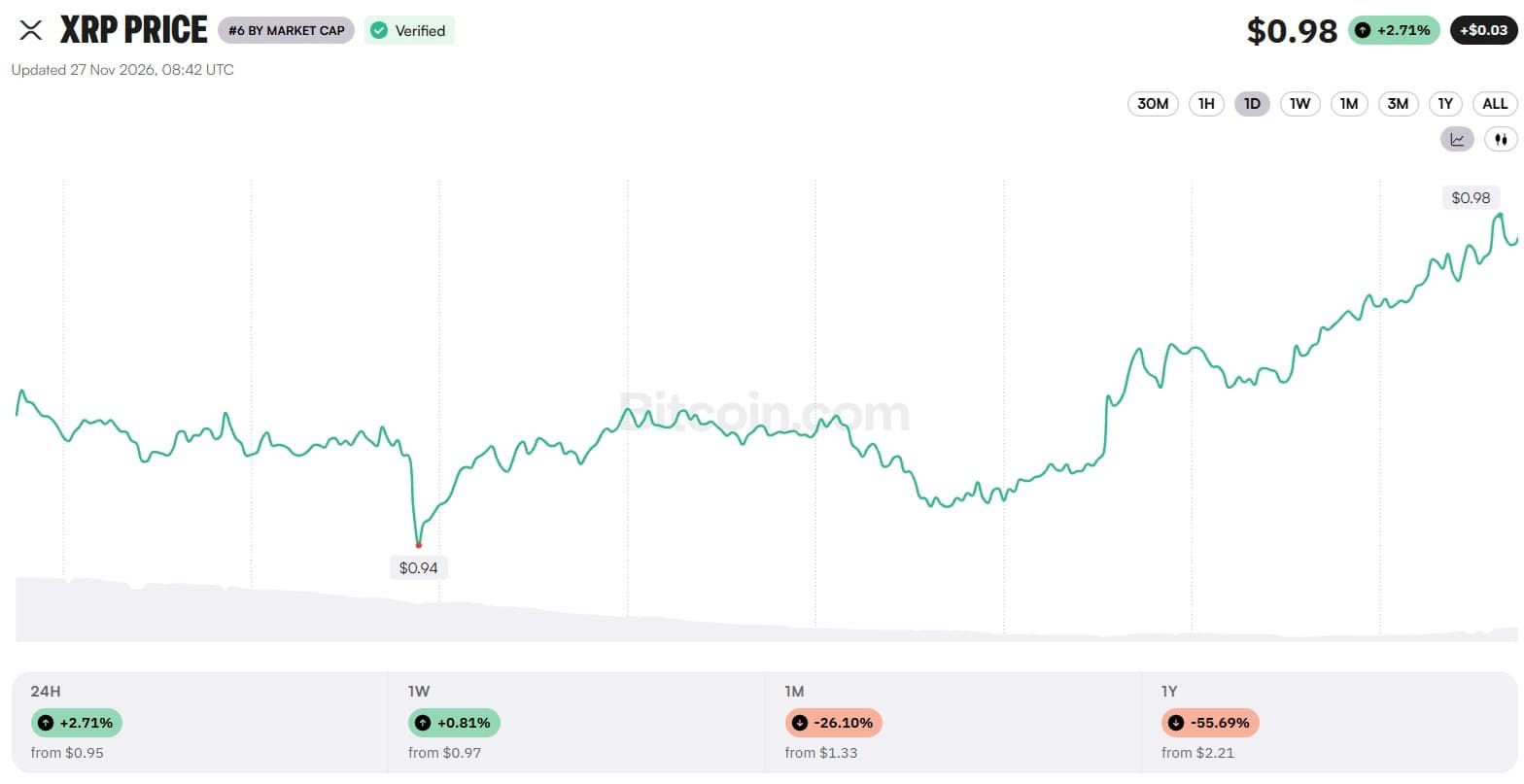
Crypto commentator X Finance Bull, who trades under that handle on X, pointed followers to Alderoty's remarks and urged XRP holders to weigh the longer-term implications for both XRP and RLUSD. The post did not offer a price target for XRP or spell out a direct mechanism by which the charter would affect the token's market value; instead, the commentator described the approval as opening a door to future opportunities across Ripple's ecosystem.
Note: The OCC supervises national banks and federal trust institutions; the GENIUS Act sets the compliance regime for payment stablecoin issuers.
For XRP holders, the practical read-through is indirect. Ripple's token is separate from RLUSD, and the charter does not alter XRP's supply, ledger mechanics or listing status. What the approval may change is the company's standing with banks and payment processors that have been slow to touch digital assets without a federal regulator in the room. A second supervisory channel could shorten compliance reviews for partners evaluating Ripple's payment rails, which in turn supports the network's transaction volume over time.
The strategic bet is that regulatory depth, rather than speed, wins institutional business. Ripple has spent years arguing that stablecoin issuance should sit inside the banking perimeter rather than beside it, and the OCC approval gives that argument a concrete example. Rival issuers that have chosen a single state or federal route may now face pressure to match the dual structure, particularly as the market-cap threshold in the GENIUS Act pushes larger players toward federal oversight anyway.
Whether the optionality Alderoty describes translates into market share is a separate question. Stablecoin competition is increasingly decided by distribution and reserve transparency, and a charter does not by itself deliver either. But for a company whose central legal battles have long concerned how regulators classify its products, holding approvals from both Albany and Washington removes a recurring objection from the sales conversation.
Once added, BigGo Finance appears first in Google Search Top Stories, so you get the broadest, most up-to-the-minute, and most comprehensive global financial news first.