Stablecoin payments took a sharp consumer-distribution step on November 5, 2026, when Samsung Wallet launched its USDC on Solana account for eligible U.S. Galaxy users. The integration gives 82 million compatible devices a native on-chain stablecoin wallet — pre-installed, trusted and already used for cards, keys and IDs. For business operators, the move matters less for consumer spend and more for what happens when stablecoin payins and payouts inherit this mass-market reach.
Table of Contents
- What just happened: Samsung Wallet adds USDC
- Why this matters for stablecoin payments
- The background: stablecoin payments for business operators
- Concrete implications and recommended actions
- What to watch next and open questions
- Key Takeaways
- Further reading
What just happened: Samsung Wallet adds USDC
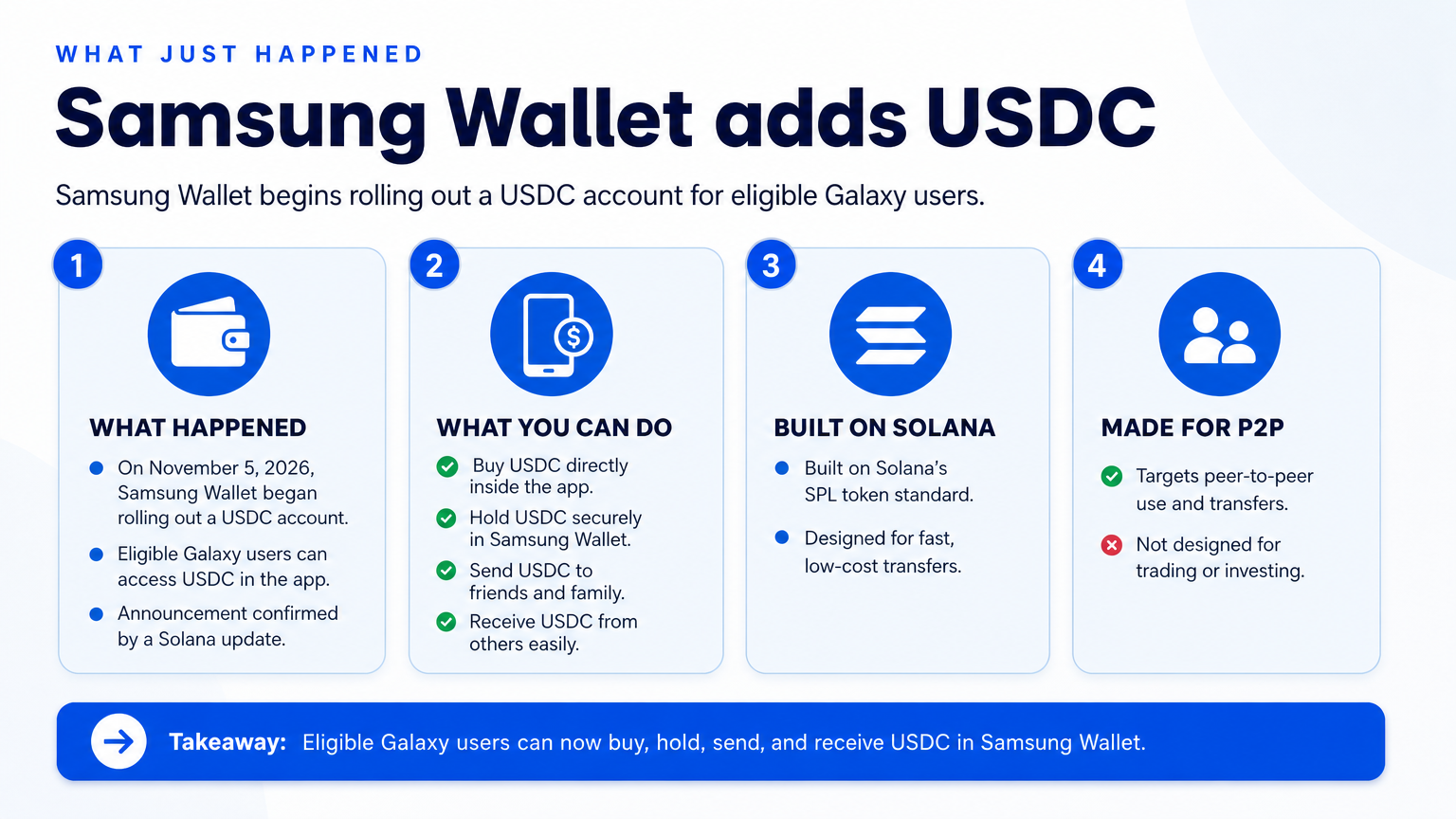
On November 5, 2026, Samsung Wallet began rolling out a USDC account that lets eligible Galaxy users buy, hold, send and receive USDC directly inside the app. The announcement was confirmed by a Solana update. Built on Solana’s SPL token standard, the feature targets peer-to-peer transfers and basic holding — not trading — and sits alongside existing wallet functions such as loyalty cards and digital keys.
Solana pegged the addressable footprint at 82 million compatible Galaxy devices, an order of magnitude larger than any dedicated crypto wallet’s U.S. user base. Because the stablecoin account lives in a pre-installed, familiar app, consumers don’t need a separate download or seed-phrase management. For businesses, the implication is different: a large pool of counterparties can now receive or send stablecoin payments through an interface they already trust, without opening an exchange account.
Why this matters for stablecoin payments
From a consumer wallet feature to a business payment signal
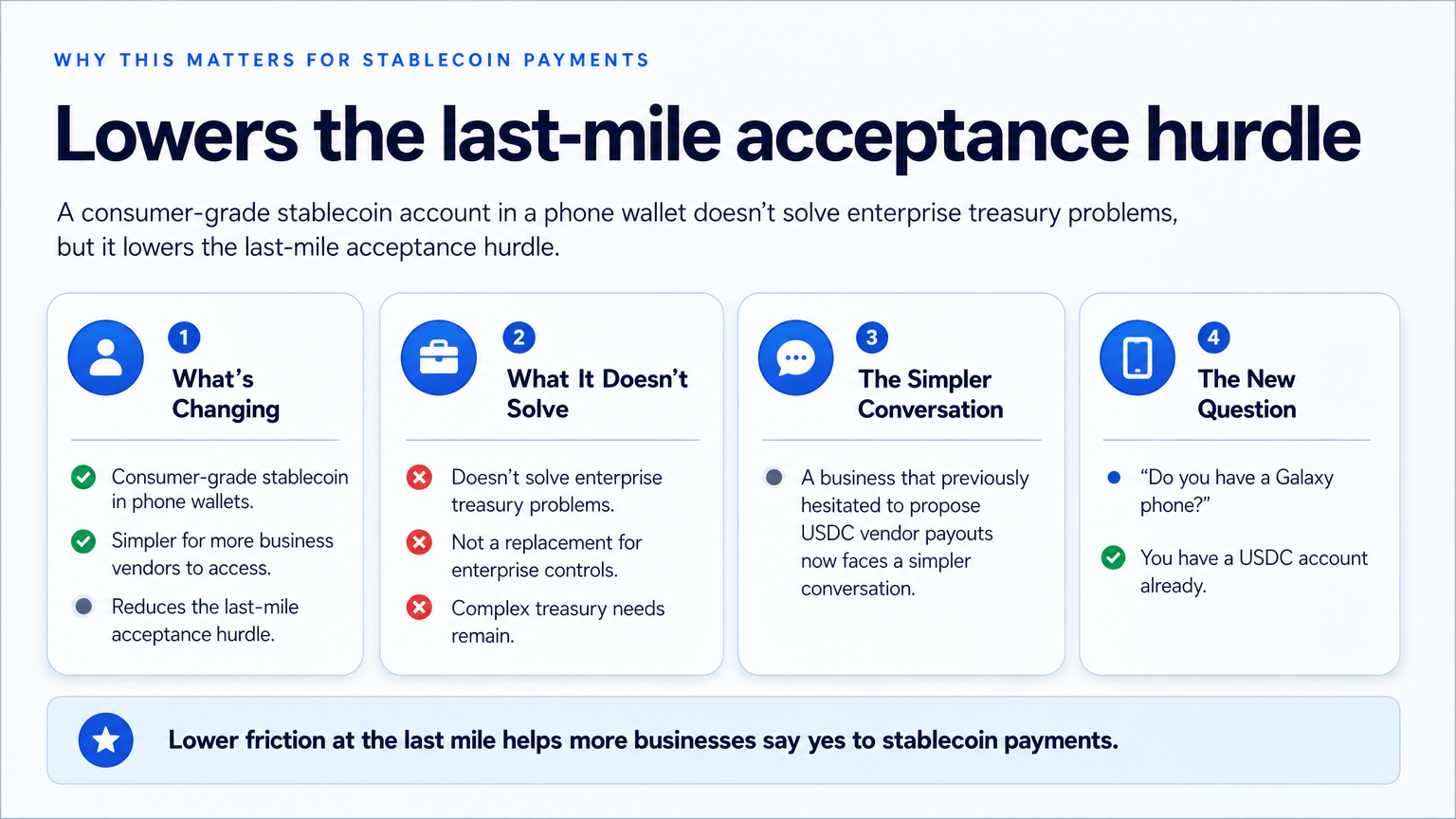
A consumer-grade stablecoin account in a phone wallet doesn’t solve enterprise treasury problems, but it lowers the last-mile acceptance hurdle. A business that previously hesitated to propose USDC vendor payouts now faces a simpler conversation: “Do you have a Galaxy phone? You can receive USDC in Samsung Wallet.” The payment rail itself isn’t new; the difference is that consumer acceptance gets a real boost.
Yet on November 5 the answer for businesses is still incomplete. The Samsung Wallet Stablecoin Account is a consumer wallet, lacking segregated sub-accounts, multi-user permissions, compliance reporting, and automated off-ramp — the controls a company needs for auditable, cross-border stablecoin payments. The launch increases the number of endpoints that can interact with a business’s stablecoin flow; it does not supply the controls those endpoints require.
What mainstream distribution changes for settlement and adoption
Ranking pages for “stablecoin payments” largely describe API rails and enterprise settlement networks, missing the significance of a default consumer endpoint. This gap matters because adoption feeds adoption: when consumers hold USDC in a familiar app, they’re more likely to accept it as payment, pressuring businesses to support stablecoin payins. But operational gaps — dispute handling, refunds and billing workflows — remain unresolved for most payment gateways. Samsung’s announcement expands demand-side readiness, not enterprise settlement infrastructure.
The background: stablecoin payments for business operators
What are stablecoin payments?
Stablecoin payments transfer digital tokens pegged 1:1 to fiat, usually the U.S. dollar. USDC, issued by Circle, is a fully reserved, dollar-backed stablecoin that settles on public blockchains. When a business sends or receives a stablecoin payment, value moves on-chain and typically settles in seconds. The Federal Reserve’s March 30, 2026 note highlights their potential to improve cross-border speed and reduce costs, while cautioning about effects on demand for central bank money.
What are stablecoin payments used for?
Businesses use stablecoin payments for cross-border vendor settlement, contractor payouts in underbanked regions, crypto-native payroll, e-commerce processing and instant fiat-to-crypto on-ramping. A typical flow: a company holds USDC in a business stablecoin account, pays a supplier’s wallet address on Solana, and the supplier converts the received USDC to local currency through an off-ramp partner — all relying on APIs, multi-currency accounts and USDC custody separated from speculative holdings.
Why do stablecoin payments matter?
The core advantage is settlement finality in seconds instead of SWIFT’s multi-day windows, using a payment instrument that doesn’t fluctuate in value during transit. Stablecoin payments can collapse FX spread uncertainty and correspondent banking delays. But as a 2026 B2B adoption analysis noted, business use still lags consumer speculation — partly because many companies lack a compliant way to receive, hold and convert stablecoins without touching a retail wallet.
Who uses stablecoin payments?
Two cohorts dominate. Crypto-native companies — Web3 startups and DAOs — have used cross-border stablecoin payments for years, often through a DAO stablecoin treasury. More recently, traditional businesses with international payrolls or supplier networks have started testing stablecoin rails for stablecoin payins and payouts, especially where banking infrastructure is thin. Platforms that offer seamless crypto to fiat conversion alongside ACH and wire capabilities serve this second group by bridging on-chain settlement with conventional accounting.
What is the difference between stablecoin payments and cryptocurrency payments?
Stablecoin payments use tokens engineered to hold a stable value; cryptocurrency payments use volatile assets like Bitcoin or Ether. A business accepting BTC for a $10,000 invoice risks a 5% intraday drop before conversion. With USDC on Solana, the value stays pegged to the dollar, shifting the main risks to custody, conversion speed and compliance — not price movement. This makes stablecoins usable as working capital instruments, while volatile cryptocurrencies remain speculative.
What should a business check before using a consumer stablecoin wallet for vendor payments?
Consumer wallets like the Samsung Wallet Stablecoin Account aren’t designed for recurring business payments. The table below outlines the key gaps:
Table 1: Key checks before routing business payments through a consumer stablecoin wallet.
Concrete implications and recommended actions
Audit your receive, hold, and off-ramp workflow
For a business that already accepts stablecoin payments, the immediate action is to map where incoming funds sit. If they land in a personal wallet, they must be swept to a secure business stablecoin account for custody and conversion. Also confirm that your off-ramp partner supports SPL USDC — Samsung’s integration is Solana-only at launch. Failing to check this creates a chain-compatibility gap before you advertise the payment method to customers.
Separate consumer-grade custody from business treasury controls
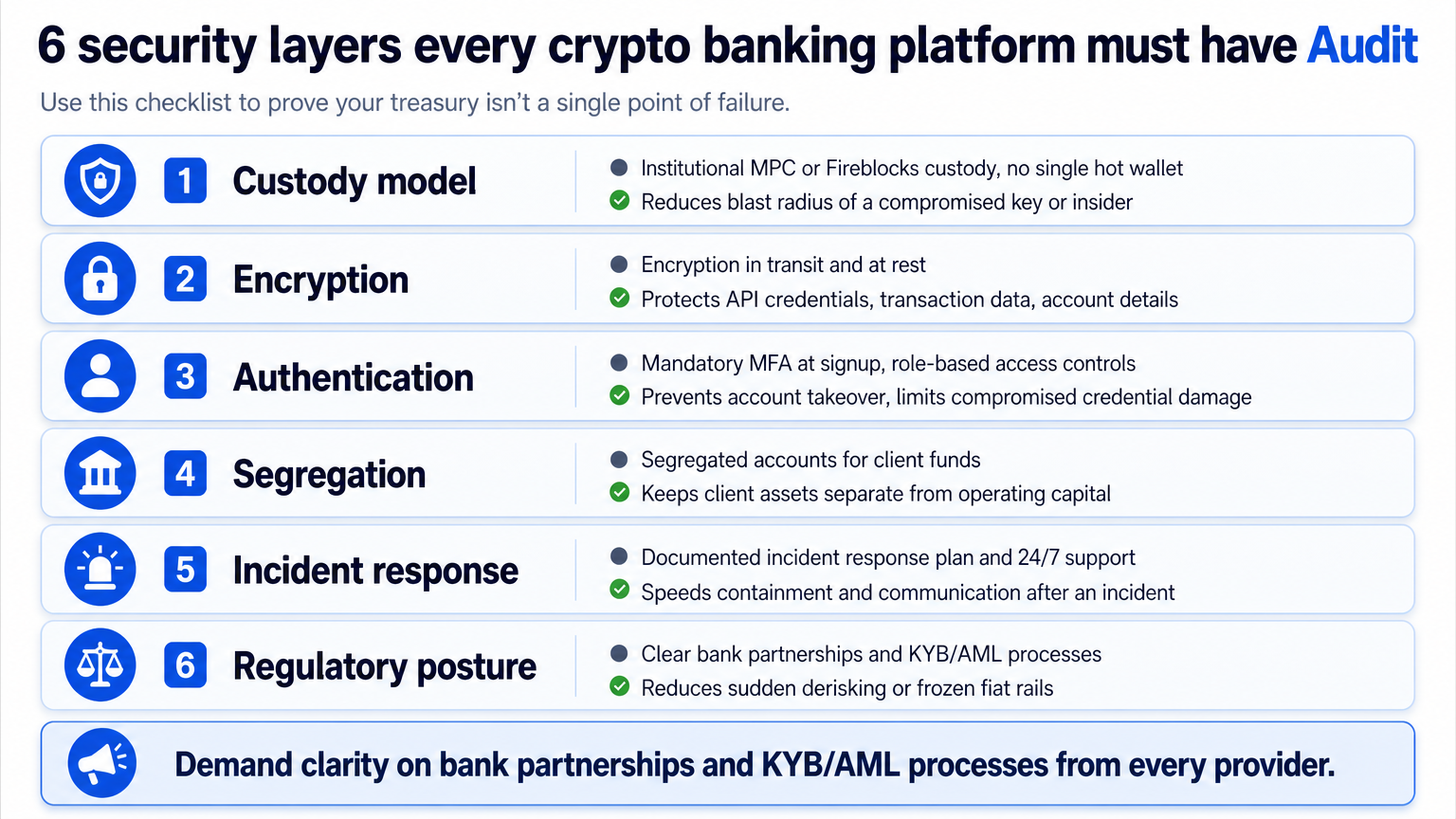
A contractor who now holds USDC in Samsung Wallet may request invoice payment in USDC on Solana. The business can do that, but it must not pay from a peer’s consumer wallet. Route the outflow from a platform that enforces access controls, maintains segregated accounts with crypto-friendly banking, and produces an audit trail. Treat the on-device wallet that receives funds and the USDC custody layer that protects corporate funds as entirely separate infrastructure tiers.
The missing invoice-to-fiat stablecoin workflow
Most stablecoin payments coverage omits the steps to convert a stablecoin receivable into settled fiat:
- Invoice is generated in fiat (e.g., USD or MXN).
- Counterparty pays the stablecoin equivalent on-chain to a business-owned address.
- Received USDC must be moved from the receiving wallet to a conversion venue — an exchange, OTC desk or integrated platform — where it is swapped for fiat.
- Fiat proceeds settle via ACH or wire into the business’s operating account.
- The full cycle incurs: network gas fees (Solana’s are often under $0.01), conversion spread and the off-ramp provider’s fee.
If step 3 requires a manual Samsung Wallet-to-exchange transfer, it introduces intraday delay and custody handoff risk. Platforms that combine stablecoin payins with automated crypto to fiat conversion — and that settle via domestic wire or ACH — eliminate that manual leg. Samsung’s launch increases the appeal of such an integrated platform, but it does not supply one.
What DAOs and Web3 teams should check
For DAOs, a contributor holding DAO stablecoin treasury disbursements in Samsung Wallet is fine for the recipient. The DAO’s responsibility is to verify that its disbursement mechanism — whether a multisig, smart contract or fiat-to-crypto bridge — is compliant, role-gated and reconciled. A platform with customizable roles, secure custody and automated payment workflows can provide the treasury oversight a phone wallet cannot.
What to watch next and open questions
Cross-chain support, eligibility, and liquidity to monitor
As of November 5, Samsung’s Stablecoin Account supports USDC on Solana only. If the feature expands to Ethereum L2s or adds direct off-ramp partnerships, business acceptance calculus would change. In the meantime, watch whether the “eligible U.S. Galaxy users” restriction narrows the actual market and whether the wallet imposes transfer limits impractical for larger B2B payments. Tracking daily USDC mint and burn on Solana’s token explorer can indicate whether the launch drives sustained settlement volume.
Regulatory treatment and FX/off-ramp gaps to track
Consumer stablecoin wallets sit in a regulatory gray zone distinct from licensed money transmitters. The GENIUS Act stablecoin framework, if enacted, could impose requirements on wallet providers holding customer funds. For businesses, the pertinent question is whether receivables from a consumer wallet trigger additional AML or licensing obligations. Off-ramp FX gaps remain: converting USDC to local fiat embeds a spread that can erode Solana’s speed advantage. Compare the all-in cost of a Samsung-adjacent stablecoin payment flow against a conventional cross-border wire, including compliance overhead a consumer wallet simply doesn’t address.
For businesses that need to keep content and analysis outputs aligned without manual overhead, Joyrise: your blog, written and published every day — it plans, writes and publishes illustrated SEO articles to your Webflow blog every day; you can read your first article before you pay — can help, though it doesn’t replace hands-on treasury due diligence.
Key Takeaways
- Samsung’s November 5 USDC on Solana launch puts a stablecoin account on 82 million devices, vastly widening the pool of counterparties who can receive stablecoin payments, but it remains a consumer-grade tool unsuited for business treasury operations.
- The launch raises demand-side adoption for stablecoin payins and payouts, yet it does not close enterprise gaps in dispute handling, billing and refund workflows that businesses still require.
- Companies must separate USDC custody tiers: consumer wallets can be convenient for receipt, but business stablecoin accounts with segregated sub-accounts, multi-user approvals and automated off-ramps are essential once vendor payouts, payroll or DAO disbursements are involved.
- Operations teams should verify off-ramp Solana USDC compatibility, track Samsung’s eligibility and transfer limits, and compare the all-in cost of stablecoin settlement against wires, accounting for the missing compliance rails in consumer wallets.
- For DAOs, the risk isn’t the contributor’s Samsung Wallet — it’s the treasury’s own lack of role-based controls, conversion automation and audit trails if the DAO tries to manage stablecoin payments from a consumer-style interface.
Start building your business’s stablecoin payment infrastructure with segregated accounts, custody-grade security, and automated fiat conversion — open an account with OneSafe today.
Further reading
Get started with Business in minutes!
Get started with Business effortlessly. OneSafe brings together your crypto and banking needs in one simple, powerful platform.