On November 15, 2026, Mastercard made it official: the card network is placing bets on both sides of the agentic payment revolution, and stablecoin payments sit at the center of the split. The same week OpenAI’s ChatGPT Wallet launched with card tokenization backed by Mastercard, American Express, and Visa, Mastercard’s own Agent Pay for Machines — a stablecoin-native system built on the Coinbase x402 protocol and settled through the BVNK firm it acquired for $1.8 billion in August — was already expanding developer access. The result is a real-time test of whether the next wave of programmatic, AI-driven transactions will run on traditional card rails or on-chain stablecoin settlement. For finance leaders managing cross-border stablecoin payments, the split carries implications far beyond who wins the AI-agent lunch money.
Table of Contents
- What just happened: Mastercard’s dual-track AI payments play
- Why the card tokenization vs stablecoins fork matters now
- Background: how we got here
- Concrete implications for your payment infrastructure
- What to watch next and open questions
- Key Takeaways
- Further reading
What just happened: Mastercard’s dual-track AI payments play

OpenAI’s ChatGPT Wallet, launched November 14 for U.S. Pro subscribers, uses card tokenization from Mastercard, Amex, and Visa. A user adds a card once, authorizes each purchase with Face ID, and the network issues a one-time token — settlement flows through existing card rails without any blockchain or USDC. “Eligible Card Members [can] use their Amex Card while reviewing and approving each purchase,” said Luke Gebb, American Express’s EVP, as reported by OpenAI. This is pure card tokenization, no stablecoin settlement.
Meanwhile, Mastercard’s Agent Pay for Machines lets autonomous software agents pay each other using USDC settled on Base, the Ethereum layer-2 network incubated by Coinbase. Built on the Coinbase x402 protocol and clearing through BVNK (acquired for $1.8 billion in August 2026), it removes the human-in-the-loop: agents can authorize micropayments for compute, data, or API calls programmatically in real time, for a fraction of a cent. In the 12 months through July 2026, AI agents made over 138 million payments through x402 on Base, signaling real volume.
OpenAI’s choice to embed card tokenization while ignoring stablecoins highlights that mainstream consumer AI agents still lack a stablecoin regulatory and liability framework that networks are willing to underwrite at scale. Chargeback rights, fraud protection, and issuer-mediated disputes — absent in USDC settlement — make card tokenization the safer default for retail agent use cases.
Why the card tokenization vs stablecoins fork matters now
For businesses running cross-border stablecoin payments, the distinction carries real costs. A $0.02 AI inference call routed through cards might incur $0.20–$0.30 in interchange, making it uneconomic. Settled on Base in USDC, that same payment clears for a fraction of a cent and is final within seconds. But a $500 freelancer payment may value chargeback protection and audit trails over speed. The stablecoin payments fork isn’t about which rail is “better” — it’s about matching attributes to the payment type, especially for USDC business payments and DAO treasury payments.
Mastercard’s $1.8 billion acquisition of BVNK signals that stablecoin settlement is expected to become a material payments rail, not a sideshow. By blessing both rails simultaneously, Mastercard removes the binary risk for enterprises: treasurers can adopt stablecoin settlement for high-frequency, low-value, cross-border machine payments and continue using cards for consumer-checkout flows. This dual endorsement accelerates stablecoin adoption by lowering the perceived risk of building on-chain payment infrastructure, especially with the OCC final rule on stablecoin regulation taking effect in 2027.
Background: how we got here
Stablecoin payments have slashed cross-border settlement from 3–5 days and 3–6% fees to under a minute and fractions of a penny. Dollar stablecoins now account for over 99% of volume, and the OCC rule provides a compliance path for banks by 2027. Yet the ChatGPT Wallet launch shows consumer-level agent adoption still defaults to card tokenization due to its liability-shifted framework, dispute rights, and universal acceptance. Stablecoin settlement lacks that native recourse, though efforts like Circle’s Sybil-resistant trust layer are building identity primitives for future dispute resolution.
Concrete implications for your payment infrastructure
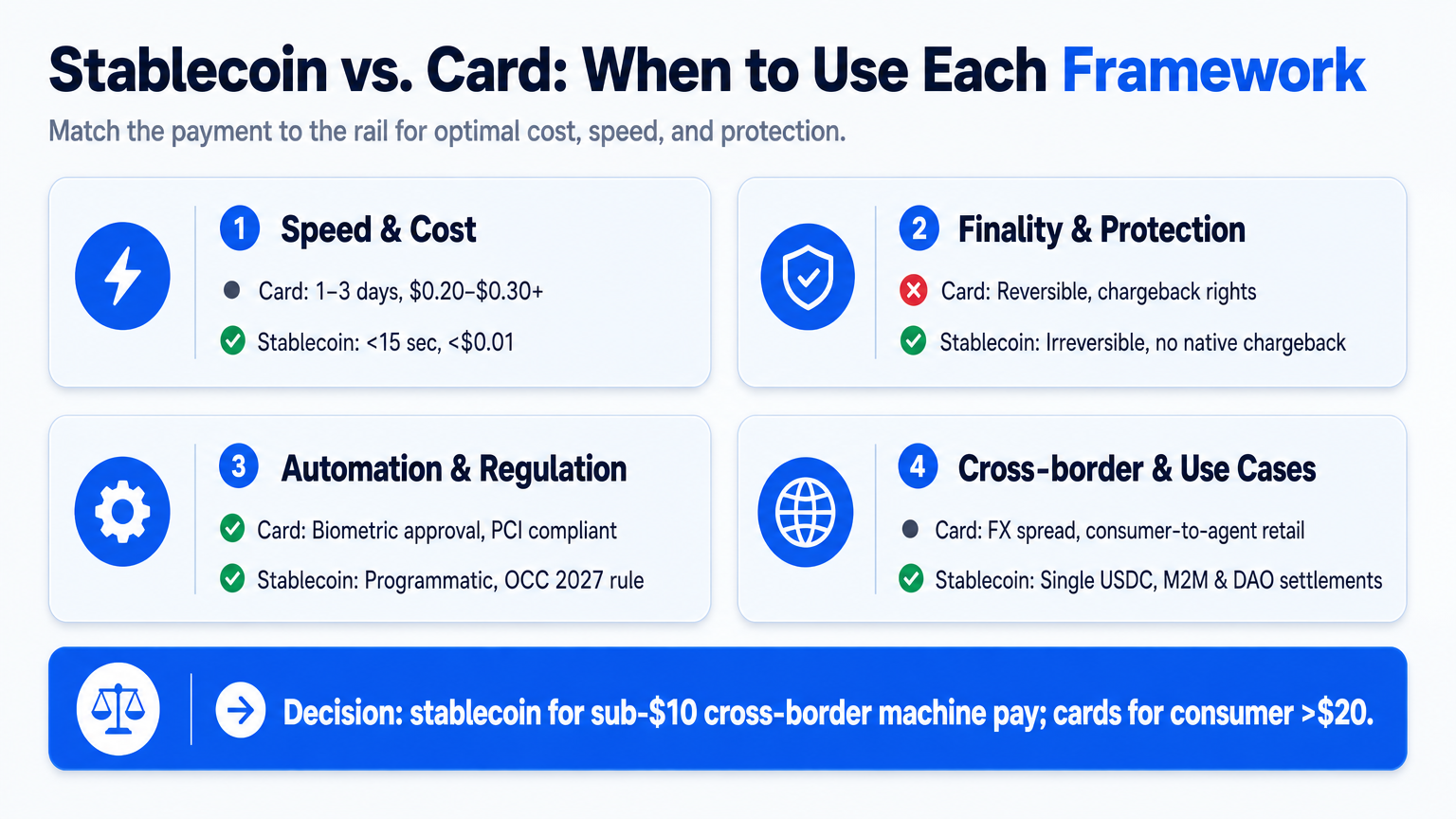
When to route through stablecoins vs. cards: a simple decision framework
Decision rule: use stablecoin settlement when the payment is sub-$10, machine-initiated, cross-border, and irreversible by design; use card tokenization when a consumer is the payer and value exceeds $20 or chargeback is legally required.
What does the ChatGPT Wallet integration tell us about the limits of stablecoin adoption today?
OpenAI’s reliance on card tokenization while ignoring stablecoins confirms that consumer-facing AI agents still lack a stablecoin regulatory and liability framework that payment networks are willing to underwrite at scale. Chargeback rights, fraud protection, and issuer-mediated disputes — native to card tokenization — are absent in USDC settlement, making cards the safer default for retail agent use cases until stablecoin payment networks mature.
How does Mastercard’s dual strategy affect the adoption of stablecoin payments?
By blessing both rails simultaneously, Mastercard removes the binary risk for enterprises. A corporate treasury team no longer has to bet on one infrastructure and hope the other doesn’t win. Instead, they can adopt stablecoin settlement for high-frequency, low-value, cross-border machine payments (via Agent Pay or similar x402 implementations) and continue to use card rails for consumer-checkout flows. This dual endorsement accelerates stablecoin adoption by lowering the perceived risk of building on-chain payment infrastructure, especially with the OCC final rule on stablecoin regulation taking effect in 2027.
Should my business use stablecoins or card rails for paying AI agents and other programmatic use cases?
If your DAO treasury needs to automatically compensate decentralized compute providers in near-real time, stablecoin settlement on Base is the only rail that makes sub-dollar micropayments economically viable — as proven by 138 million x402 transactions. If your business is deploying a consumer-facing agent that purchases goods on behalf of a user, card tokenization’s dispute framework is likely non-negotiable until stablecoin payment networks mature. In practice, many businesses will need both rails.
How can a business manage both fiat card payments and stablecoin settlements without fragmenting its treasury?
A single treasury platform that natively supports both fiat and crypto — with multi-currency fiat accounts and USDC, the ability to issue cards against fiat balances, and automated on-chain stablecoin payouts via smart contract integration — eliminates the forced either-or. Finance teams can route payments according to the decision framework above without juggling a bank, an exchange, and manual wires. A unified dashboard lets you receive USDC from AI agent protocols, instantly convert to fiat for payroll or vendor card payments, and issue spend-limit corporate cards to team members, all under one compliance umbrella.
Actionable steps for finance leads
- Audit upcoming agentic payment flows — classify by size, counterparty, and chargeback need.
- For sub-$10 cross-border agent payments, calculate the cost gap between cards and USDC on Base; stablecoin settlement often saves 50–200%.
- Pre-stage a USDC liquidity pool with a platform meeting OCC standards.
- Keep corporate cards for human-initiated expenses and any payments requiring chargeback protection.
What to watch next and open questions
- Will Visa and Amex launch stablecoin-native agent products, or force a fragmented standard?
- The GENIUS Act, EU MiCA payments chapter (2027), and potential state-level classification of AI agents as money transmitters.
- The OCC rule takes effect in 2027 but doesn’t yet explicitly address autonomous agent settlement — expect new guidance within 12 months.
- Interoperability: a common interface that treats card tokens and blockchain transactions as instances of the same payment event is needed to make dual-rail seamless.
Key Takeaways
- Mastercard’s simultaneous backing of card tokenization and stablecoin settlement means programmatic payments infrastructure must be dual-rail by design.
- For machine-initiated cross-border micropayments under $10, stablecoin settlement on Base is the only economically viable choice.
- A single platform unifying fiat card payments and stablecoin treasury eliminates the forced either-or.
- Monitor OCC’s 2027 rule and possible FinCEN guidance on agent liability by end-2027.
- Pre-stage a USDC pool and adopt conditional routing to capture on-chain savings without sacrificing consumer protection.
Ready to unify your fiat and stablecoin payment operations? Open an account with OneSafe and simplify how your business manages both worlds.
And while you optimize payment rails, Joyrise grows your organic traffic while you sleep: it analyzes your site and publishes SEO articles to Webflow, WordPress, or Shopify daily — your first article is written before you pay.
Further reading
Get started with Crypto in minutes!
Get started with Crypto effortlessly. OneSafe brings together your crypto and banking needs in one simple, powerful platform.