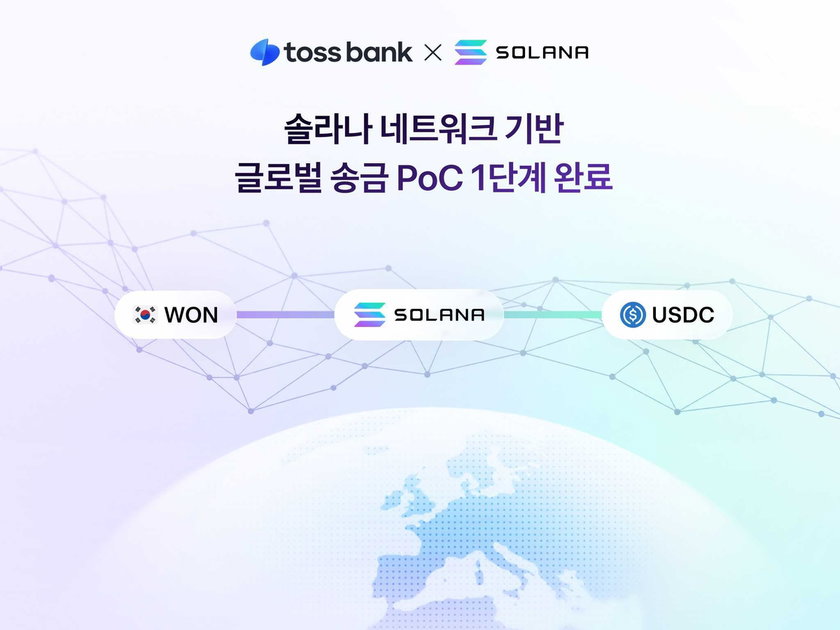
Toss Bank has completed a proof-of-concept for blockchain-based global remittances in collaboration with the Solana Foundation and Chainalysis. The project tested the entire process, from the remittance request to the arrival of funds in the recipient's wallet, utilizing the Solana network and the dollar-pegged stablecoin USDC, with final confirmation of the blockchain transactions taking only tens of seconds.
Testing the Entire Process to the Recipient Wallet
Toss Bank announced on the 16th that it had finished a proof-of-concept (PoC) for blockchain-based global remittances with the Solana Foundation and blockchain intelligence firm Chainalysis. This verification is the first joint project following the memorandum of understanding for ‘next-generation financial infrastructure cooperation based on blockchain’ signed last June.
The three organizations conducted an end-to-end test of the process where a Toss Bank customer's remittance request is delivered as funds to an overseas recipient's wallet, using the Solana blockchain network and the dollar stablecoin USDC. It took tens of seconds for the transactions to be finally confirmed on the blockchain.
Checking for Blockages of Sanctioned and High-Risk Addresses
Beyond speed, the verification included procedures for compliance with financial regulations. Toss Bank, together with Chainalysis, tested logic to automatically block transactions by identifying addresses on the U.S. Department of the Treasury's Office of Foreign Assets Control (OFAC) sanctions list and other high-risk addresses.
Because public blockchains are structured so that transaction and address activity are recorded publicly, related data can be analyzed and used for anti-money laundering (AML) and risk management procedures. This PoC examined whether compliance procedures function by integrating these analytical capabilities into the remittance flow.
Different Processing Standards from Conventional Overseas Remittances
Toss Bank currently provides overseas remittance services to 30 countries, including the United States, Canada, Australia, the United Kingdom, Singapore, Hong Kong, and European Union countries that use the euro. With existing account-based remittances, it can take additional time for funds to reach the actual recipient's account after a transfer is completed in the app, depending on the processing methods of the local receiving bank.
In this verification, the measurement focused on the time from the remittance request until the USDC reached and was finally confirmed in the wallet on the blockchain, rather than a recipient's bank account.
Technological Experiment Phase Before Commercial Service
These results represent a stage of testing the technical flow and compliance procedures of blockchain remittances. At the time of the agreement last June, Toss Bank and the Solana Foundation planned to first verify the technical feasibility of stablecoin remittances using the Solana network, then expand the scope to include linking with overseas partners and integrated verification of AML and Know Your Customer (KYC) processes.
Park Jin-hyun, Head of Strategy at Toss Bank, described this PoC as the first instance where an experiment applying blockchain-based digital financial infrastructure to Toss Bank’s financial services has led to tangible results. Lee Seong-san, Head of Solana Foundation Korea, stated that they aim to create a next-generation global remittance standard by combining the trust of traditional finance with the efficiency of blockchain.
Copyright © JKN. Unauthorized reproduction or redistribution prohibited.