A new study published November 8, 2026 by Economy.ac upends a core assumption behind the rise of stablecoin payments in emerging economies.
Table of Contents
- What Just Happened: The Economy.ac Study on Stablecoin Adoption
- Why This Matters for Global Businesses Right Now
- Stablecoin Payments 101: What Every Operator Needs to Know
- How to Act on These Insights Without Getting Trapped
- What to Watch Next in Stablecoin Payments
- Key Takeaways
What Just Happened: The Economy.ac Study on Stablecoin Adoption
The Nov. 8 research at a glance
The Economy.ac review examines transaction patterns across several emerging economies where stablecoin usage has surged. By analyzing on-chain flows and local financial data, the authors document that stablecoins are filling gaps left by weak local banking, high inflation, and restricted access to dollars. Yet the core economic mechanism is not the creation of new investment or output. Instead, users move existing fiat into stablecoins to store value, send remittances, or make payments, and then convert back to local currency when needed. The dollars at the center of these transactions are already in circulation; the stablecoin merely changes their form and location temporarily.
Key finding: stablecoins move existing dollars, don’t create new value
The study’s central finding matters for any business accepting or paying with stablecoins: stablecoin adoption does not, by itself, generate new economic activity in the sender’s or receiver’s local economy. Think of a freelancer in Argentina who receives USDC and immediately off-ramps to pesos to pay rent. The dollars existed before the transfer, and after the transfer they are gone from the local crypto ecosystem. The productivity gain is only the reduction in friction—faster, cheaper settlement—but no net new capital enters the system. For global businesses, that means stablecoin rails are a better conduit, not a magic growth engine.
Why This Matters for Global Businesses Right Now
The promise of stablecoin payments still rests on speed and cost
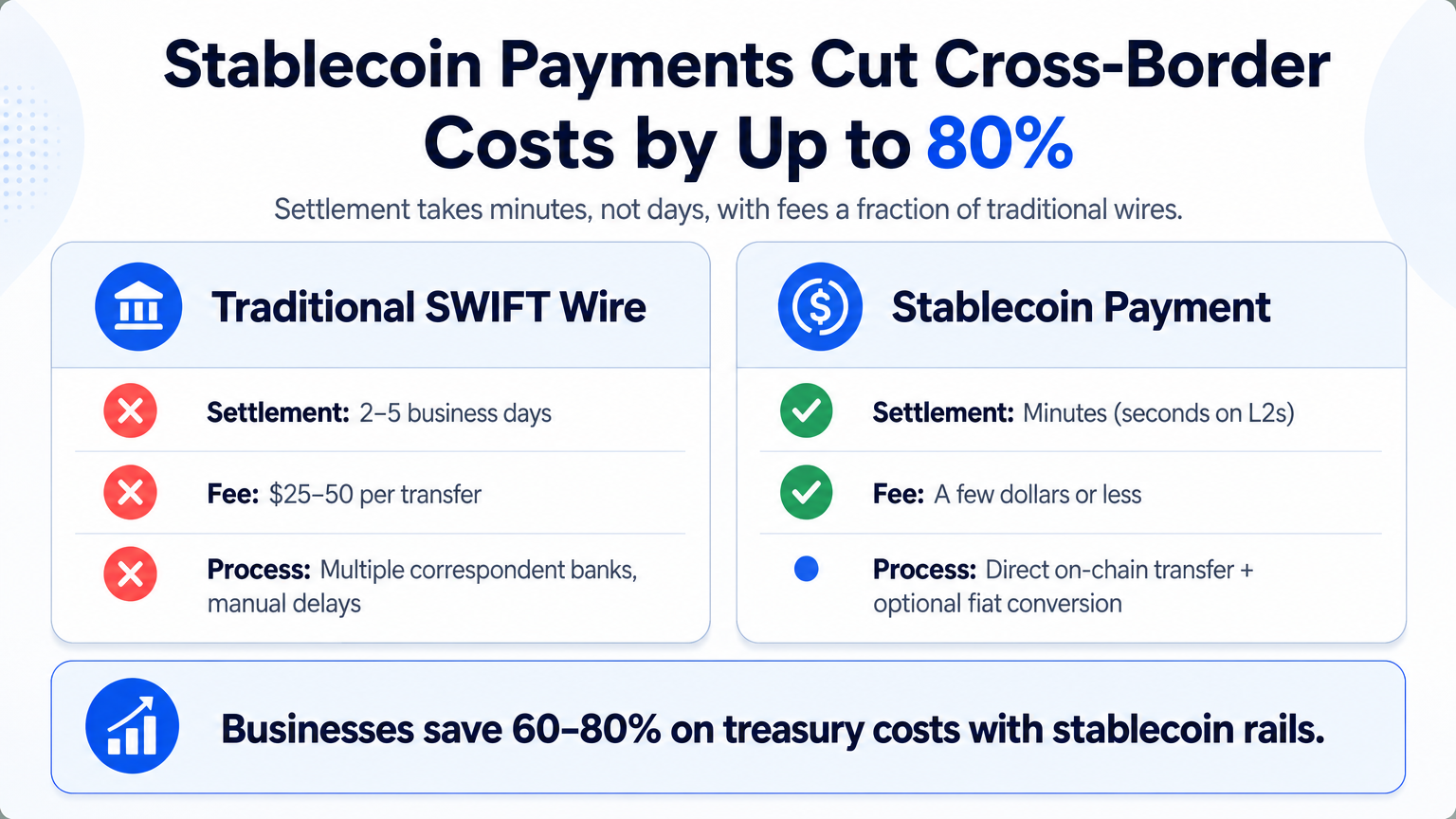
None of this erases the operational gains that make stablecoin payments attractive. Cross-border stablecoin payments settle in minutes, cost cents rather than SWIFT’s $25–50, and eliminate correspondent-bank delays. That’s why business stablecoin payments have grown rapidly among startups, Web3 companies, and DAOs paying international contractors. But the redistribution-only pattern forces a hard question: if stablecoins merely shuttle existing dollars around, what happens when your business needs to convert those stablecoins into local fiat to pay a landlord, a tax authority, or a supplier who only accepts bank transfers?
Redistribution-only flows expose businesses to closed-loop risk
The answer is closed-loop risk. A company that treats stablecoins as a standalone treasury and payment rail, without a direct connection to local fiat banking, ends up cycling dollars within a crypto-native bubble. It can pay another entity willing to hold USDC, but struggles to discharge real-world obligations that demand local-currency settlement. The Economy.ac finding sharpens this warning: in markets where stablecoin usage is high but purely redistributive, an over-reiance on stablecoins without integrated fiat rails can leave a business unable to tap the broader financial system when it matters most. That’s the difference between a payment tool that saves money and one that becomes an operational bottleneck.
Stablecoin Payments 101: What Every Operator Needs to Know
What are stablecoin payments?
Stablecoin payments are transactions where the transfer of value is denominated in a cryptocurrency pegged to a fiat currency, almost always the US dollar. The payer and payee agree to a stablecoin (e.g., USDC, USDT), and the payment moves across a blockchain. It combines the programmability and speed of crypto with the price stability of fiat.
How do stablecoin payment flows and settlement mechanics work?
A typical flow: the sender initiates an on-chain transfer from a wallet, the transaction is confirmed by the network (often in seconds), and the recipient’s wallet reflects the funds. For stablecoin settlement into a bank account, a third-party processor or an integrated platform converts the stablecoin to fiat and deposits it into the recipient’s account via local rails like ACH or SEPA. The process can be automated so that the end user only sees a fiat balance credited within minutes, not days.
What technologies enable stablecoin payment acceptance?
Businesses can accept stablecoins through dedicated stablecoin payment processing gateways, APIs, or embedded widgets that handle conversion and compliance checks. Processors like those compared by Eco provide out-of-the-box solutions, while a gateway as defined by Crossmint enables merchants to add stablecoin acceptance to a checkout flow. Underlying all of them are smart contracts, custodial or non-custodial wallets, and liquidity providers that ensure instant fiat settlement where needed.
How do stablecoin payments improve speed and cost efficiency?
On-chain settlement takes minutes (or seconds for modern L2s) versus the 2–5 business days typical of SWIFT wires. Fees average a few dollars or less, regardless of amount, while correspondent-bank fees regularly hit $25–50 per wire. This is why global business payments in stablecoins can reduce treasury costs by 60–80% for frequent, cross-border transfers, as Circle’s analysis has documented.
What obstacles limit broader stablecoin payment adoption?
Regulatory uncertainty remains the top barrier. The BIS has outlined considerations for cross-border use, but local licensing, reserve requirements, and anti-money-laundering rules differ wildly—as seen in the recent Florida stablecoin regulation debates. Additionally, fragmented on/off-ramp infrastructure means a business often needs multiple accounts just to move between stablecoins and local fiat. And as the Economy.ac finding makes clear, the lack of net new economic activity can reduce the incentive for local banks and regulators to build the missing connectivity.
How to Act on These Insights Without Getting Trapped
Don’t treat stablecoins as an isolated rail—integrate fiat from day one
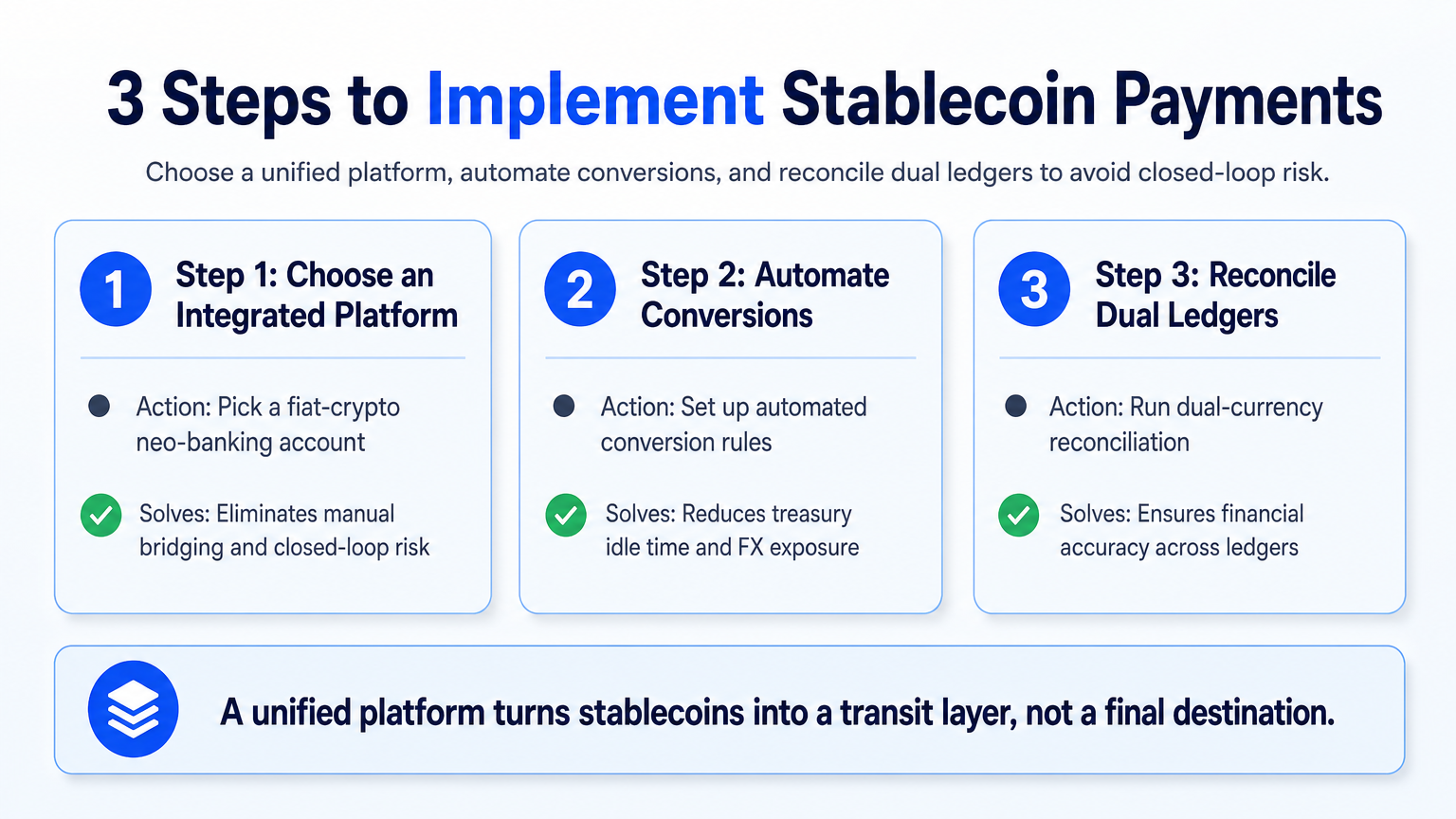
The single most actionable takeaway for any business using stablecoin payments is to avoid a wallet-only setup. Accepting USDC into a non-custodial wallet without a direct pipeline to a fiat bank account leaves you with a pile of digital dollars you cannot easily spend. Instead, treat stablecoins as a fast transit layer, not a final destination. A unified platform that connects fiat-to-crypto payments with domestic wire, ACH, and FX capabilities ensures that every stablecoin received can be converted and settled in the local currency of your choice without delay.
What a unified fiat-crypto platform does that a wallet-only approach cannot
A platform that natively integrates both fiat and crypto accounts (such as a neo-banking service built for global businesses) eliminates the fragmentation at the center of the redistribution problem. It lets you:
- Receive stablecoin payments and automatically convert them to USD, EUR, or CAD.
- Pay local vendors in their local currency via wire or ACH, using stablecoin liquidity on the back end.
- Hold multi-currency balances for different operating jurisdictions without opening a separate bank account in each country.
This architecture directly addresses closed-loop risk, because the stablecoin never needs to sit idle. It’s a pass-through to the fiat rails your real-world operations depend on. For example, OneSafe’s model—combining crypto on/off-ramps, multi-currency accounts, and corporate cards in a single account—illustrates how a business can run global payments without leaving dollars stranded on-chain. The result is a global business payments stack that works with the redistribution reality, not against it.
The DAO and Web3 startup use case: payroll, vendor payouts, treasury management
Decentralized organizations and startups face the redistribution challenge acutely. A DAO might hold a treasury in stablecoins and need to pay contributors in five different countries. Without a native fiat integration, that means manually bridging to an exchange, converting, and then sending separate wires—slow and expensive. A unified platform streamlines DAO payments and crypto treasury management by enabling batch payroll in local currencies, automated vendor payments, and real-time visibility across fiat and crypto balances. For Web3 startups, the same logic extends to managing marketing spend, paying cloud bills, and handling investor distributions in fiat—all from one system that treats stablecoins as a liquidity tool, not a standalone vault. (For more on DAO treasury safety, see Crypto Banking Alert: MEXC Ban and What It Means for Your DAO.)
How can businesses implement and manage stablecoin payments?
A practical framework in three steps:
Choose an integrated platform, not a patchwork.
Onboard with a service that provides both fiat bank accounts (in your required currencies) and native stablecoin wallets, so you don’t have to manually shuffle funds between a crypto exchange and a bank.Set up automated conversion rules.
Configure real-time or scheduled conversion from received stablecoins into fiat balances, and vice versa when making cross-border payments. This keeps working capital where it’s needed without manual intervention.Run a dual-currency reconciliation process.
Because on-chain and fiat ledgers settle at different speeds, implement a reconciliation workflow that matches every stablecoin deposit with its corresponding fiat credit. This is where stablecoin settlement tracking becomes critical for audit readiness and compliance.
Choose an integrated platform, not a patchwork.
Onboard with a service that provides both fiat bank accounts (in your required currencies) and native stablecoin wallets, so you don’t have to manually shuffle funds between a crypto exchange and a bank.
Set up automated conversion rules.
Configure real-time or scheduled conversion from received stablecoins into fiat balances, and vice versa when making cross-border payments. This keeps working capital where it’s needed without manual intervention.
Run a dual-currency reconciliation process.
Because on-chain and fiat ledgers settle at different speeds, implement a reconciliation workflow that matches every stablecoin deposit with its corresponding fiat credit. This is where stablecoin settlement tracking becomes critical for audit readiness and compliance.
What to Watch Next in Stablecoin Payments
Regulatory clarity and its implications for real-economy use
Regulators are moving. Recent licensing frameworks in Nigeria (see Stablecoin Payments: Nigeria’s New Licensing Rules) signal a shift from permissive gray zones to structured oversight. That could bring the local-bank integrations necessary to move stablecoins from redistribution circuits into productive credit and investment. Watch for similar frameworks in other emerging economies over the coming year, as well as US federal guidance that might finally distinguish payment stablecoins from speculative assets.
The shift from peripheral redistribution to on-chain-native value creation
The Economy.ac study ends with a question: When will stablecoins generate new output instead of just moving existing dollars? The answer likely lies in crypto treasury management products that allow stablecoin holders to earn yield, supply liquidity to real-world lending pools, or collateralize trade finance—activities that create new economic value. As stablecoin payment processors add yield-bearing options and as on-chain credit markets mature, the redistribution narrative could evolve. Businesses should track these developments closely, because the first platforms that bridge stablecoin payments with productive on-chain finance will solve the very fragmentation the study describes. (For a wider view of how mainstream adoption could reshape treasury, see Samsung’s Stablecoin Payments Play: What It Means for Business.)
Key Takeaways
- The November 2026 Economy.ac study confirms that stablecoin payments in emerging markets primarily redistribute existing dollars rather than create new economic output, which means businesses must integrate stablecoins with local fiat rails to avoid closed-loop dependency.
- Speed and cost advantages of stablecoin settlement remain compelling, but the real operational win comes from instant fiat conversion and automated cross-border payment workflows, not from holding stablecoins in isolation.
- A unified fiat-crypto platform that handles payroll, vendor payments, and multi-currency treasury eliminates the fragmentation that a wallet-only approach introduces, turning stablecoins into a transit layer instead of a dead end.
- DAOs and global startups should prioritize dao payments and treasury setups where stablecoin liquidity automatically feeds fiat obligations, reducing manual reconciliation and exposure to on/off-ramp friction.
- Watch for regulatory frameworks and on-chain yield products that could transform stablecoin usage from redistribution into genuine economic expansion, and position your infrastructure to capture that shift early.
To keep your team informed on evolving payment structures without writing daily content yourself, consider Joyrise: your blog, written and published every day: Joyrise plans, writes and publishes illustrated SEO articles to your Webflow blog every day. Read your first article before you pay.
For a financial platform that delivers the unified fiat-crypto operations recommended in this analysis, open an account with OneSafe and start moving money across borders without the fragmentation.
Get started with Business in minutes!
Get started with Business effortlessly. OneSafe brings together your crypto and banking needs in one simple, powerful platform.