tBTC Security Pause: No BTC Lost, Yet the Bridge Remains Halted Today
Threshold Network has confirmed that its Bitcoin-backed token remains fully backed, even as the tBTC security pause continues on the bridge that creates and redeems it.
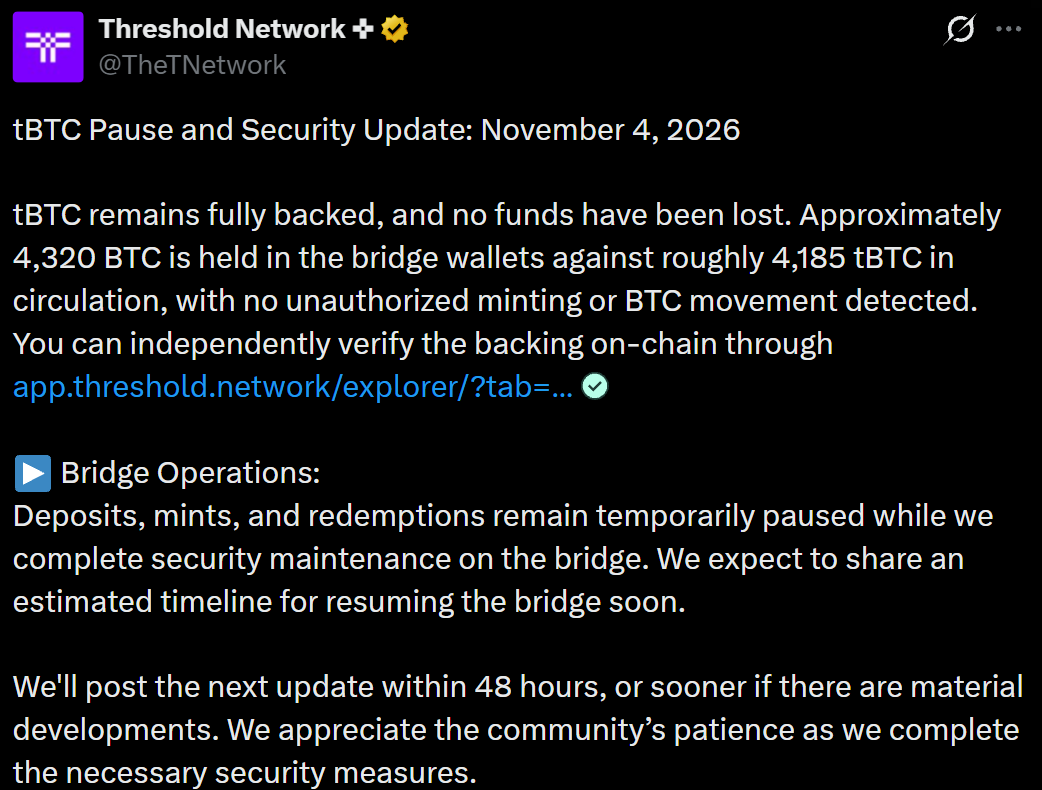
In its November 4 update, the team said no funds have been lost, while deposits, mints, and redemptions stay temporarily stopped during security maintenance.
What the Team Announced on November 4
The latest notice says reserves in the bridge wallets exceed the token supply and that no unauthorized minting or BTC movement has been detected.
The project also said it expects to share an estimated timeline for resuming the bridge soon, with the next update due within 48 hours, or sooner if material developments appear.
The halt itself began earlier. According to the October 31 update thread, the team had stopped new BTC deposits, minting, and new Bitcoin redemption requests through its app as a precaution while security maintenance was completed.
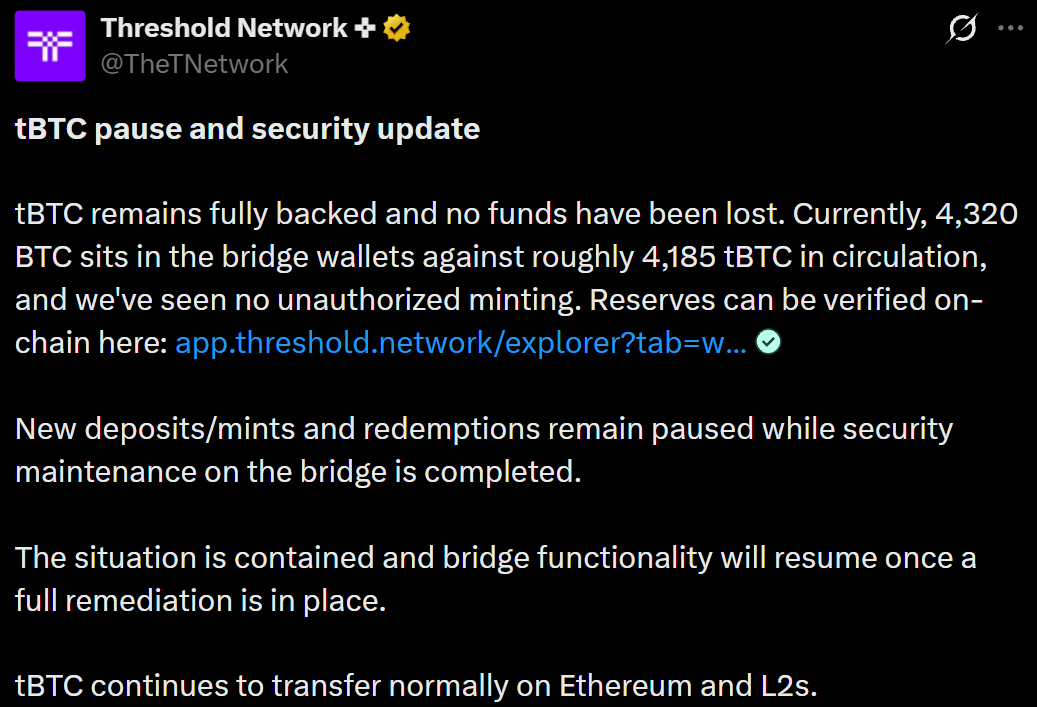
In short, the tBTC security pause is a temporary stop on new activity, not a reported loss of funds.
Here is the sequence of official updates:
Date
What the team said
Oct 30, 2026
New deposits, minting, and redemption requests paused as a precaution.
Oct 31, 2026
Fully backed; no funds lost; about 4,320 BTC held against about 4,185 tokens
Nov 1, 2026
Node operators patched or shut down servers; a separate small incident was disclosed.
Nov 4, 2026
Halt continues; no unauthorized minting or movement; timeline coming soon.
Reserves Check: Is the Token Really Backed?
Backing is the central question during any bridge stoppage. The published numbers point to a small surplus, and anyone can check the wallets on the official explorer instead of simply trusting a social post.
That is the strongest answer a bridge can give: public, on-chain proof that users can examine themselves.
Metric
Figure
BTC in bridge wallets
About 4,320
Tokens in circulation
About 4,185
Difference (our calculation)
About 135 BTC
Backing ratio (our calculation)
About 103%
Unauthorized minting
None detected
Unauthorized BTC movement
None detected
These are approximate snapshots taken from the project’s own statements, and live wallet balances can change as activity continues.
Why Node Operators Took Precautions
In a follow-up post, the team pointed to a recently disclosed Linux kernel flaw, CVE-2026-98432, which can allow remote code execution on unpatched servers.
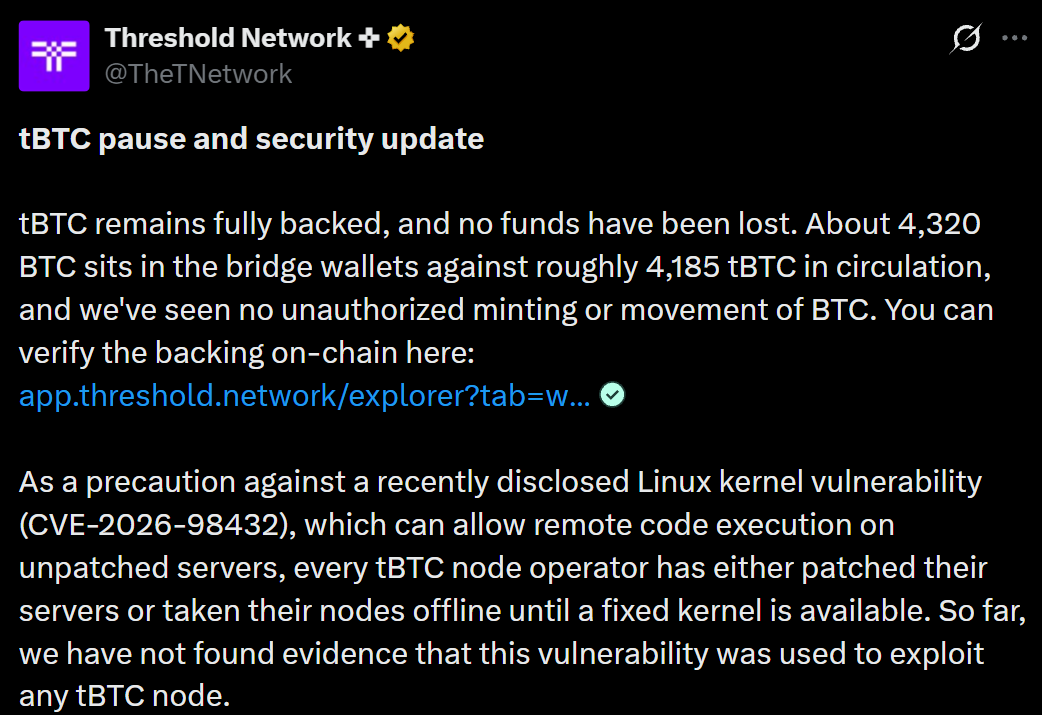
Every node operator, it said, had either patched its servers or taken nodes offline until a fixed kernel is available.
The team added that it had found no evidence the flaw was used against any node.
A flaw of this type matters because attackers could run commands on a server without physical access, so operators chose caution over speed.
A separate incident was also disclosed:
-
One operator reported a breach in its broader infrastructure
-
The Ethereum account its node uses to pay fees lost about 0.5 ETH
-
The project described it as unrelated to the kernel flaw
One operator reported a breach in its broader infrastructure
The Ethereum account its node uses to pay fees lost about 0.5 ETH
The project described it as unrelated to the kernel flaw
Neither disclosure explains every detail behind the maintenance work, and the November 4 update gives no further technical specifics.
For readers, the key point is simple: the stated issue concerns operator servers, not any reported loss of Bitcoin.
How the Bridge Is Designed to Protect Bitcoin
The network documentation describes the token as a tokenized Bitcoin built on threshold cryptography and secured by a rotating network of independent node operators, so no single entity can act alone on funds.
The tBTC v2 repository adds that wallets are managed by randomly selected operator groups, starting at 51-of-100 signing thresholds.
In plain terms, a large majority of operators must agree before Bitcoin moves.
This is why the security posture of each operator matters so much and why the team acted on server risk first.
Think of it like a vault needing many keyholders: the vault stays safe only if enough keyholders stay safe.
What Holders and Users Should Know Now
Based on the official posts, here is the current situation:
-
New BTC deposits and minting are paused
-
New redemption requests are paused
-
The first notice said pending redemptions may still be paid on Bitcoin
-
No restart date has been announced yet
-
The next update is promised within 48 hours
-
Reserve data can be checked on the explorer at any time
New BTC deposits and minting are paused
New redemption requests are paused
The first notice said pending redemptions may still be paid on Bitcoin
No restart date has been announced yet
The next update is promised within 48 hours
Reserve data can be checked on the explorer at any time
Anyone following this tBTC security pause should rely on verified channels and the on-chain explorer and treat unofficial restart claims with caution.
Users holding the token on other networks should also watch liquidity conditions, since a stopped redemption route can affect how easily the token swaps back to Bitcoin.
Nothing here is investment advice, and price effects remain uncertain.
Conclusion
The tBTC security pause is described as a precaution, and the latest figures show more BTC held than tokens issued.
The open questions are timing and technical detail: when operators finish maintenance and when the bridge reopens.
The team has not yet shared a restart estimate, so any date seen elsewhere is unconfirmed.
Until the next update arrives, verified reserves and official announcements remain the best guide for anyone affected.
Disclaimer
This article is for educational and informational purposes only and is not financial or investment advice. Crypto assets are high risk, their prices can be very volatile, and you can lose some or all of your money. Always do your own research and consider speaking with a licensed financial advisor before making investment decisions.
About the Author Bablu Singh Nirwan
English Blog Writer at coingabbar.com
Bablu Singh Nirwan is a Content Writer with 6 months of experience covering blockchain, cryptocurrency, Web3, and digital finance. He specializes in researching emerging trends, simplifying complex topics, and creating SEO-optimized content. His work focuses on clarity, accuracy, and engaging insights that keep readers informed about the evolving crypto industry.
Frequently Asked Questions (FAQ)