US producer inflation data due Friday morning has become the next test for markets already pricing a near-certain Federal Reserve rate increase in December, with Bitcoin trading below $70,000, gold having lost the $4,100-an-ounce level and technology shares wobbling on renewed volatility.
The Bureau of Labor Statistics will release the October Producer Price Index at 8:30 a.m. Eastern Time. Economists surveyed ahead of the print expect headline producer prices to have risen 0.4% from September, a sharp deceleration from the prior month's 1.3% jump, which was the largest monthly gain since March 2022. Core PPI, which strips out food and energy, is forecast at 0.3%, down from 0.7%.
Even with the slower monthly pace, the year-over-year headline rate is expected to accelerate to 6.6% from 6.3%, while core annual producer inflation is seen holding at 5%. The report lands two days after consumer price data showed October CPI climbing 0.4% month over month, above the 0.3% consensus, with core CPI up 0.3% against expectations of 0.2%.
That sticky reading did more than nudge the headline numbers. It reset the conversation around the Fed's policy path. Fed funds futures now imply roughly an 88% chance of a quarter-point increase at the December meeting, with the residual probability pointing to a half-point move, according to CME Group's FedWatch tool. Hawkish comments from Fed officials have reinforced that pricing.
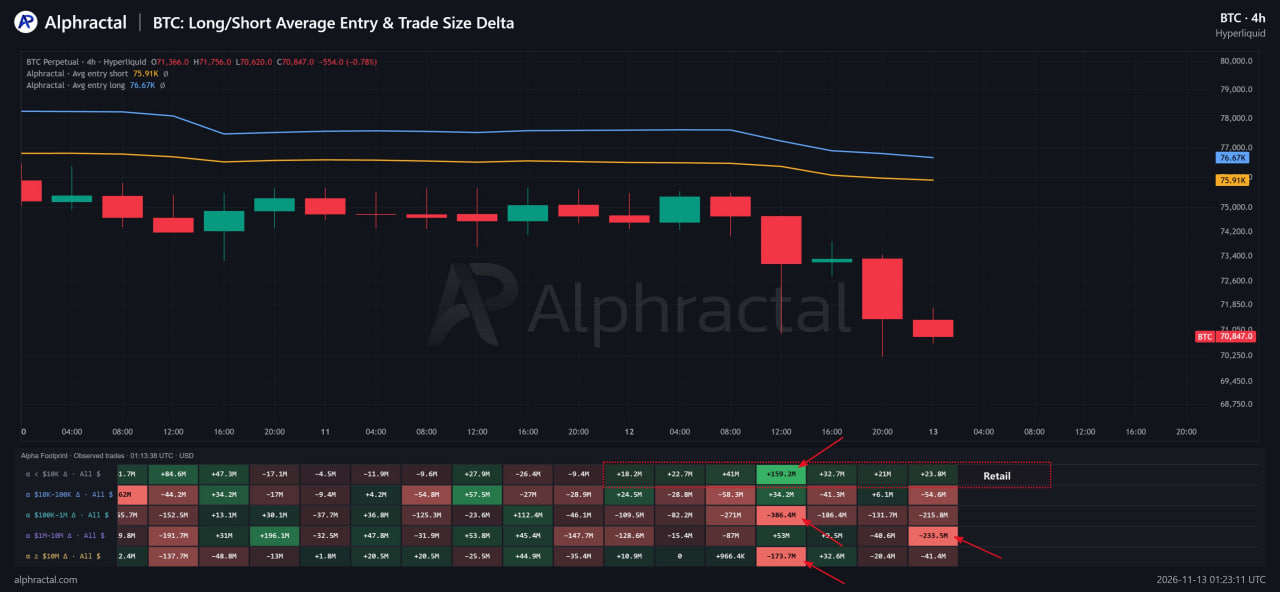
The stakes are highest for assets whose valuations hinge on the discount rate. Bitcoin has already slid under $70,000 as leveraged selling, institutional outflows and tighter financial conditions sap demand for speculative holdings. The cryptocurrency's retreat came after a warning over more than $50 billion in futures exposure that had raised fears of cascading liquidations. Ethereum has faced similar pressure, with exchange-traded fund withdrawals totaling $144.8 million.
A hot PPI print would likely reinforce the case for higher rates, pressuring digital assets through a firmer dollar and reduced appetite for risk. A soft number, by contrast, could offer a brief reprieve by easing immediate pressure on rate expectations.
Gold presents a different set of sensitivities. The metal has struggled even with geopolitical tensions running high, breaking below $3,900 an ounce earlier as rising Treasury yields lifted the opportunity cost of holding a non-yielding asset. A stronger dollar adds a second channel of pressure by raising the cost of bullion for buyers outside the United States.
Goldman Sachs analysts cut their price targets in recent days, lowering the end-2026 forecast to $4,150 an ounce from $4,650 and the end-2027 view to $4,800 from $5,400, citing the Fed's shift toward a more hawkish stance. The bank's research also cautioned that early-stage equity drawdowns can force investors to sell gold to raise cash, though it said structural central-bank buying should continue to underpin prices, with private wealth and long-term investors potentially treating bullion as a hedge against fiscal sustainability risks.
UBS strategists take a more constructive view, forecasting $4,600 an ounce by the end of 2026 and arguing that rate pressure is a short-term disturbance rather than a change in the structural case built on high debt loads, a weaker dollar outlook, geopolitical risk and official-sector purchases.
Those purchases remain substantial. The World Gold Council reported that central banks and other official institutions added 321 metric tons of gold in the third quarter, up 42% year over year and the largest quarterly increase since the fourth quarter of 2024. Physical gold ETFs took in 211 tons over the same period, lifting total holdings to a record 4,256 tons and reversing second-quarter outflows.
Flows into Chinese gold-themed funds tell a more mixed short-term story. In the fourth quarter through Nov. 10, 14 such ETFs drew a combined 4.25 billion yuan (approximately $638.0 million) in net inflows, though the money split sharply: Guotai Gold ETF attracted more than 2.2 billion yuan (approximately $330.3 million) while Huaan Gold ETF saw more than 800 million yuan (approximately $120.1 million) leave. Huaan's fund recorded outflows on 12 of 13 trading sessions starting Oct. 23. Over the full third quarter, gold-themed ETFs in China still pulled in 26.733 billion yuan (approximately $4.0 billion).
Equities carry their own exposure to Friday's number. The Nasdaq has been volatile following a leadership crisis at Nvidia (NVDA), which has clouded the outlook for AI semiconductor and infrastructure companies. Higher yields weigh on growth-stock valuations by shrinking the present value of future earnings, a particular concern for technology firms that rely on expensive financing to build out AI capacity. Wall Street's recent recovery attempts have already been knocked back by inflation worries, leaving investors primed to react to another upside surprise.
Market participants are split on whether one data point changes the trajectory. Chris Zaccarelli, chief investment officer at Northlight Asset Management, said that while a December hike is his base case, the latest inflation figures have pushed the possibility of another increase in January 2027 into the market discussion. If investors begin to price sustained tightening rather than a single meeting, the pressure on gold and other rate-sensitive assets would reflect a shift in the expected policy path rather than a one-off bout of volatility.
Others counsel patience. A fund manager at a state-owned asset manager, speaking on condition of anonymity, said the CPI surprise is bearish for gold in the near term but that any judgment on a trend reversal requires watching real yields, the dollar and global investment demand rather than extrapolating from a single report. A representative of UBS SDIC Fund Management said short-term swings are likely unavoidable even if hike expectations firm further, and that the durability of gold's resilience depends on real rates and safe-haven demand.
For now, positioning data suggest investors are not abandoning the longer-term case. The combination of official-sector buying, record ETF holdings and forecasts that still sit well above current prices gives gold a structural bid beneath a market that is, for the moment, trading the Fed.