On November 5, 2026, Reuters reported that a hack on the Binance exchange had prompted U.S. regulators to check in on bank systems — an unusual move that signals the link between centralized exchanges and the traditional banking rails is now under active scrutiny. For the Web3 startups, DAOs, and global businesses that depend on crypto banking platforms to manage fiat and digital assets in one place, the immediate question isn’t about Binance. It’s: Does my provider isolate my operating funds from exchange counterparty risk? This article separates alarm from action, giving finance leads a concrete due‑diligence framework to run right now.
Table of Contents
- What Just Happened
- Why This Changes Crypto Banking
- What Startups and DAOs Should Do This Week
- How Quickly Can You Onboard?
- What to Watch Next
- Key Takeaways
- Sources
What Just Happened
According to the Reuters exclusive, a significant hack at Binance prompted U.S. regulators to check in on bank systems with exposure to crypto firms. The scale of the breach wasn’t detailed, but the direction is critical: regulators are tracing the thread from an exchange breach to the banking infrastructure that crypto businesses rely on every day. A hacked exchange is now seen not just as a consumer-protection failure but as a potential threat to the banks that process wires, ACH, and fiat-currency flows for crypto entities. If a compromised exchange funnels stolen funds through a partner bank, that bank could face AML, capital, or reputational exposure. For any business using a crypto banking platform, this means your provider’s banking partners are now under heightened due diligence — and your operating funds could be at risk if the provider commingles assets on exchanges.
Why This Changes Crypto Banking
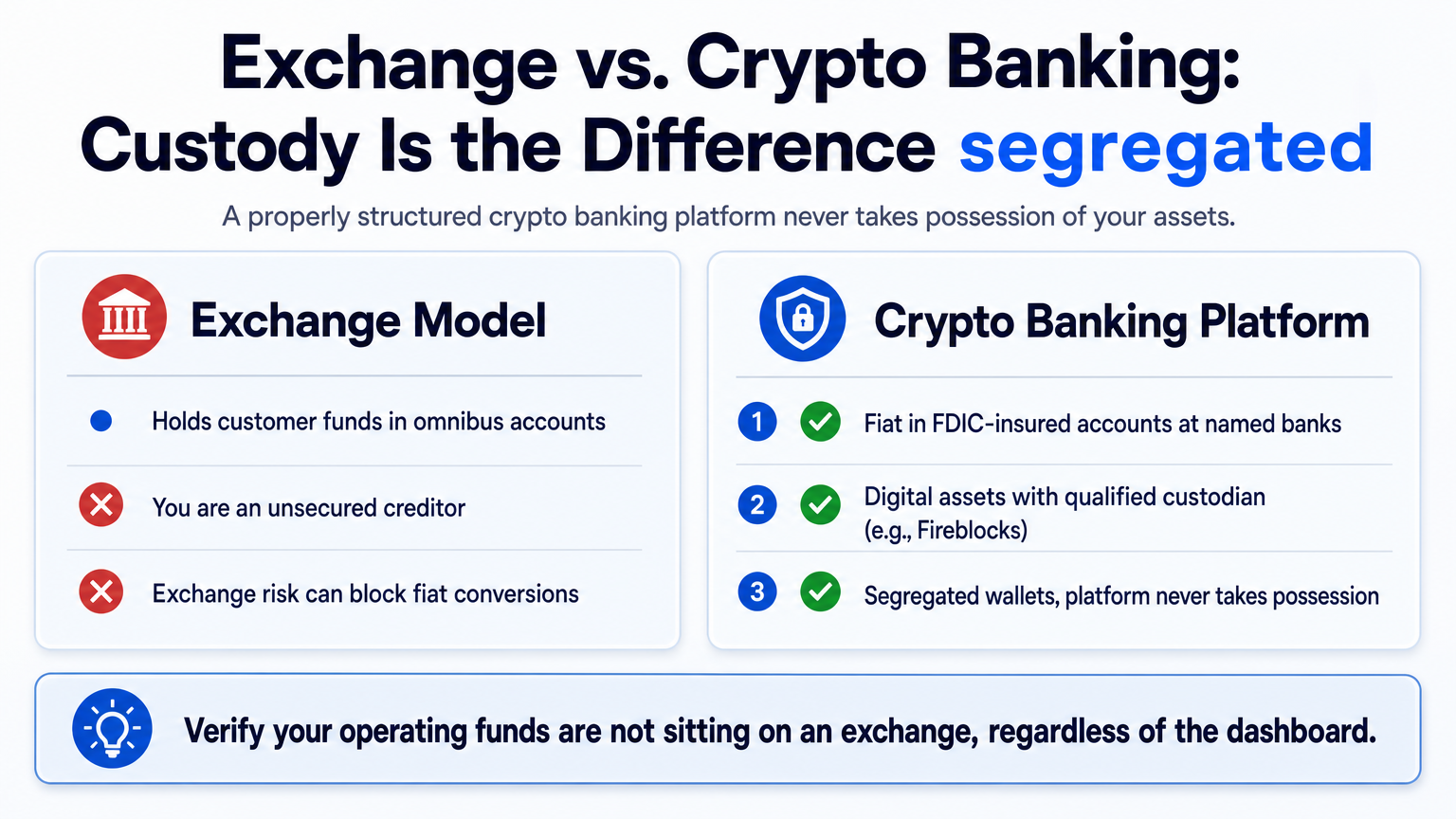
A crypto banking platform is fundamentally different from an exchange. An exchange matches buyers and sellers and typically holds customer funds in omnibus accounts, making you an unsecured creditor. In contrast, a properly structured crypto banking platform never takes possession of your assets. It layers technology on top of licensed banks and qualified custodians: your fiat sits in FDIC‑insured accounts at named partner banks, while digital assets are held with a qualified custodian (for example, Fireblocks) in segregated wallets. The platform provides the interface for payments, conversions, and compliance — but the actual custody lies with regulated institutions, insulating your operating capital from an exchange’s failure.
The Binance hack is an exchange risk event. However, if your “crypto banking” provider uses exchange‑based treasuries for USDC on‑ramp off‑ramp, even a partial freeze could block your fiat conversion and delay payroll. The immediate safe move is to verify that your operating and payroll balances are not sitting on an exchange, no matter what the front‑end dashboard suggests.
Are crypto assets safe with a neo-banking platform?
Safety depends entirely on the custody model. When digital assets are held with a qualified custodian like Fireblocks and your organization controls the keys through permissioned MPC wallets, you are protected against platform insolvency and insider theft. But “safe” does not mean risk‑free: stablecoins carry peg and smart‑contract risk, and regulatory uncertainty remains. The distinction to make is between custody security and market risk — a platform can protect your access to assets without erasing the assets’ volatility. For operating capital, institution‑grade custody with mandatory MFA is materially safer than an exchange account.
The new questions every finance lead should ask:
- Which exact, named bank partners hold our fiat?
- Where are our digital assets held at rest — a qualified custodian, or an exchange wallet?
- Has the platform ever held customer assets on a centralized exchange, even temporarily, for liquidity or USDC conversion?
- What was the platform’s direct or indirect exposure to Binance, and has it been wound down?
These are no longer annual due‑diligence items; they are urgent.
What Startups and DAOs Should Do This Week
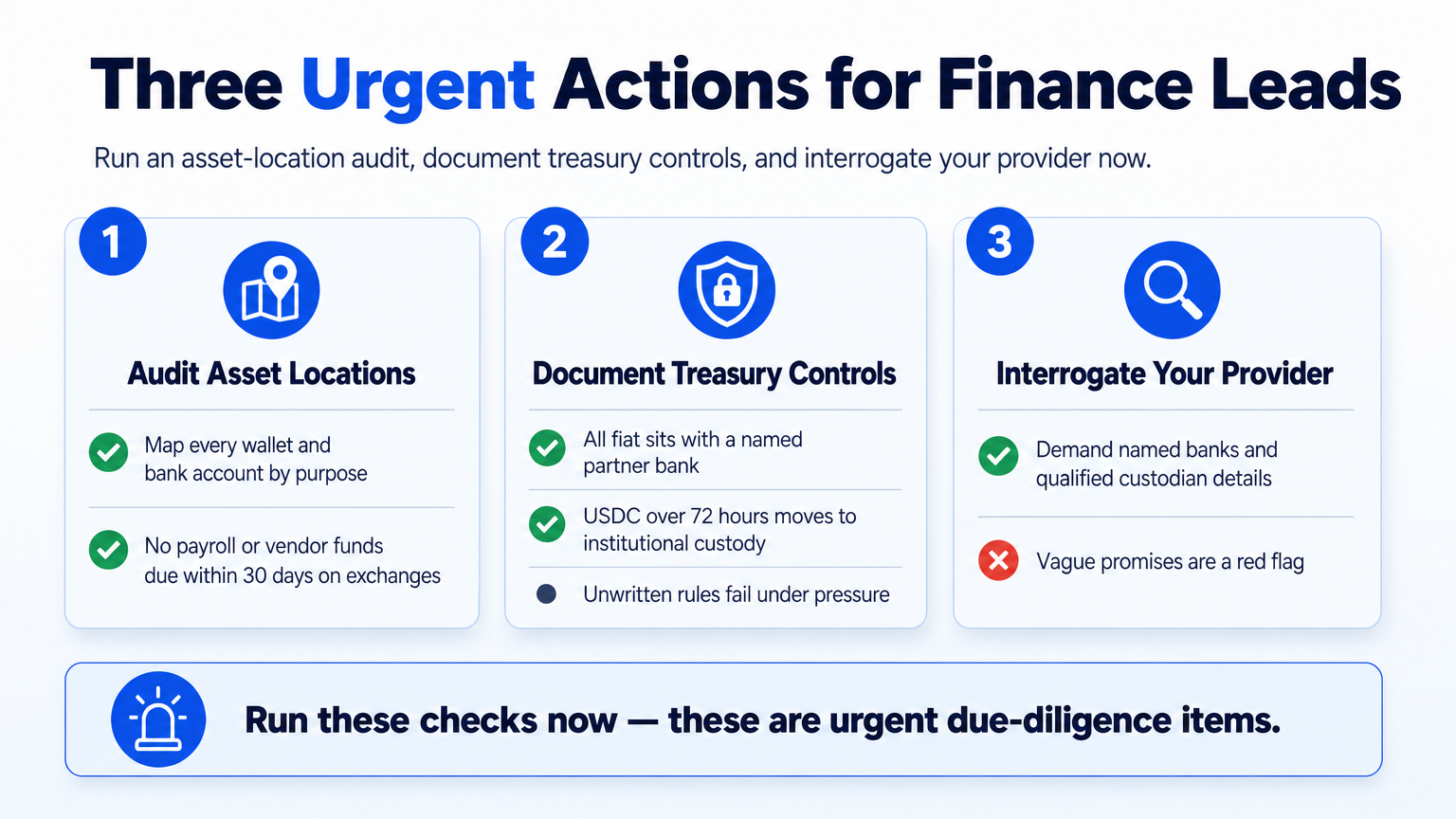
Run an asset‑location audit. Map every wallet and bank account by purpose (payroll, vendor payments, trading, idle treasury). For any balance needed for near‑term expenses, confirm the funds aren’t in an exchange‑controlled address. At minimum, no payroll or vendor payment funds due within 30 days should sit on a centralized exchange.
Document treasury controls. Formalize a policy: all fiat sits with a named partner bank; any USDC held for more than 72 hours moves to your institutional custody account. An unwritten rule fails under pressure.
Interrogate your provider. After the Binance bank‑system check‑in, your crypto banking platform must answer these questions with specifics — vague promises are a red flag.
For DAOs specifically. The safest architecture is a two‑layer setup: a crypto banking platform for fiat operations (payroll, vendor payments, corporate cards) and on‑chain multisigs like Safe for long‑term treasury. Sweep only the needed operating funds to the platform. Use the platform’s built‑in role‑based controls — for example, OneSafe includes customizable permissions for DAO treasury management — to enforce spending limits without manual oversight. This isolates the bulk of the treasury from any single platform’s operational risk.
How Quickly Can You Onboard?
A mature crypto banking platform can complete KYB onboarding within a week — sometimes starting the application in under 10 minutes — because the process is digital and built for international businesses. That’s far faster than opening a traditional multi‑currency account. But speed does not replace the due diligence above. Use the first week to ask the custody and banking‑partner questions while you upload formation documents. Confirm fee transparency (e.g., transparent fiat deposit fees, free USDC deposits/withdrawals, corporate cards with clear spend limits) before committing.
What to Watch Next
The November 5 regulator check‑ins mark a paradigm shift: exchange hacks now trigger banking‑infrastructure reviews. Expect partner banks to demand attestations that customer assets are never commingled with exchange holdings and that USDC on/off‑ramps have fallback liquidity providers. Platforms that can demonstrate clean segregation and transparent banking relationships — as we explored in our analysis of the OCC’s stablecoin path for crypto banking — will be best positioned as regulation tightens.
In the coming weeks, watch for any joint statement from federal banking agencies or state regulators clarifying the expectations set during the Binance inquiry. Banks may begin to limit the types of crypto businesses they serve, shrinking the partner pool for platforms that cannot prove zero exchange exposure. Your provider should proactively explain why your funds were unaffected; a silent provider during this period warrants skepticism. Also, monitor for any USDC off‑ramp freezes that point to exchange‑dependent liquidity.
To stay ahead of these changes, some teams use a service like Joyrise, which plans, writes and publishes illustrated SEO articles to your Webflow blog every day — you can read your first article before you pay — to keep stakeholders informed without adding to internal workloads. Meanwhile, the Reuters report leaves gaps we’re still watching: the exact scale of the Binance hack, which regulators are involved, and whether any bank systems were compromised. But the threat model has already shifted, and the new due diligence is permanent.
Key Takeaways
- The Binance hack has U.S. regulators checking bank systems, turning exchange risk into a banking‑partner risk. Crypto banking platforms must now prove they isolate client funds from exchange exposure.
- A true crypto banking platform does not hold customer assets on exchanges; fiat sits with licensed banks and digital assets with qualified custodians like Fireblocks — a separation that protects operating capital.
- This week: audit your asset locations, demand that your provider name specific bank partners and custody details, and confirm zero exchange‑held exposure for operating funds.
- DAOs can eliminate exchange counterparty risk by pairing a crypto banking platform for operations with on‑chain multisigs for long‑term treasury, enforced by policy and role‑based controls.
- Crypto banking regulation is entering a phase where partner‑bank oversight intensifies; platforms with transparent banking relationships and clean segregation will continue moving money without disruption.
Get a crypto banking account designed for global startups and DAOs, with segregated fiat accounts and institutional‑grade digital asset custody — sign up for OneSafe and start onboarding in minutes.
Sources
- Cryptocurrency Banking Solutions | Buy, Sell & Hold Crypto
- Ripple: Financial Infrastructure & Blockchain Technology ...
- Crypto Bank and Crypto Banking 101
Get started with Crypto in minutes!
Get started with Crypto effortlessly. OneSafe brings together your crypto and banking needs in one simple, powerful platform.