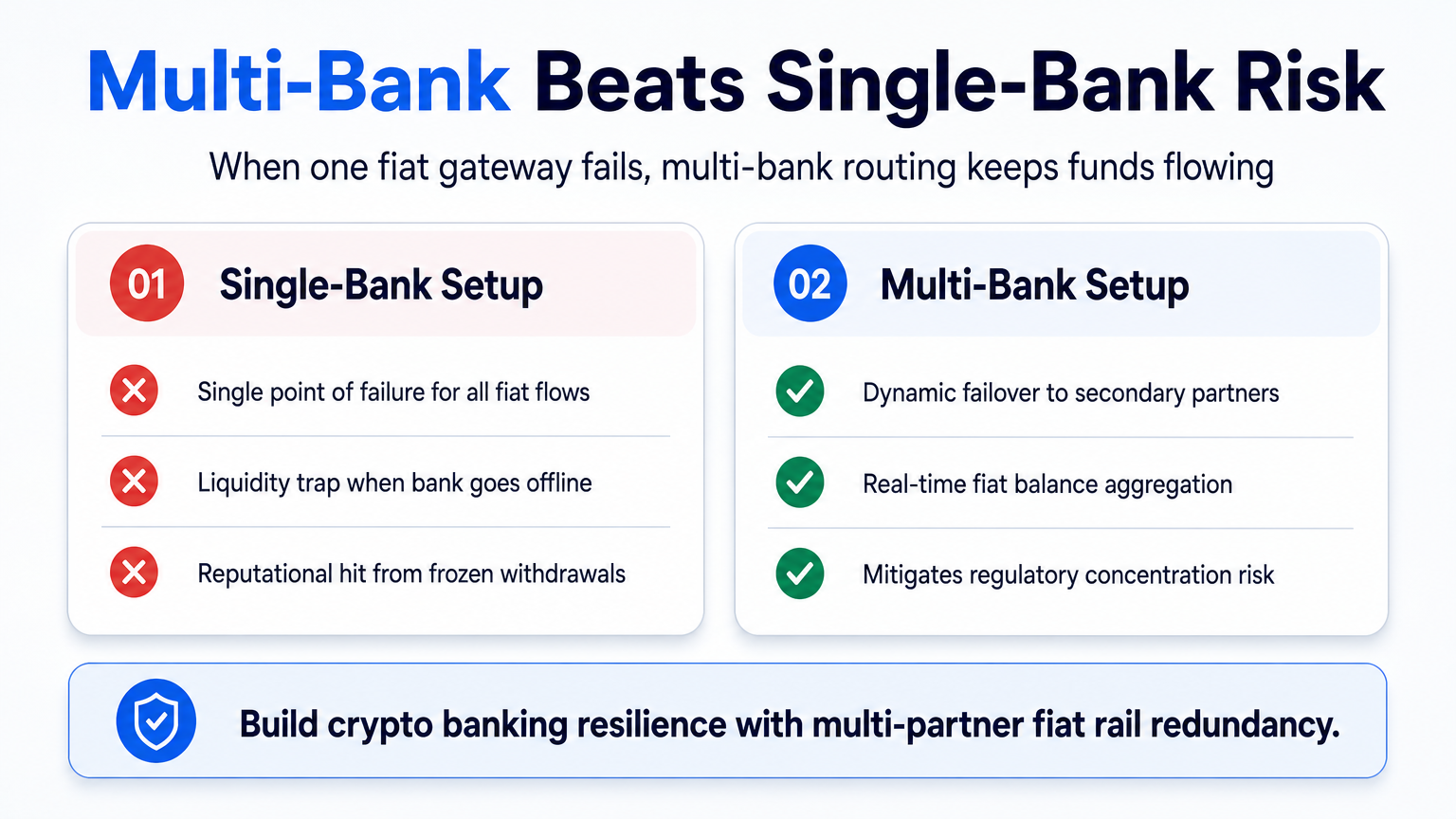
On November 14, 2026, American cryptocurrency exchange Coinbase suspended Indian rupee (INR) withdrawals after an outage at its banking partner—a disruption that began November 9 and, as of this writing, remains unresolved. For thousands of users, the result was stark: crypto assets visible on-screen, but no way to move funds into a local bank account. The incident cuts to the heart of a tension in crypto banking that platforms rarely advertise. The rails that make fiat off-ramps possible still depend on traditional banking infrastructure, and when that infrastructure fails, the “borderless” promise evaporates.
Table of Contents
- What Just Happened: Coinbase’s INR Withdrawal Freeze
- Why This Matters for Crypto Banking’s Big Promise
- How Dependent Is Your Crypto Banking Platform on Bank Partners?
- Building Resilience: Multi-Bank Strategies and Real Off-Ramp Alternatives
- What to Watch Next for Crypto Banking Infrastructure
- Actionable Takeaways for Founders, Finance Leads, and DAOs
- Why Crypto Bank?
- Are Cryptocurrencies Regulated?
- Key Takeaways
- Sources
- Further reading
What Just Happened: Coinbase’s INR Withdrawal Freeze
According to an Instagram post from the exchange on November 14, Coinbase temporarily halted INR withdrawals after its banking partner experienced an operational outage (Instagram, November 14, 2026). The disruption had already been affecting users since November 9. Coinbase framed the suspension as a protective measure, but the result was a liquidity trap: crypto holdings that could previously be converted to INR and withdrawn now sit behind a broken off-ramp. Traders who rely on INR pairs face delayed settlement and uncertainty, injecting friction into the Indian crypto market at a time when stablecoin adoption is climbing across South Asia.
Why This Matters for Crypto Banking’s Big Promise
The gap between ‘borderless crypto’ and banking reality
Crypto banking platforms market themselves as bridges between decentralized finance and everyday commerce. A business opens a crypto bank account, converts USDC to fiat, and pays a supplier in local currency—all within one interface. But the Coinbase INR suspension exposes a structural truth: the fiat leg of that bridge is almost always operated by a traditional bank, and platforms have limited control when that bank stumbles. The cryptocurrency may be permissionless, but the bank account it flows into is not.
Traditional bank partners: the single point of failure most platforms don’t advertise
Every fiat to crypto platform that handles local currency payouts relies on at least one banking partner licensed in that jurisdiction. When a bank partner outage occurs, the platform’s fiat rails go dark for that currency—regardless of how robust its crypto infrastructure is. A service can custody digital assets on Fireblocks, enforce multi-factor authentication, and pass security audits, yet still be brought to a halt by a third-party bank’s operational failure. Bank partner dependency is the silent Achilles’ heel of Web3 banking.
How Dependent Is Your Crypto Banking Platform on Bank Partners?
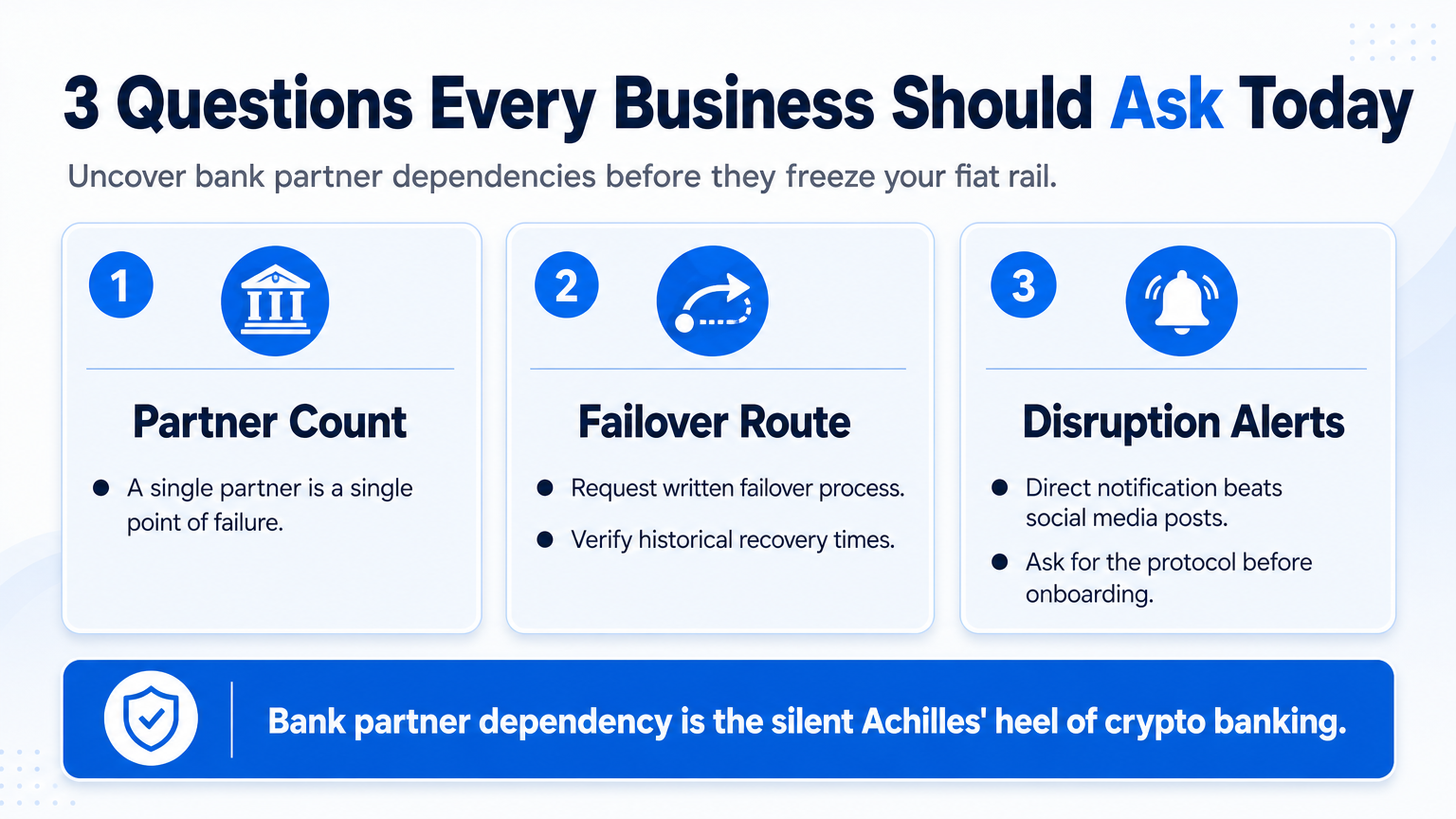
3 questions every business should ask its provider today
- How many bank partners back each supported fiat currency? A single partner is a single point of failure.
- If one bank partner goes down, can I still withdraw that currency through an alternate route—or is the entire rail blocked? Ask for the documented failover process and historical recovery times.
- What communication protocol do you follow during a disruption? Direct notification beats discovering the issue on social media.
The hidden risks of third-party reliance
A unified platform that combines fiat accounts, corporate cards, and crypto custody can reduce operational complexity, but it also concentrates third-party risk. If the underlying bank relationship for domestic wires or card issuance fails, the platform’s entire fiat capability for that currency can freeze. Businesses running payroll through such a platform should pay particular attention: a bank partner outage during a pay cycle can delay salary disbursements even if the digital assets needed to fund them are fully available.
Building Resilience: Multi-Bank Strategies and Real Off-Ramp Alternatives
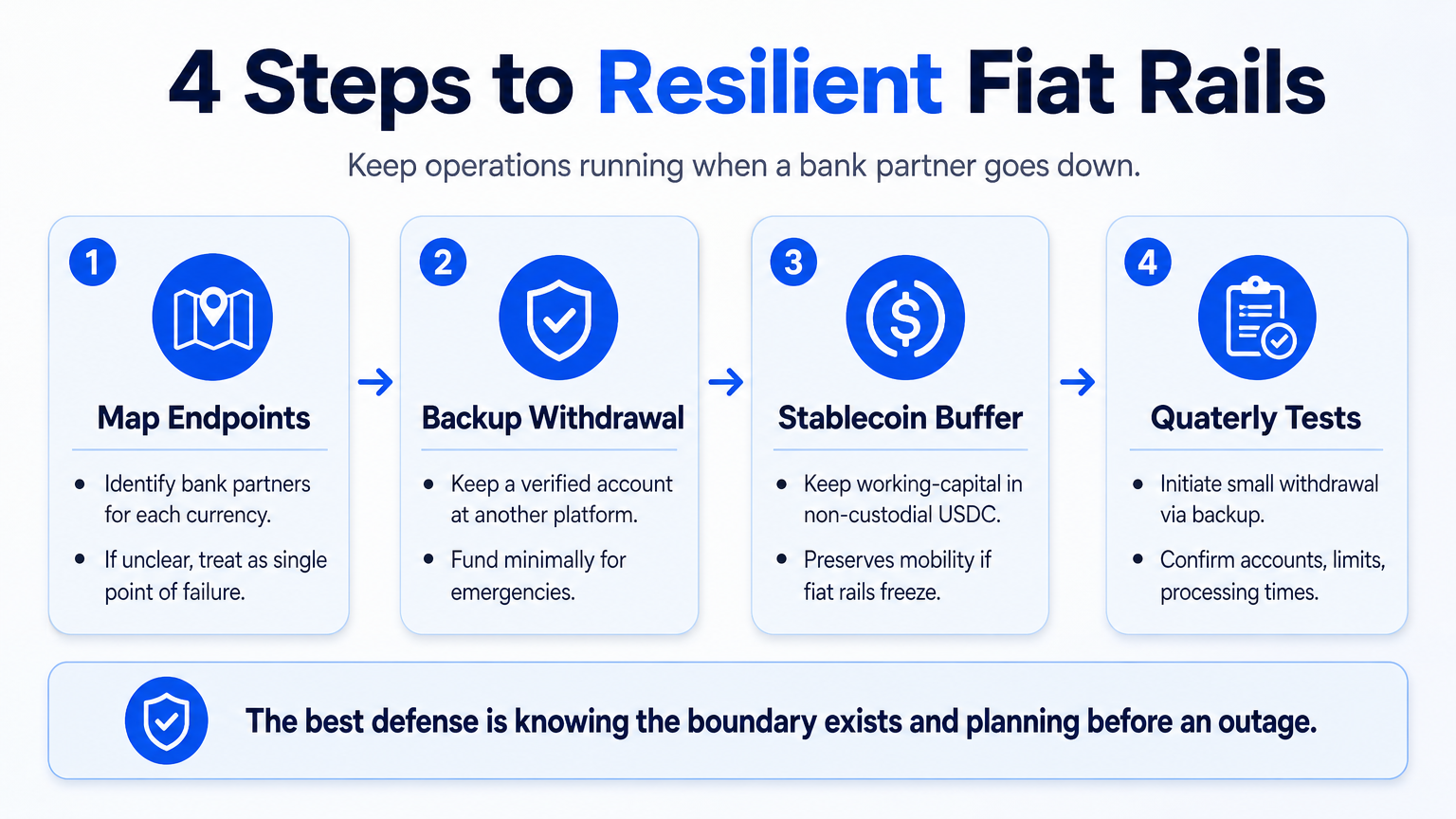
Practical steps to keep operations running when a bank partner goes down
- Map your fiat endpoints. For every currency, identify which banking partner(s) sit behind each platform account. If you can’t get a clear answer, treat that currency rail as a single point of failure.
- Maintain a secondary withdrawal route. Keep a verified account with a second platform or traditional bank that supports the same fiat currency, minimally funded and ready for emergency transfers.
- Hold working-capital reserves in stablecoins at a non-custodial address. This preserves value mobility even if a custodian freezes fiat rails.
- Test your contingency plan quarterly. Initiate a small withdrawal through your backup route to confirm accounts, limits, and processing times.
How a unified platform like OneSafe helps—and where even the best tools can’t eliminate risk
OneSafe is a financial technology company that provides neo-banking services for global businesses and DAOs through partnerships with banks. It offers a unified platform supporting multi-currency accounts in USD, Euro, and CAD, with more currencies on the way. Its fiat capabilities—ACH, domestic and international wires, corporate cards—run on underlying banking partners, and onboarding typically completes within a week. Businesses can manage fiat and crypto from one interface, with built-in on/off-ramp functionality. Yet the Coinbase case underscores a boundary: when the bank partner serving a specific currency rail goes down, the platform’s ability to process fiat in that currency is constrained. The best defense is knowing that boundary exists—and planning for it before an outage.
What to Watch Next for Crypto Banking Infrastructure
The Coinbase INR suspension is likely to attract regulatory attention in India, where authorities already scrutinize crypto exchange operations and banking relationships. Any resulting policy could force platforms to disclose or diversify their bank partner dependencies. Meanwhile, the incident will accelerate demand for transparency about third-party risk in Web3 banking. Developments like Circle’s sybil-resistant stablecoin infrastructure (Stablecoin Payments: Circle’s Sybil-Resistant Trust) and Thailand’s new daily-cap stablecoin regulation (Thailand's Stablecoin Regulation: Key Details & Business Impact) show how regulators are actively shaping fiat-stablecoin bridges. Central bank digital currency trials may eventually offer alternative settlement rails (What Central Bank Stablecoin Tests Mean for Crypto Banking), and traditional banks entering custody still leave fiat off-ramp questions largely unanswered (Crypto Banking Shake-Up: Deutsche Bank’s Custody Launch & What’s Missing). For a deeper dive on why fiat exits remain the hardest problem, see the Stablecoin Payments' Hardest Problem: The Fiat Exit analysis.
Actionable Takeaways for Founders, Finance Leads, and DAOs
- Ask providers: “Will you disclose the identities of your bank partners before onboarding, and will you notify us proactively if a partner relationship changes?”
- Never run a single fiat rail for payroll. Split salary disbursements across at least two withdrawal methods.
- Time large fiat withdrawals during business hours in the bank partner’s jurisdiction, when operational issues are more likely to be caught and resolved quickly.
- Keep onboarding for a backup crypto business account current; the window to open a new account and complete KYB can be a week or more—too long if payroll is due.
Why Crypto Bank?
A crypto bank is a technology platform that provides account services, payment rails, and custody infrastructure for organizations operating in both fiat and digital assets. It sits at the intersection of traditional banking (through partners) and on-chain asset management, offering a single interface for accounts, wires, cards, and off-ramps. The value is the integration; the risk landscape is shaped by the reliability of the underlying bank partners.
Are Cryptocurrencies Regulated?
Regulation is fragmented. In the U.S., multiple agencies assert authority, while the FDIC has issued guidance on crypto-asset safekeeping. Visa’s analysis of Crypto in Banking: What You Need to Know walks through the patchwork. For a business evaluating a fiat to crypto platform, the regulatory status of the platform’s banking partners matters more than the platform’s own claims—because those partners determine whether fiat rails stay open when a regulator intervenes.
Key Takeaways
- The Coinbase INR suspension, ongoing since November 9, 2026, shows a bank partner outage can freeze a crypto platform’s fiat off-ramp entirely.
- Bank partner dependency is the largest under-advertised risk in crypto banking; businesses should demand transparency about the number and identity of partners backing each currency.
- Resilience requires pre-planned backup withdrawal routes, non-custodial stablecoin reserves, and quarterly contingency testing.
- Regulatory scrutiny of crypto-banking relationships is intensifying globally; future policy may mandate bank-partner disclosure.
- A unified fiat-crypto platform can streamline global operations, but its fiat capabilities are only as reliable as the bank partners it depends on.
Start building a multi-currency account backed by transparent banking partnerships—create your OneSafe account today.
While you’re securing your crypto banking operations, your content engine shouldn’t stall. Joyrise grows organic traffic while you sleep—it analyzes your site and writes and publishes SEO articles to Webflow, WordPress, or Shopify every day, with your first article written before you pay.
Sources
- Cryptocurrency: Risks and Opportunities
- Crypto-Asset Safekeeping by Banking Organizations
- We Must Protect Investors and Our Banking System from ...
Further reading
Get started with Crypto in minutes!
Get started with Crypto effortlessly. OneSafe brings together your crypto and banking needs in one simple, powerful platform.