Crypto banking is no longer a retail-only story. On November 20, 2026, Cryptonews.net reported that forex brokers are moving faster than banks into crypto services because they have always assembled their technology from vendors, rather than treating their core stack as a strategic asset. That outsourced model has made stablecoin deposits and blockchain-based payment tools a natural next step for brokers—and it holds a clear operational lesson for businesses that still run fiat and crypto in separate accounts.
Table of Contents
- Crypto Banking in Brief: The Essentials
- Summary: Forex’s Outsourced Tech Is Its Secret to Fast Crypto Adoption
- Key Takeaways: What the Forex Shift Reveals About Crypto Banking
- What Your Business Should Do About It
- The Horizon: What to Watch Next
- Crypto Banking Questions Answered
- Key Takeaways
Crypto Banking in Brief: The Essentials
What “Crypto Banking” Means for Your Business
Crypto banking is not just an exchange account with a card attached. For a business, it means a financial account—or a fintech platform delivered through banking partners—that lets you hold, move, and convert fiat and digital assets inside one operating structure. The practical difference from using an exchange matters: an exchange optimizes for trading and custody of listed assets, while business crypto banking services add payment rails, permissions, invoicing, corporate cards, and treasury controls that an ordinary exchange login does not provide.
Why Regulation and Volatility Still Matter
Fragmented regulation remains the biggest structural constraint on business crypto banking. KYC and KYB checks are required to open a crypto-linked account, and rules differ by jurisdiction. U.S. stablecoin policy is still moving, as covered in our stablecoin regulation updates. Volatility is the separate operational risk: if a company holds working capital in a volatile token, a sharp daily move can change payroll or supplier obligations. Regulation shapes what you can hold; volatility shapes what you should hold.
Summary: Forex’s Outsourced Tech Is Its Secret to Fast Crypto Adoption
On November 20, 2026, Cryptonews.net reported that forex brokers have demonstrated crypto integration does not have to be slow. The report, “Forex Has Always Outsourced Its Tech. That’s Why It’s Adopting Crypto So Fast,” explains that forex is a channel-driven business: brokers have long assembled their technology from vendors and relied on third-party intermediaries to handle deposits and withdrawals. As digital-asset volumes have grown, many brokers already accept stablecoin deposits, and larger mid-sized and large brokers are no longer satisfied with simply plugging into third-party payment gateways. Instead, they are partnering with crypto infrastructure providers to build their own blockchain tools.
Key Takeaways: What the Forex Shift Reveals About Crypto Banking

1. Outsourcing makes crypto integration a natural next step – and a competitive lever
Forex crypto adoption is an architecture story, not a technology miracle. The brokers that moved fastest did not build an in-house core stack from scratch; they connected to vendors, then upgraded the parts that mattered as digital-asset volume grew. Why it matters: your business can copy the pattern. Buying modular infrastructure beats waiting on internal engineering when a new settlement rail becomes commercially relevant.
2. Stablecoin deposits are becoming the new normal for cross‑border value movement
The report’s most concrete fact is that many forex brokers already accept stablecoin deposits. Why it matters: for a multi-currency business account, stablecoins are not primarily a speculative asset. They settle faster than correspondent banking and avoid some FX friction. The trend is toward using stablecoin deposits as operating cash flow, not just as trading collateral. That aligns with the broader shift in stablecoin payments approved at the bank level.
3. Third‑party payment gateways are giving way to own‑stack ambitions
The strategic move is from renting gateway access to building proprietary blockchain rails. Why it matters: when evaluating crypto banking services, a company should ask whether a platform simply resells another provider’s rails or gives direct control over settlement, reconciliation, and permissions. The brokers’ shift tells you where margin and control will eventually concentrate.
4. The laggards aren’t banks—they’re businesses that still separate fiat and crypto operations
Banks are the obvious slow movers, but the operational cost now falls hardest on companies that keep a traditional bank account for payroll and vendor payments plus a separate exchange for crypto. That split creates two ledgers, two compliance processes, and manual reconciliation. Why it matters: the forex example shows that integration speed is a function of architecture, not industry. The real drag is fragmentation inside your own finance stack.
5. Speed to market now depends on choosing the right infrastructure partner
Brokers did not win because they had better engineers; they won because they already had a vendor relationship model. Why it matters: the fastest path to a unified fiat and crypto platform is selecting a partner whose custody, compliance, and payment rails are already live—not commissioning a custom build that will miss the window.
What Your Business Should Do About It

Audit your current fiat‑crypto fragmentation
Run a five-question audit before choosing any platform.
This audit exposes the hidden cost of fragmentation: it is not the crypto exposure itself, but the handoffs between systems.
Move to a single platform that treats fiat and crypto as one treasury
A unified fiat and crypto platform removes the handoff between bank and exchange. For example, OneSafe—a financial technology company, not a bank—offers multi-currency business accounts in USD, Euro, and CAD, fiat and crypto payments, ACH and wire transfers, corporate cards with spend limits, and crypto on‑off ramp functionality through partner banks. Banking services are provided by those partners. The point is that treasury management is now an implementation problem, not a strategy problem: the tools exist, but they only work when they sit in one ledger.
Prioritize custody and permissioning built for organizations, not individuals
DAO treasury management has fundamentally different requirements from a personal wallet: multiple signers, role-based permissions, audit trails, and segregated custody. A platform serving DAOs and global businesses should segregate client assets, use institutional custody, and enforce multi-factor authentication by default. OneSafe, which positions itself as neo-banking for startups, global businesses, and DAOs, offers customizable roles and permissions for DAOs and custody with assets held on Fireblocks. That organizational control layer is what an exchange account rarely provides. A volatility-resistant treasury design starts with custody, not with token selection.
The Horizon: What to Watch Next
More mid‑sized forex brokers will announce proprietary blockchain rails
After the larger brokers move, mid-sized firms typically follow the vendor-led model. The signal to track is not a single broker’s announcement but a pattern of infrastructure partnerships. Watch for whether brokers emphasize settlement speed or cost reduction; that tells you the business case they are chasing.
Regulatory responses to broker‑led crypto integration will shape the 2027 playbook
If brokers build proprietary rails that move stablecoin deposits across borders, regulators will face growing pressure to clarify stablecoin policy. That response will determine whether broker-led integration remains a payments story or becomes a licensing story. The charter wave in crypto banking suggests the regulatory piece is far from settled.
Platforms that serve DAOs and global businesses will face their biggest stress test yet
As more companies try to consolidate fiat and crypto, platforms serving DAOs and global businesses will be tested on reconciliation, permissions, and cross-border fiat rails. The useful early warning will be whether a platform can handle both invoice-level fiat payments and on-chain stablecoin settlement without forcing the customer to run two systems.
Teams that need a repeatable way to document these shifts for clients or internal stakeholders can use Joyrise, which analyzes your site, then writes and publishes SEO articles to Webflow, WordPress or Shopify every day; your first article is written before you pay.
Crypto Banking Questions Answered
What is crypto banking, and how does it differ from using an exchange?
Crypto banking services combine fiat account features—ACH or wire transfers, corporate cards, bill pay—with crypto custody, conversion, and payment rails. An exchange is primarily a venue for buying, selling, and holding assets; it may not provide the treasury controls, permissions, invoicing, or multi-currency business account functions a company needs. NerdWallet’s crypto banking primer describes the space in similar terms: it is banking-adjacent infrastructure, not just a trading login.
Why are forex brokers suddenly ahead in crypto adoption?
As reported on November 20, 2026, their advantage comes from an outsourced technology model. Forex has historically assembled its stack from vendors rather than defending an in-house core system. That made stablecoin deposits and blockchain payment tools an integration project, not a bank-level transformation.
How can my business benefit from a unified fiat-and-crypto account?
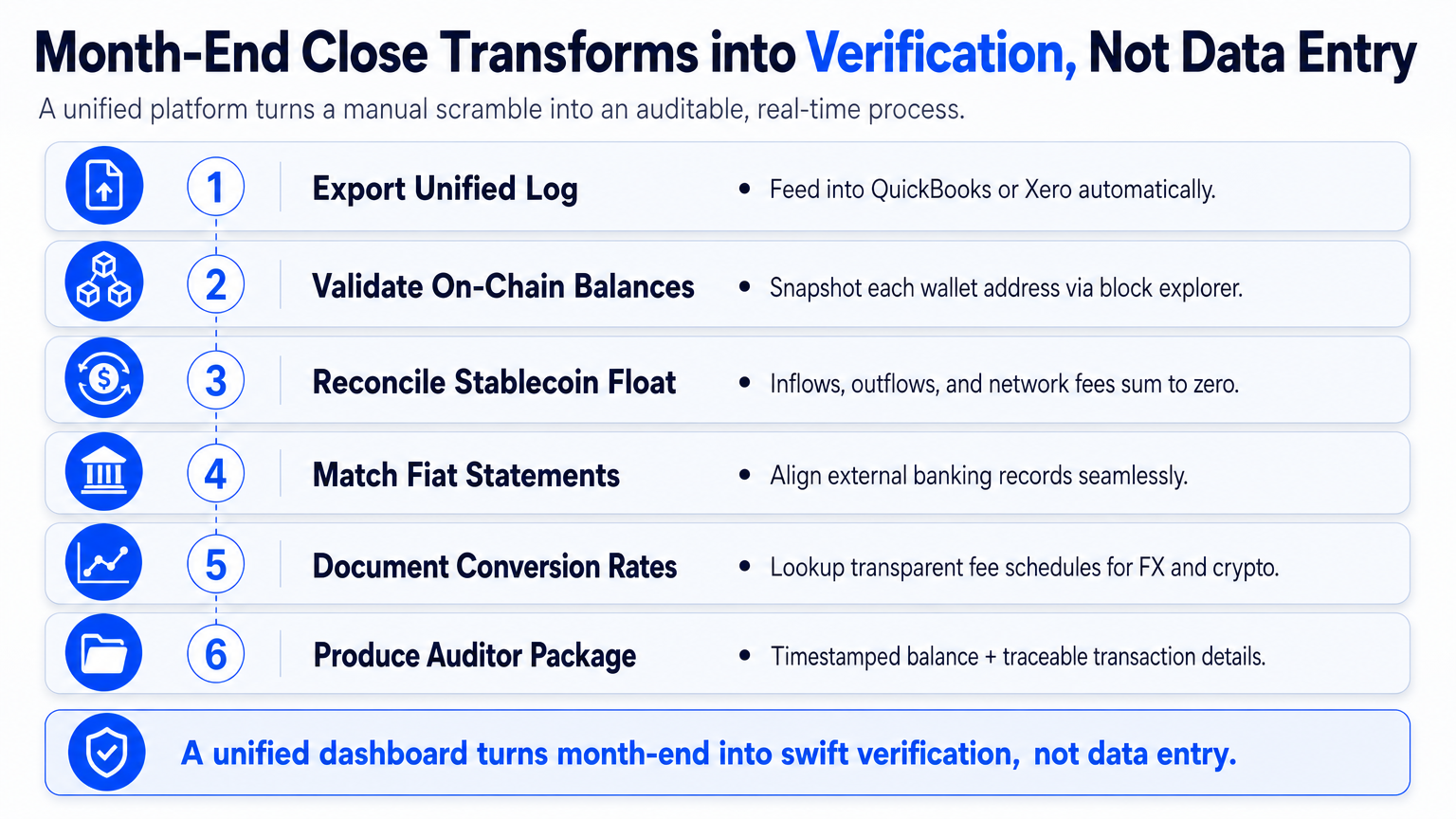
You remove the handoff between bank and exchange. That means fewer days waiting on wires, fewer manual reconciliations, one set of permissions, and the ability to pay a vendor in fiat while receiving client payments in stablecoins through the same ledger. For a treasury team, it turns two balance sheets into one.
What should I look for when choosing a crypto banking platform for my company?
Look for institutional custody and segregation, not a shared hot wallet. Then check for role-based permissions for multiple employees and signers, fiat rails such as ACH and wire, a crypto on‑off ramp with transparent fees, corporate cards with spend limits including crypto-funded options if your team needs them, and KYB onboarding that is fast but not permissionless.
How does regulation affect business crypto banking right now?
Regulation affects which fiat rails you can access, which stablecoins you can hold, and how much compliance documentation you must maintain. U.S. stablecoin policy has been in flux through 2026. A unified platform should handle part of the compliance layer for you, but it cannot remove your own obligation to verify counterparties and keep records.
What are the real risks of crypto volatility for your operating cash flow?
If you hold working capital in volatile tokens, a sharp drawdown can leave you short for payroll, supplier invoices, or tax obligations. The mitigation is not to avoid crypto entirely; it is to denominate operating cash in stablecoins or fiat and convert only when a payment requires it. Volatility is a cash-flow risk, not just an investment risk.
Key Takeaways
- Forex brokers’ outsourced technology model is why crypto integration has been fast; businesses can copy the pattern by buying modular rails instead of building from scratch.
- Stablecoin deposits are becoming a practical settlement layer for cross-border business payments, not just a retail trading convenience.
- The real laggards are businesses that still separate fiat and crypto operations, because that split creates manual reconciliation and slower settlement.
- Choose a business crypto banking platform on custody, permissions, fiat rails, and on/off ramp quality—not on whether it lists the most tokens.
- Watch broker-led proprietary blockchain rail announcements and the regulatory response through 2027; they will shape which unified platforms remain viable.
If your business is ready to consolidate fiat and crypto operations, sign up for a unified account at OneSafe.
Get started with Crypto in minutes!
Get started with Crypto effortlessly. OneSafe brings together your crypto and banking needs in one simple, powerful platform.