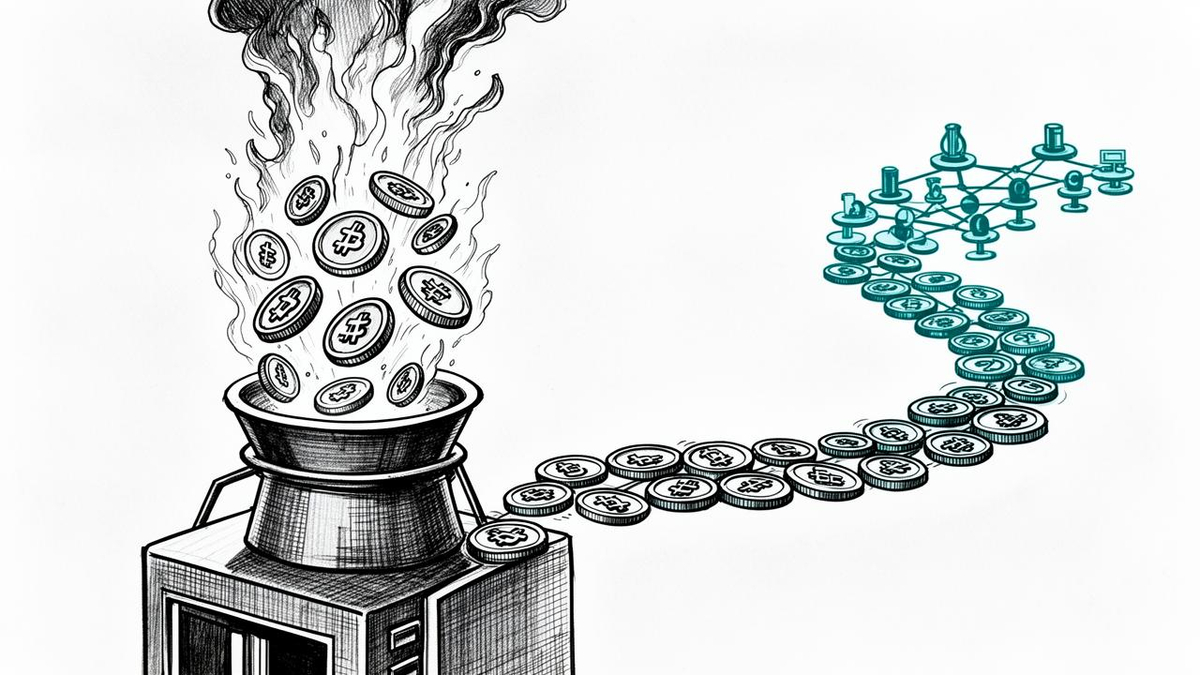
ZetaChain has put a governance proposal to a vote that would destroy roughly 55 million ZETA tokens and move the asset onto the Solana network, one of several supply, fund-flow and political threads running through the altcoin market this week.
Balloting is scheduled to close on November 7. If holders approve, tokens that were set aside for validator rewards but never distributed would be burned on a monthly schedule through 2027, and the foundation has said it will not sell newly unlocked tokens over the same period. The existing unlock timetable would stay as it is.
Approval would also mean winding down the current mainnet around December 9 and converting ZETA into a Solana-based token at a 1:1 ratio. New minting rights would be abolished permanently once replacement tokens are created against existing balances. Distribution would run through the ZetaHub migration portal only after Hacken completes a security review and publishes its report.
Alongside the migration, the project plans to launch ZetaLabs, a financial market analysis service in which ZETA would be used to pay fees and to vote on which market, data and AI models receive support. Staking ZETA for access to premium features is targeted for the first quarter of 2027.
Ether funds draw net inflows, but flows diverge
U.S. spot Ethereum ETFs took in a combined $53.04 million in net subscriptions, according to figures circulated on November 4. BlackRock's ETHA led with $32.8 million, followed by Fidelity's FETH at $19.24 million. Grayscale's Mini ETH and ETHE products added $13.6 million and $9.68 million respectively.
The headline number masks movement in the other direction: BlackRock's staking product ETHB lost $22.4 million, its largest single-day net redemption since June 29.
Note: Figures reflect a single trading day and are stated in U.S. dollars.
Ondo takes aim at Korean equities
Ondo Finance is working with Kakao Pay Securities to tokenize South Korean-listed shares and offer them to investors outside the country, a step that would let foreign buyers reach Korean equities through blockchain infrastructure. Kunal Patel, an executive at the firm, said round-the-clock trading could draw new capital by easing obstacles such as time-zone gaps and the account-opening process.
The harder problem, in his telling, is not issuing a token but stitching together separate networks and platforms with adequate liquidity, infrastructure and regulatory compliance. Ondo reports more than $4 billion in assets under management on-chain.
Political assets slide after Democratic sweep
Trump-linked holdings came under selling pressure after Democrats won majorities in both chambers of Congress. The TRUMP token fell as low as $1.22, a record low, according to CoinGecko data, and was trading near $1.27. Trump Media shares closed the November 4 session down about 24.5% at $4.49.
Bloomberg tied the retreat to the prospect of congressional scrutiny of the Trump family's business dealings, which Democrats had said they would pursue if they took control. The White House has argued there is no conflict of interest involving the president's commercial activities. The episode renewed questions about how political developments and regulatory uncertainty feed into politically themed digital assets.
T3 alliance ends as security questions mount
The T3 Financial Crime Unit set up by Tron, Tether and TRM Labs stopped operating at the end of August. Slow intervention and weak coordination hampered the effort, according to Bloomberg. Tron is developing a separate intervention model, while Tether and TRM Labs will keep working together through the Beacon Network, which shares information in real time.
The wind-down lands in a period when freezing illicit assets has become central to the industry's defenses. The FBI has linked attackers behind a $6.3 billion theft from Binance to North Korea. Tether has frozen about $1.5 billion in USDT, and blockchain-wide blocked funds are estimated at roughly half of the stolen amount. Elliptic has said most of the related laundering activity has moved across the Tron network.
Circle's quarter lifted by ARC token sales
Circle reported third-quarter revenue of $865 million, up 16.9% from a year earlier. Strip out $182 million from ARC token sales and the picture changes: revenue falls about 8% to $683 million. Reserve income, the company's core earnings engine, declined 8% to $658 million.
USDC on-chain transaction volume climbed 49% to $13.9 trillion, but that activity does not translate directly into revenue for the issuer, which earns interest on the reserves backing the stablecoin. Circle is trying to broaden its base by expanding its CPN payments network and buying Tazapay for $400 million in stock, though CPN is not expected to add meaningfully to revenue before 2027.
The common thread across these developments is that token supply policy, institutional positioning, real-world asset tokenization and political risk are now moving altcoin prices as much as technology roadmaps do. ZetaChain's burn and migration remain contingent on a vote that closes in days, while the Ethereum ETF complex shows aggregate demand even as individual products move in opposite directions.