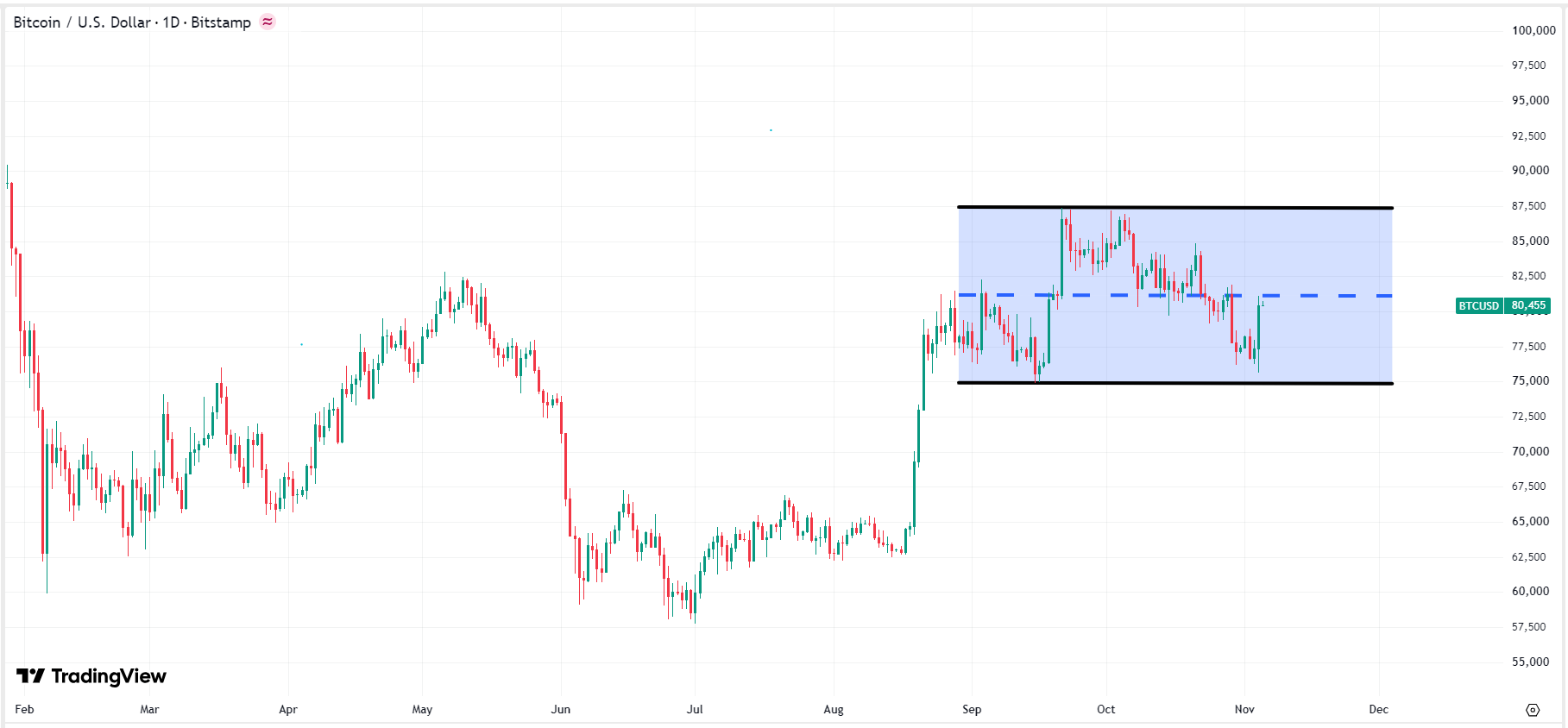
Amid the US midterm elections, bitcoin updated its 1.5-month low on the morning of November 4 Moscow time: the price dropped to $75,735.7, after which the market reversed and gained almost 4%, rising above $78,500.

Ether showed a similar movement. After a morning drop to $2,230, the cryptocurrency recovered and went above $2,330. The sharp change in market sentiment coincided with the first political signals from the US, where preliminary results of the congressional elections were not in favor of the Republicans.
The memecoin $TRUMP, launched in January 2025 three days before the inauguration of newly elected US President Donald Trump, stood out separately. On November 4, 2026, the token lost more than 7% and fell to $1.47. However, the coin’s weakness was not a surprise: in recent months it had mostly fallen in price, losing more than half its value from the August high, and collapsing 50 times from the January 2025 peak.
The Political Factor Increased Investor Caution
According to preliminary congressional election data, the Democratic Party is expected to win a majority in both the US Senate and House of Representatives. Donald Trump, representing the Republican Party, has already acknowledged his party’s defeat.
This news was sensitive for the crypto market, as Trump is considered a supporter of a more liberal approach to digital assets. His political successes previously tended to support cryptocurrency prices, while expectations of Republican failure in the midterms, on the contrary, led investors to reduce risk.
Dmitry Tsarkov, Director of Trading Operations at GBIG Holdings, notes that against the backdrop of political uncertainty, bitcoin naturally tested monthly lows and fell below $77,000. In his view, this is not a sign of fundamental weakness of the asset, but a typical risk-off reaction by institutional capital, which prefers to reduce positions before the final configuration of Congress becomes clear.
Dmitry Tsarkov, Director of Trading Operations at GBIG Holdings, notes that against the backdrop of political uncertainty, bitcoin naturally tested monthly lows and fell below $77,000. In his view, this is not a sign of fundamental weakness of the asset, but a typical risk-off reaction by institutional capital, which prefers to reduce positions before the final configuration of Congress becomes clear.
Tsarkov believes that digital assets traditionally price in macroeconomic risks in advance, even before the official vote count is completed. He highlights two scenarios. In the first, political gridlock blocks aggressive fiscal initiatives, which puts pressure on global inflation and markets. In the second, one party gains full control, and investors begin to price in a sharp expansion of the budget deficit. According to the expert, this scenario could increase demand for bitcoin as a tool to protect against fiat currency depreciation.
After the political picture becomes clearer, Tsarkov believes the market’s attention will quickly return to key economic factors: monetary policy, the trajectory of the Fed’s interest rate, and the Treasury balance.
Pressure Increased by ETF Outflows and Binance Hack
Guzel Protsenko, CEO of Alfa-Forex, links pressure on cryptocurrencies not only to political uncertainty in the US but also to the consequences of the hack of the largest cryptocurrency exchange, Binance. The incident occurred on the evening of October 29: crypto assets worth about $6.3 billion were withdrawn from investors’ wallets.
According to Guzel Protsenko, the main problem for the market now is the lack of confident spot demand. On October 30 and November 2, $1.04 billion was withdrawn from BTC ETFs. The BTC/USDT pair fell below $76,000 due to technical factors and the liquidation of long positions.
According to Guzel Protsenko, the main problem for the market now is the lack of confident spot demand. On October 30 and November 2, $1.04 billion was withdrawn from BTC ETFs. The BTC/USDT pair fell below $76,000 due to technical factors and the liquidation of long positions.
Protsenko names the nearest support for bitcoin at $75,000, and the next important level at $72,500. She also notes that Binance is trying to stop the outflow of funds through financial guarantees and greater transparency: the exchange covered the losses itself, allocated more than 100% of the required amount, returned 98% of affected assets (as confirmed by the updated Proof of Reserves), froze and intercepted $2.85 billion of stolen funds, closed vulnerabilities, strengthened wallet protection, and improved device control.
In her opinion, it is currently difficult for buyers to turn the situation around. A drop in bitcoin to $72,500 could push some investors out of the market and return the main cryptocurrency to a downward trend. The official results of the midterm elections will be known in a few days. If ETF outflows intensify, it will be hard to avoid a new decline. Before the US Fed meeting, the market will likely move sideways. At the same time, a political deadlock in Congress could be a positive factor if it limits strict regulation, but at the moment, technical factors and security issues are more important for digital currencies.
Why the Market Quickly Bought the Dip
Vladislav Alexandrov, Managing Director of investment company ALT3 Capital, believes that the morning rebound in bitcoin can be explained by a reassessment of Trump’s role for the crypto industry. Despite his reputation as a supporter of “digital gold,” the expert believes his political promises should be compared with real consequences.
Alexandrov recalls that the tariff wars in the spring hit risky assets and increased inflationary pressure. Then the market faced the Hormuz conflict and an energy crisis. Against this background, discussions of a dovish Fed policy were replaced by questions about how many more rate hikes might occur by year-end.
Alexandrov recalls that the tariff wars in the spring hit risky assets and increased inflationary pressure. Then the market faced the Hormuz conflict and an energy crisis. Against this background, discussions of a dovish Fed policy were replaced by questions about how many more rate hikes might occur by year-end.
He also points out that the important CLARITY Act bill for the crypto industry was never passed. The fate of the TRUMP memecoin, which lost about 85% of its value from its peak, symbolically shows the gap between expectations and reality, according to Alexandrov. The expert is not sure that the Republicans’ defeat will necessarily weaken the crypto lobby. If the Democrats start blocking Trump’s initiatives, for example by moving to cut US government spending on geopolitical conflicts, the crypto sector could benefit more from this than from the president’s favorable rhetoric. Alexandrov assesses the market’s near-term prospects as moderately positive.
Alfred Khamzin, CEO of Web3Capital Academy, also considers the market’s reaction indicative: the initial sell-off was quickly replaced by buying. On the first voting results, bitcoin fell below $76,000, but then returned above $78,000. In his opinion, this indicates a rapid reassessment of political risks by investors.
Khamzin explains the drop by fears that strengthening Democrats in Congress will complicate the advancement of legislative initiatives the crypto industry is counting on. But the market assesses not only the party balance, but also the real decisions that may follow.
Khamzin explains the drop by fears that strengthening Democrats in Congress will complicate the advancement of legislative initiatives the crypto industry is counting on. But the market assesses not only the party balance, but also the real decisions that may follow.
The expert notes that confrontation between Congress and the president can slow both restrictive measures and initiatives beneficial to the industry. Therefore, political deadlock is not necessarily seen by investors as a negative scenario. At the same time, regulatory uncertainty for the crypto market remains: the CLARITY Act faced procedural obstacles in the Senate even before the elections, and if both chambers do indeed come under Democratic control, the prospects for a new version of the bill in 2027 will become a separate factor for market assessment.
Khamzin does not consider the current bitcoin recovery to be the start of a new sustainable rally. Rather, the market has played out its initial emotional reaction to political news and switched back to fundamental factors. In the near future, the dynamics of cryptocurrencies will be influenced not so much by politicians’ statements as by regulators’ actions, capital inflows and outflows in crypto ETFs, institutional investor behavior, and the overall situation in financial markets.